Why Security Ratings Matter More Than Marketing Claims
Every door manufacturer describes their product as "secure." The difference is whether that claim has been independently verified to a recognised European standard. Front door security ratings provide an objective, comparable measure of how well a door resists forced entry, and not all ratings are equal.
Understanding the distinction between SR1, SR2 and SR3 is essential for anyone specifying an entrance door for a high-value property. The rating determines what tools an attacker can use, how long the attack is sustained, and how skilled the operative is assumed to be. For homeowners in areas such as Esher, Virginia Water and Gerrards Cross, this is not an academic exercise, it is a practical decision that affects insurance, property value and personal safety.
The Standard: BS EN 1627:2011
All legitimate door security ratings in the UK and Europe are defined by BS EN 1627:2011, the European standard for resistance to manual attack. This standard replaced the earlier ENV 1627:1999 and is the benchmark used by testing laboratories, insurers and police forces across Europe.
BS EN 1627 defines six resistance classes, designated RC1 through RC6 (commonly referred to as SR1 through SR6 in the UK market). The standard does not test individual components in isolation. It tests the complete doorset, door leaf, frame, locking mechanism, hinges, glazing and fixings, as a single integrated system. A door cannot achieve a rating if any component falls below the required standard.
The testing is conducted by independent, UKAS-accredited laboratories. The manufacturer submits a production doorset, and the laboratory subjects it to a defined sequence of static, dynamic and manual attacks. The door either passes or fails. There is no partial credit.
SR1 Through SR6: A Complete Breakdown
SR1 (RC1): Opportunistic Force Only
SR1 represents the lowest resistance class. The door must withstand bodily force, kicking, shoulder-barging, leaning and pushing. No tools are used in the test. SR1 offers minimal protection against any determined intruder and is generally considered insufficient for standalone residential security.
Most basic uPVC doors and lightweight timber doors fall into this category, though many are never formally tested at all. An untested door has no verified resistance class, which is a worse position than SR1.
SR2 (RC2): Simple Tools, Casual Burglar
SR2 is the most common security rating for premium residential doors in the UK. The test assumes a casual burglar with limited skill, using simple hand tools: screwdrivers, pliers, wedges and small wrenches. The attack is sustained for 3 minutes.
This is the level at which most high-quality composite doors and premium aluminium doors are certified. SR2 meets and exceeds the requirements of PAS 24 (which is the standard referenced by UK Building Regulations) and represents a meaningful step up from SR1.
However, SR2 does not account for heavier tools or a more determined attacker. A burglar carrying a crowbar, drill or grinder is operating beyond the scope of SR2 testing.
LPS 1175 SR3 (Issue 8). Heavy-Duty Tools, Experienced Burglar
SR3 is the LPCB police-preferred residential security tier under LPS 1175. It is the highest tier most UK homeowners specify, sitting above PAS 24 and BS EN 1627 RC4 in the SteelR ladder, with SR4 (Commercial-grade) and LPS 1673 (Ultra-high) available as further upgrades for documented elevated threat profiles. The SR3 test assumes an experienced burglar with knowledge of door construction, using professional-grade tools including crowbars up to 750mm, drills, chisels, hacksaws and angle grinders. The attack is sustained for 5 minutes of active working time.
The 5-minute threshold is significant. Police data indicates that the vast majority of residential burglaries are abandoned within 3 minutes if entry is not achieved. An SR3 door provides a margin of safety well beyond the point at which most burglars will give up and move on.
LPS 1175 SR3 certification requires steel construction. No timber, composite or aluminium doorset has achieved LPS 1175 SR3. The material density and structural integrity of steel is necessary to resist the tool set and attack duration specified at this level.
LPS 1175 SR4 (D10 Issue 8). Commercial-Grade Power Tools
SR4 (Security Rating 4 under LPS 1175 Issue 8) introduces a broader power-tool catalogue including reciprocating saws, impact drills and bolt cutters. Attack duration extends beyond SR3 against a defined commercial-grade objective. This is the certification used for data centres, bank vaults and high-risk commercial premises. SteelR offers SR4 as the Commercial-grade upgrade tier on every residential door, available where the threat profile or insurer requirement justifies it. (Note: SR ratings belong to LPS 1175; BS EN 1627 uses RC1 to RC6 in a parallel scheme. The two are not equivalent.) For guidance on which tier suits a specific brief, see the SR3 vs SR4 decision aid.
LPS 1175 SR5 to SR8. Government and Critical Infrastructure
SR5, SR6, SR7 and SR8 represent successively higher tiers under LPS 1175, used for embassies, military installations, critical infrastructure and defence applications. They are not commercially specified for residential use. SteelR's residential ladder runs to LPS 1175 SR4 (Commercial-grade) and adds LPS 1673 attack-resistance certification (a separate LPCB scheme) for ultra-high threat profiles where a documented risk assessment justifies it.
How the Testing Actually Works
BS EN 1627 testing comprises three distinct phases, each governed by its own sub-standard:
Static Load Testing (BS EN 1628)
Hydraulic equipment applies concentrated and distributed loads to the door leaf, frame and locking points. This simulates an attacker using body weight, a car jack or a hydraulic spreader to force the door. The test measures deflection and permanent deformation. The door must not open, and any deflection must recover within tolerance.
Dynamic Load Testing (BS EN 1629)
A weighted pendulum (50kg) strikes the door at specified heights and locations, simulating impacts from a battering ram or repeated kicks. The test measures whether the door remains closed, the frame stays intact and the locking mechanism stays engaged. For SR3, the impact energy is 300 joules, equivalent to a trained adult's full-force kick delivered with a running start.
Manual Attack Testing (BS EN 1630)
This is the critical phase. A skilled operative attempts to breach the door using the tool set defined for the relevant resistance class. The operative is briefed on the door's construction and weak points before the test begins. The clock runs only during active tool engagement, time spent assessing the door or changing tools is not counted.
For SR3, the operative has access to crowbars, flat-blade screwdrivers, drills up to 10mm, chisels, hammers, hacksaws and angle grinders. Success means creating a through-opening large enough to reach the locking mechanism or pass through the doorway. If the door survives the full allocated time without breach, it passes. For a detailed breakdown of what our doors withstand, see our security specification.
PAS 24 vs SR Ratings: Understanding the Difference
There is significant confusion in the UK market between PAS 24 and the SR rating system. They are not the same standard, and they are not interchangeable.
PAS 24:2022 is a British standard (Published Available Specification) referenced by Approved Document Q of the UK Building Regulations. It tests resistance to manual attack using a defined tool set for a specified time. PAS 24 is broadly comparable to SR2 in terms of the tools permitted, but the testing methodology and pass criteria differ.
PAS 24 is the minimum legal requirement for new-build residential properties in England and Wales. It is a competent standard that represents a genuine improvement over untested doors. However, it does not approach the level of protection provided by SR3.
The key differences:
- Tool set, SR3 permits heavier, more aggressive tools than PAS 24
- Attack duration, SR3 mandates a longer active attack period
- Operative skill, SR3 testing assumes a more experienced attacker with knowledge of door construction
- Complete system, SR3 tests the entire doorset assembly, not individual components
- Independent accreditation, SR3 testing must be conducted by a UKAS-accredited laboratory
For homeowners who want security that genuinely exceeds building regulation minimums, SR3 is the appropriate specification. PAS 24 tells you the door is legal. SR3 tells you the door is secure.
How Security Ratings Affect Insurance
Home insurance policies in the UK typically require doors and windows to meet minimum security standards. The most commonly referenced lock standard is BS 3621, but an increasing number of insurers now recognise and reward higher doorset certifications.
An SR3-rated entrance door may qualify you for reduced premiums or enhanced cover, particularly on high-value properties. Some specialist high-net-worth insurers explicitly ask whether doors carry SR2 or SR3 certification. In areas with above-average burglary rates, a verified security rating can be the difference between obtaining cover and being declined.
It is worth noting that the rating must apply to the installed doorset, not just the door leaf or the lock. Insurers are becoming more sophisticated in their understanding of door security, and a mismatched system, an SR3 door in an SR1 frame, for instance, will not satisfy their requirements.
Always confirm your insurer's specific requirements before specifying a door. Many SteelR customers find that the premium reduction on high-value property insurance offsets a meaningful portion of the door's cost over its lifetime.
Secured by Design: The Police Accreditation
Beyond the BS EN 1627 framework, Secured by Design (SBD) is the official UK police security initiative. Products carrying the SBD accreditation have been assessed and approved by police Designing Out Crime Officers.
Secured by Design is not a replacement for SR ratings, it is complementary. SBD assessors evaluate the complete doorset and the manufacturing process, ensuring that production quality matches test quality. Ongoing factory audits confirm consistency. Research conducted by the Home Office shows that developments built to Secured by Design standards experience up to 75% less burglary than equivalent developments without the accreditation.
For a comprehensive overview of how these standards work together, visit our security overview.
Why SR3 Is the Gold Standard for Residential Properties
For high-value residential properties, SR3 represents the optimal balance between security performance, practical availability and cost-effectiveness. It provides protection against the full spectrum of tools a residential burglar is likely to carry, for a duration that exceeds the abandonment threshold identified by police research.
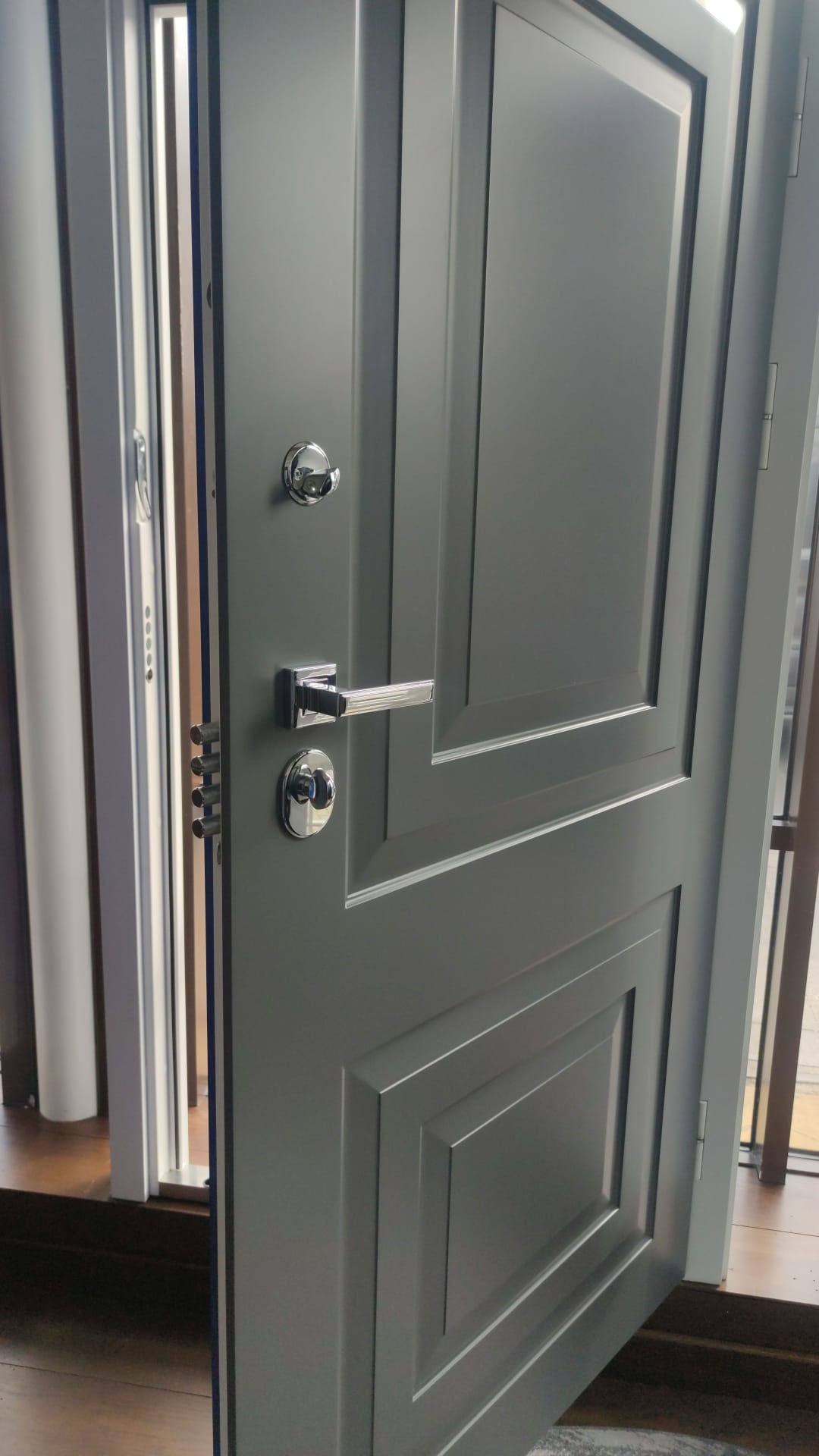
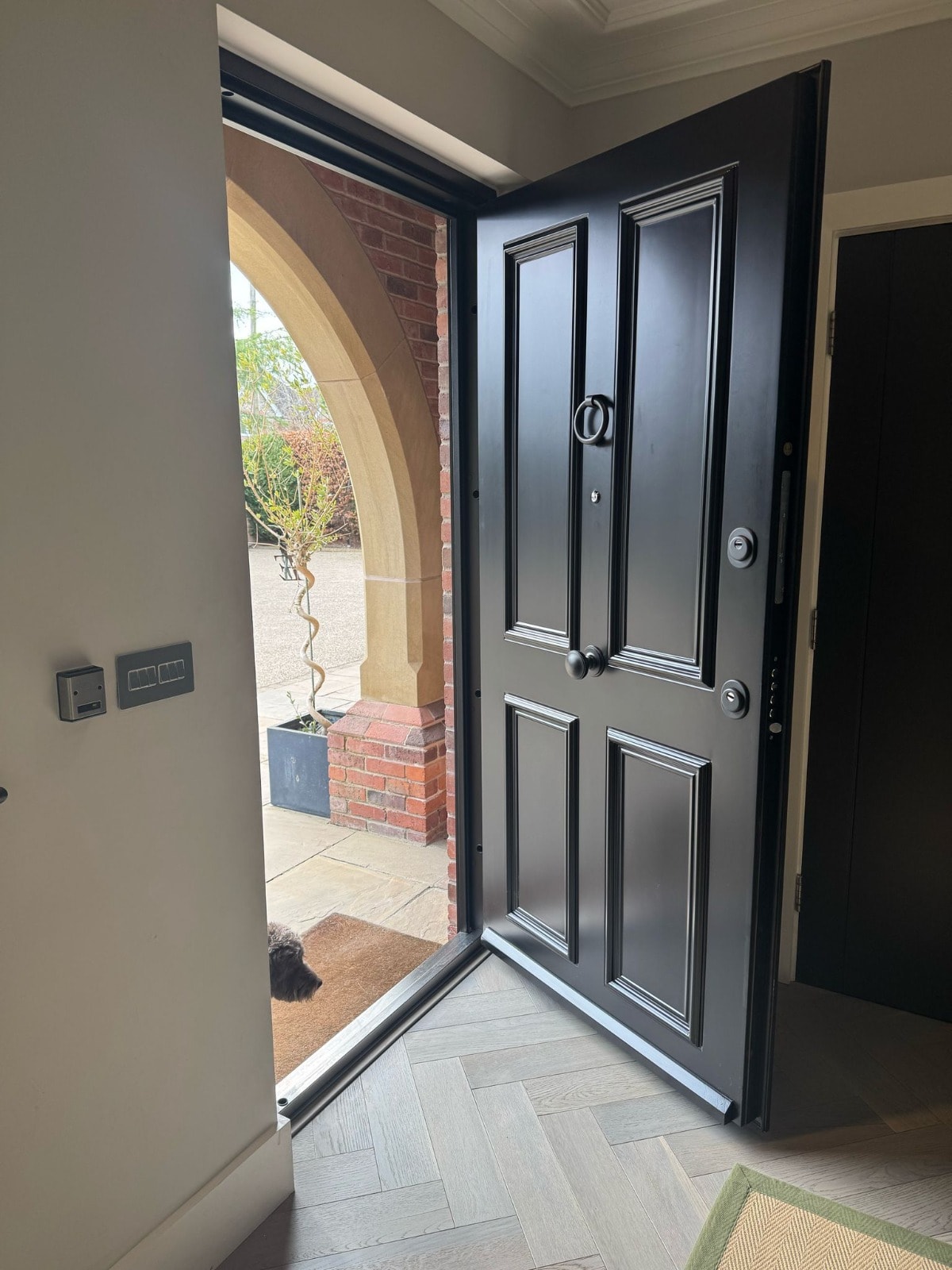
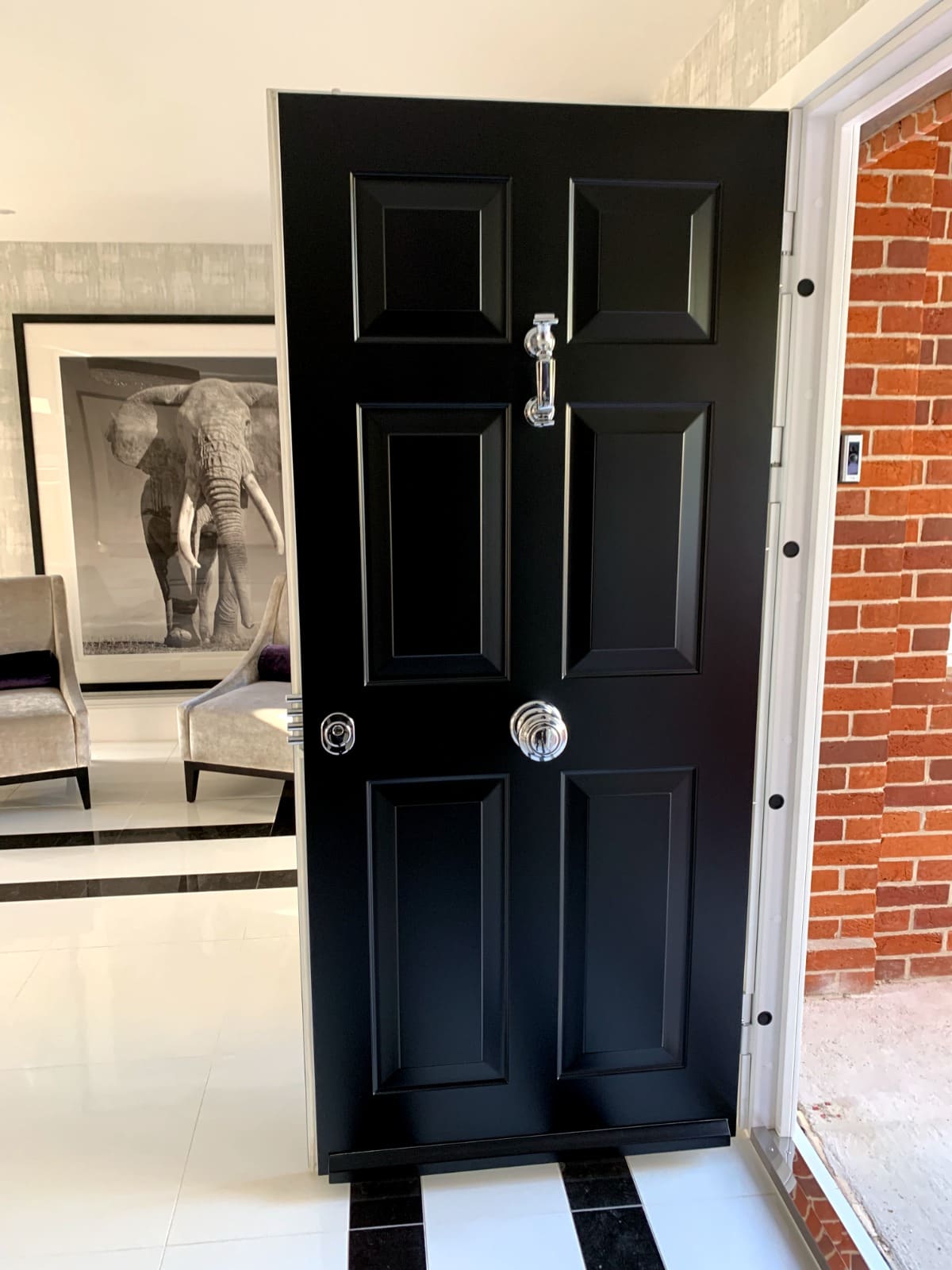
SR3 is achievable only with steel construction, multi-point locking, security-rated glazing, heavy-duty hinges and professional installation. Every SteelR entrance door is BS EN 1627 RC4 certified as Standard, with LPS 1175 SR3 available as the Enhanced upgrade tier. Manufactured under ISO 9001 quality management and available in the full RAL colour range to complement any architectural style.
Whether you are securing a Georgian townhouse in Esher, a contemporary new build in Virginia Water, or a country estate in Gerrards Cross, the security specification remains the same. To discuss your requirements or request a consultation, contact our team.
Frequently Asked Questions
What is the difference between SR and RC security ratings?
SR (Security Rating) and RC (Resistance Class) refer to the same classification system under BS EN 1627:2011. SR is the terminology commonly used in the UK market, while RC is the European designation. SR3 and RC3 are identical in their testing requirements and pass criteria.
Is PAS 24 good enough for home security?
PAS 24 meets UK Building Regulations and provides a meaningful level of security above untested doors. However, it is broadly comparable to SR2 and does not test resistance to heavy-duty tools such as crowbars, drills and angle grinders. For high-value properties or areas with elevated burglary risk, SR3 provides a substantially higher level of protection.
Can a timber or composite door achieve SR3?
No. As of 2026, no timber or composite doorset has achieved SR3 certification under BS EN 1627. The material density and structural integrity required to resist the SR3 tool set and attack duration necessitates steel construction. Premium timber and composite doors can achieve SR2 or PAS 24, but SR3 remains exclusive to steel.
Do security ratings affect my home insurance premium?
Many UK insurers recognise SR-rated doors, particularly at the SR3 level, and may offer reduced premiums or enhanced cover terms for high-value properties. The specific benefit varies between insurers, so it is advisable to check with your provider before making a specification decision.
How long does an SR3-rated door maintain its certification?
The SR3 certification applies to the doorset as manufactured and installed to the tested specification. Provided the door is maintained according to the manufacturer's guidelines and no modifications are made to the locking system, frame or glazing, the security rating remains valid for the lifetime of the installation. Manufacturing consistency is assured through ISO 9001 quality management systems.
What is Secured by Design and is it the same as SR3?
Secured by Design is the official UK police initiative that accredits security products. It is separate from both the BS EN 1627 classification system (RC1 to RC6) and the LPS 1175 scheme (SR1 to SR8) but complementary to both. A door can carry an SR3 rating, an RC4 certification and Secured by Design accreditation simultaneously: the SR and RC ratings certify physical resistance under different methodologies, while Secured by Design confirms police-approved security standards and ongoing manufacturing quality audits. For a deeper technical breakdown of LPS 1175 SR3, see our SR3 residential steel door page.