What Is Secured by Design and Why Does It Matter in 2026
Secured by Design (SBD) is the official police security initiative owned by Police Crime Prevention Initiatives Ltd, a police-owned organisation that works across the UK to reduce crime through environmental design, product certification and development planning.
It is not a marketing scheme. It is not a voluntary quality mark. Secured by Design is the only security accreditation in the UK backed by active police involvement, evidence-based crime data and formal recognition within the planning system. In 2026, with burglary patterns evolving and building regulations tightening, understanding SBD is more relevant than ever, whether you are a developer delivering new homes or a homeowner upgrading an existing property.
The Updated SBD Standards for 2026
Secured by Design updates its standards periodically to reflect emerging crime patterns, technological developments and changes to building regulations. The 2026 framework represents the most comprehensive version to date.
SBD Homes 2026
The flagship standard for residential developments, SBD Homes 2026, covers the full scope of physical security measures for new dwellings. It specifies requirements for entrance doors, windows, garage doors, perimeter treatments, lighting, mail delivery, cycle storage, communal access and utility areas.
For entrance doors specifically, SBD Homes 2026 requires:
- Testing to PAS 24:2022 as an absolute minimum for all external doorsets
- Multi-point locking with a minimum of three locking points
- Cylinder protection meeting TS007 three-star rating or equivalent
- Door viewers or alternative visitor identification systems
- Letter plates that resist fishing and lock manipulation attacks
These are minimum requirements. SBD does not prevent specifiers from exceeding them. Doors achieving SR3 certification, the highest physical security rating for residential entrance doors, surpass every SBD requirement by a significant margin. For a technical comparison of PAS 24 and SR3, see our security specification page.
SBD Commercial 2026
For mixed-use developments that include commercial units at ground floor with residential above, SBD Commercial 2026 sets additional requirements for the interface between commercial and residential zones, a critical vulnerability in many urban developments.
SBD for New Developments: Planning Benefits
For property developers, Secured by Design is not merely a security standard. It is a planning tool, a marketing asset and, increasingly, a regulatory expectation.
Section 17 Crime and Disorder Act 1998
The Crime and Disorder Act 1998 places a statutory obligation on local authorities to consider the prevention of crime and disorder in all their functions. Section 17 means that planning authorities must actively consider crime prevention when assessing development applications. This gives Secured by Design direct relevance in the planning process.
A development designed to SBD standards provides evidence that the applicant has addressed crime prevention at the design stage. Planning officers can, and increasingly do, reference SBD in their assessments, conditions and section 106 agreements.
Designing Out Crime Officers
Every police force in England and Wales has Designing Out Crime Officers (DOCOs) who provide free, pre-application advice to developers on how to achieve SBD standards. This advice covers site layout, building orientation, access control, lighting, landscaping and product specification.
Engaging with DOCOs early in the design process offers several advantages:
- Pre-application feedback that identifies potential security issues before they become planning objections
- Formal support letters from the police that strengthen planning applications
- Ongoing guidance through the construction process to ensure SBD certification is achieved at completion
- Condition discharge evidence when planning conditions reference security or SBD compliance
For developers working on projects across London, Manchester and Birmingham, where urban density creates particular security challenges, DOCO engagement is especially valuable.
The 75% Crime Reduction
The most frequently cited SBD statistic is also the most compelling. Independent research demonstrates that developments built to Secured by Design standards experience up to 75% less burglary than equivalent developments without SBD. This figure has been validated across multiple studies, including research by the University of Huddersfield that analysed crime data across thousands of dwellings.
This is not a marginal improvement. It represents a fundamentally different level of security performance, achieved through the combination of physical product standards, environmental design and coherent site-wide security thinking.
The reduction is not limited to burglary. SBD developments also show significant reductions in vehicle crime, criminal damage and antisocial behaviour. The underlying principle, that thoughtful design makes crime more difficult and less rewarding, applies across crime categories.
SBD for Homeowners: Retrofitting
Secured by Design is not exclusively for new developments. Individual homeowners can retrofit SBD-accredited products to improve the security of existing properties.
The SBD Product Range
SBD certification covers a comprehensive range of building products. While entrance doors are the most visible element, the accreditation extends across the full building envelope:
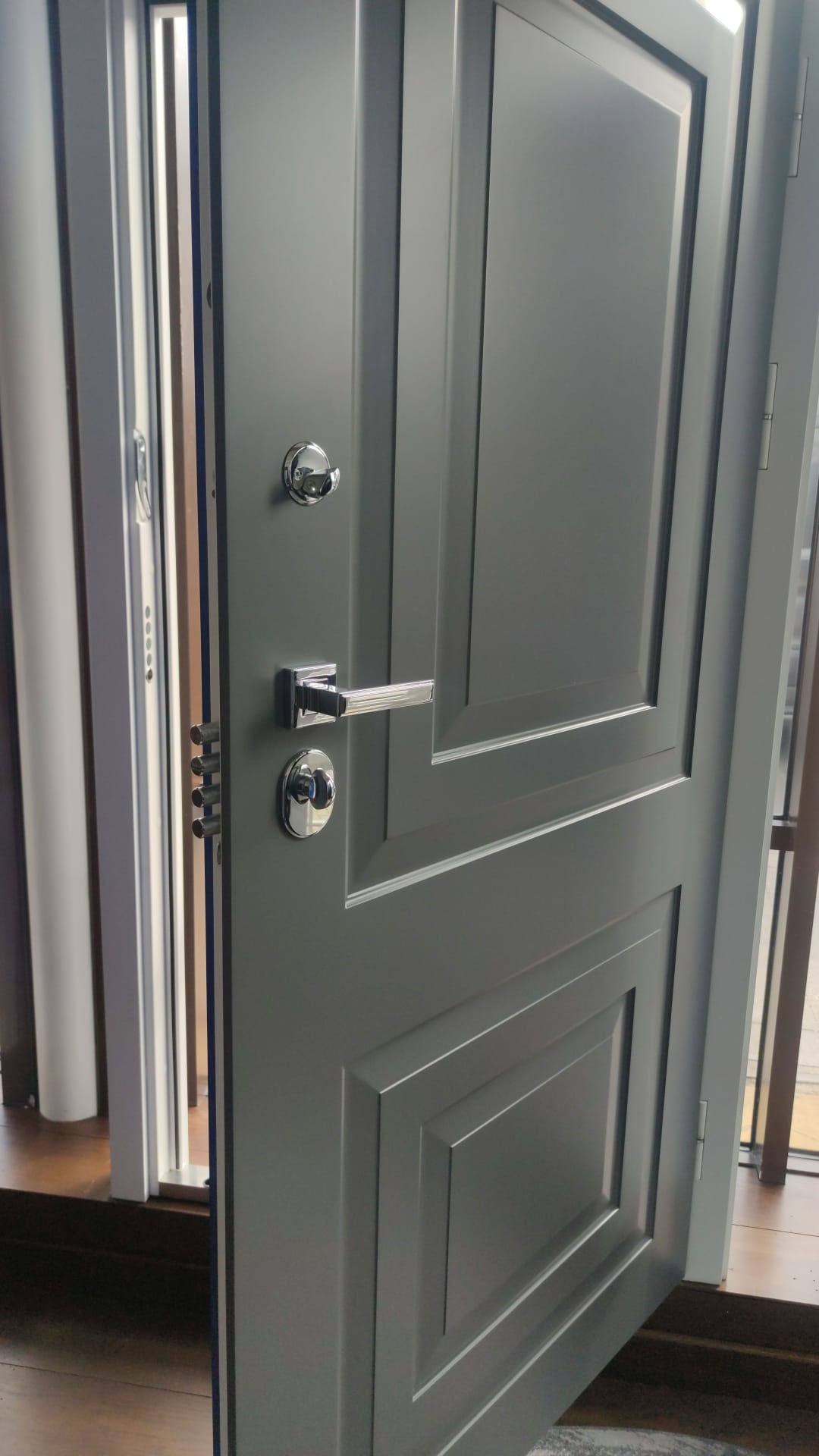
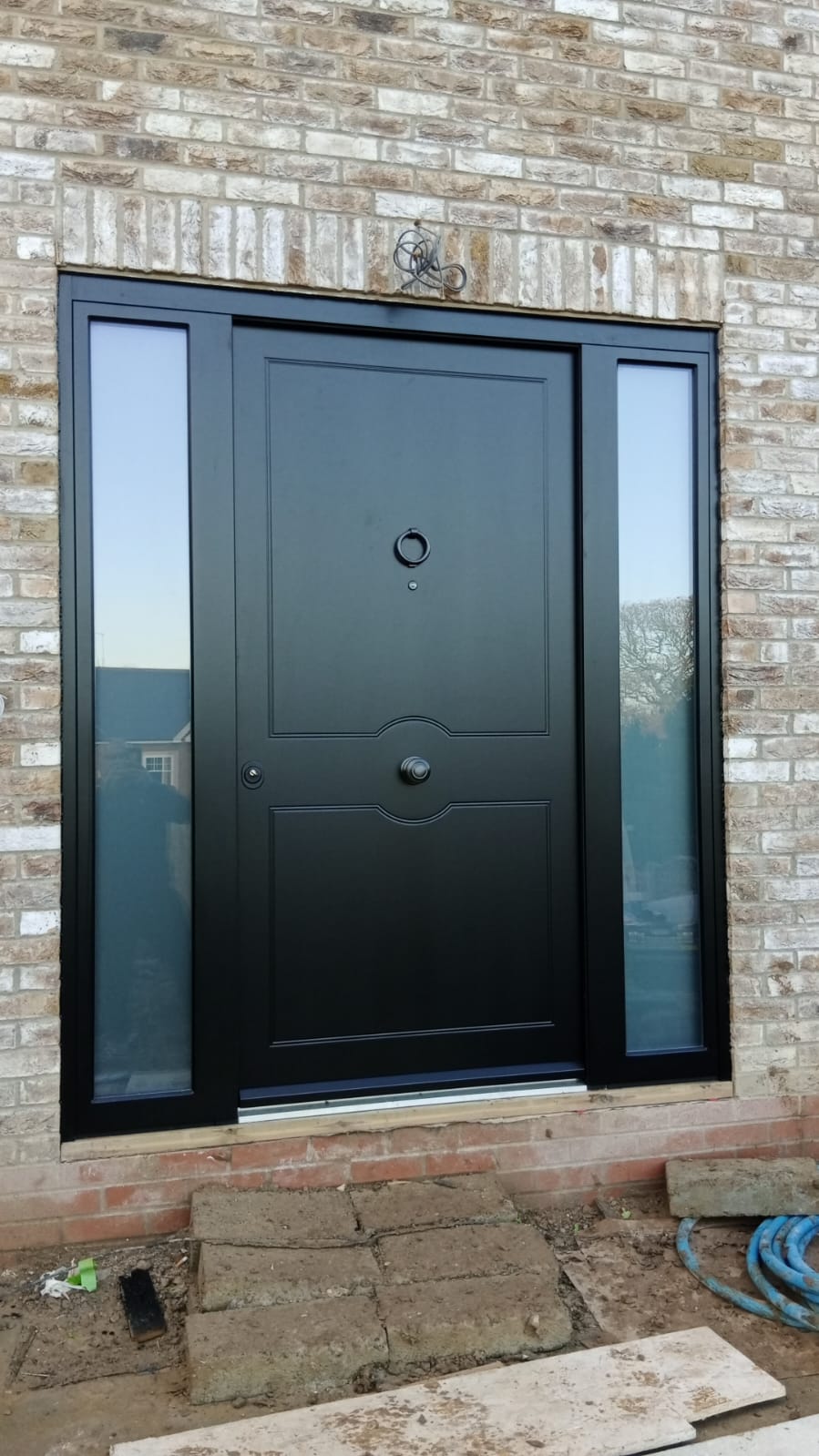
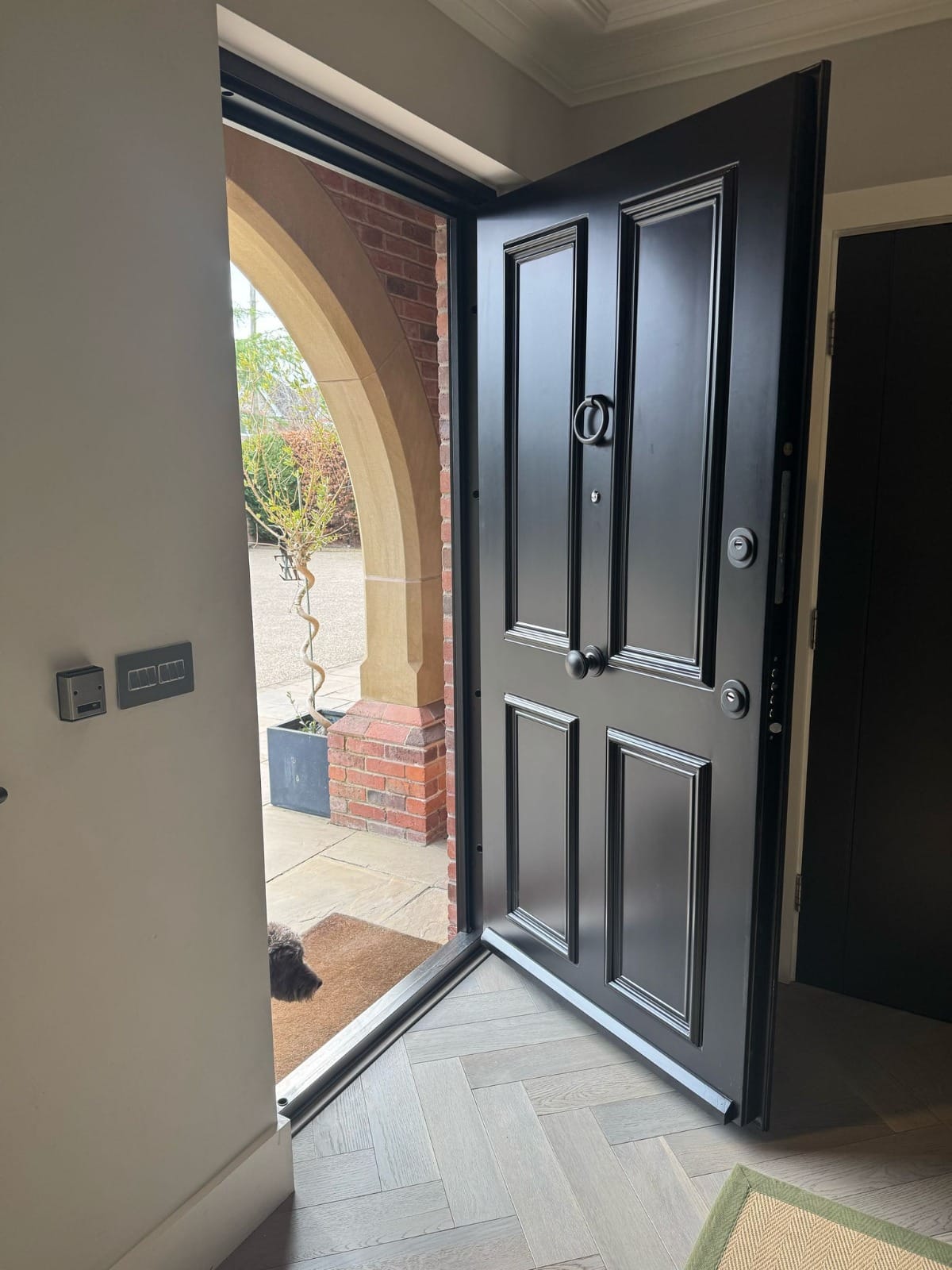
Doors, the most impactful upgrade. An SBD-accredited entrance door has been tested and certified as a complete doorset, including the door leaf, frame, locking system, hinges and hardware. SteelR entrance doors achieve SBD accreditation through a combination of SR3-rated steel construction, multi-point locking, anti-snap cylinders and reinforced frame assemblies. Browse our collection for examples.
Windows, SBD-accredited windows meet PAS 24 for resistance to forced entry and incorporate locking handles, toughened or laminated glass in accessible positions, and restricted opening mechanisms where appropriate.
Locks, SBD-accredited locks go beyond standard BS 3621 requirements. Cylinders must meet TS007 three-star rating, and lock assemblies are tested as part of the complete doorset rather than in isolation.
Lighting, SBD recommends dusk-to-dawn lighting at all entrance points, avoiding movement-activated lights (which can be triggered deliberately to cause nuisance and subsequent deactivation by the homeowner). Consistent, low-level lighting at entrances is more effective as a deterrent.
Fencing and gates, perimeter treatments are specified to balance natural surveillance (not creating hiding places) with defensible space (clearly marking the boundary between public and private territory).
What SBD Certification Means in Practice
When a product carries the SBD accreditation mark, it means:
- The product has been independently tested by a UKAS-accredited laboratory
- The manufacturer has been audited and approved by SBD
- The product meets or exceeds the current SBD standard for its category
- The product is listed on the SBD member company database, which can be verified publicly
- The certification is subject to ongoing compliance, manufacturers must maintain standards to retain accreditation
This is a meaningfully different proposition from self-declared security claims or "designed to" PAS 24 assertions that have no independent verification.
Police Involvement in the Scheme
One of the most distinctive aspects of Secured by Design is the direct involvement of serving police officers. SBD is not a commercial enterprise, it is owned and operated by a police organisation, and its standards are informed by operational policing intelligence.
Designing Out Crime Officers are serving police officers with specialist training in crime prevention through environmental design (CPTED). Their advice is based on actual crime patterns, not theoretical risk assessments. When a DOCO reviews a development layout and recommends changes to entrance positions, lighting arrangements or access control, those recommendations are informed by direct knowledge of how burglars operate in that specific area.
This police involvement also means that SBD carries weight with planning authorities in a way that commercial security accreditations do not. A recommendation from a DOCO carries the authority of the police service, not merely the opinion of a private consultant.
Developer Benefits
For developers considering SBD accreditation for new residential projects, the benefits extend beyond crime prevention:
Marketing Advantage
Properties marketed as Secured by Design carry a recognisable quality mark that resonates with security-conscious buyers. In premium market segments, particularly in urban areas where burglary risk is a genuine concern for purchasers, SBD accreditation is a differentiator that justifies premium positioning.
New developments across London boroughs, Manchester and Birmingham increasingly use SBD accreditation as a selling point, particularly for apartments and gated communities where communal security is a primary purchaser consideration.
Planning Support
As discussed above, SBD compliance provides tangible planning benefits. In some local authority areas, SBD is now a condition of planning consent for residential developments. Even where it is not formally required, demonstrating SBD compliance strengthens applications and reduces the risk of objections related to security and community safety.
Reduced Long-Term Costs
SBD developments have lower crime rates, which translates to reduced insurance claims, fewer maintenance call-outs for damaged communal areas, less antisocial behaviour requiring management intervention, and higher long-term property values due to lower crime perceptions.
For housing associations and build-to-rent operators managing properties over decades, these ongoing savings are significant and quantifiable.
Warranty and Liability
Specifying SBD-accredited products provides a defensible position in the event of warranty claims or disputes related to security performance. If a break-in occurs and the developer specified products meeting SBD standards, the liability position is fundamentally different from a scenario where minimum-specification products were used.
SBD and Building Regulations Alignment
In 2026, the alignment between Secured by Design and building regulations is tighter than at any point in the scheme's history.
Approved Document Q
Approved Document Q (security in dwellings) mandates that all doors and windows in new residential buildings meet PAS 24:2022 or equivalent security standards. SBD Homes 2026 meets and exceeds all Document Q requirements, meaning that SBD compliance automatically satisfies the relevant building regulation.
Fire Safety and the Building Safety Act
The Building Safety Act 2022 introduced new requirements for fire safety in residential buildings, particularly those over 18 metres. For developments that require both security-rated and fire-rated entrance doors, the specification becomes more complex. Doors must simultaneously meet PAS 24 for security and BS EN 1634 for fire resistance.
SteelR manufactures entrance doors that combine BS EN 1627 RC4 Standard certification (with LPS 1175 SR3 Enhanced upgrade) and FD30/FD60 fire ratings within a single doorset. This dual certification is particularly relevant for apartment buildings, HMOs and mixed-use developments where both standards apply. For full details, see our fire rated doors page.
Part L (Conservation of Fuel and Power)
Part L sets thermal performance requirements for building elements including entrance doors. SBD-accredited steel entrance doors with insulated cores and thermal break technology comfortably exceed Part L's 1.8 W/m2K maximum, with thermal-upgrade specifications available achieving as low as 0.8 W/m2K.
The practical significance is that a single doorset can satisfy Document Q (security), Part L (thermal), Building Safety Act (fire) and SBD (police-backed security) simultaneously. This simplifies specification for developers and eliminates the risk of installing different doors to meet different standards in different parts of a development.
How to Specify SBD Products
For developers and architects, specifying Secured by Design products follows a clear process:
1. Register with SBD, the Secured by Design website maintains a searchable database of accredited member companies and products 2. Consult your local DOCO, free pre-application advice on achieving SBD for the development as a whole 3. Specify by accreditation, reference SBD accreditation numbers in tender documentation to ensure that only genuinely certified products are quoted 4. Verify at installation, confirm that delivered products match the specified SBD-accredited items and that installation meets the manufacturer's certified methodology 5. Apply for certification, once the development is complete, apply for SBD development certification through the local police force
For entrance door specification specifically, our security overview page details the full range of certifications that SteelR doors carry, including SBD, SR3, PAS 24, ISO 9001 and fire ratings where applicable.
The Cost of Not Specifying SBD
The financial case for SBD is asymmetric. The incremental cost of specifying SBD-accredited products over minimum-standard alternatives is modest, typically a small percentage of the total build cost for a residential development. The cost of not specifying SBD is potentially far greater:
- Higher insurance premiums for the development and individual units
- Increased crime with associated management costs and reputational damage
- Planning complications if the local authority expected SBD compliance
- Lower resale values if comparable nearby developments carry SBD accreditation and yours does not
- Liability exposure if security failures can be attributed to inadequate specification
The incremental cost of Secured by Design compliance is typically recovered within the first two years of a development's operational life through reduced crime-related costs alone.
Frequently Asked Questions
Is Secured by Design mandatory for new homes?
Not universally, but increasingly in practice. Approved Document Q mandates PAS 24 security standards, and many local planning authorities now expect or condition SBD compliance for residential developments. Some London boroughs and metropolitan districts have adopted SBD as a standard planning condition. Even where not formally mandated, SBD is recognised as best practice and strengthens planning applications.
Can I get Secured by Design accreditation for my existing home?
Individual homes cannot receive full SBD development accreditation (which assesses site layout, lighting and environmental design as well as products). However, you can install SBD-accredited products, doors, windows, locks and lighting, to achieve the product-level security standards that SBD specifies. This provides the same physical security benefits and is recognised by insurers.
How does Secured by Design differ from PAS 24?
PAS 24 is a product testing standard that assesses the physical security of a doorset or window in laboratory conditions. Secured by Design is a broader accreditation scheme that requires PAS 24 compliance plus manufacturer auditing, ongoing quality management, and assessment of the product within the context of the complete building. SBD also covers environmental design factors that PAS 24 does not address.
Do insurance companies recognise Secured by Design?
Yes. Most UK insurers recognise SBD accreditation, and many offer reduced premiums for properties with SBD-accredited entrance doors. High-net-worth insurers are particularly responsive to SBD and SR3 certification, as these accreditations provide independently verified evidence of above-average security that reduces underwriting risk.
What is the difference between SBD Silver and SBD Gold?
SBD Silver requires all external doors, windows and access points to meet the specified security standards. SBD Gold requires Silver-level physical security plus additional measures including secure communal areas, access control systems, lighting to SBD standards and post-completion security management plans. Gold is typically specified for apartment buildings and larger developments.
Can a door be both fire rated and Secured by Design?
Yes. SteelR manufactures entrance doors that simultaneously achieve BS EN 1627 RC4 Standard certification (with LPS 1175 SR3 Enhanced upgrade available), Secured by Design accreditation and FD30 or FD60 fire ratings. This dual certification is essential for apartment buildings, HMOs and developments subject to the Building Safety Act, where both security and fire resistance are regulatory requirements for the same door opening. For a deeper specification overview, see our Secured by Design steel front door hub page.