Quick Answer
Steel front doors achieve LPS 1175 SR3 Enhanced certification, a 25 to 30 year service life and thermally broken construction with U-values from 0.8 W/m²K. Composite doors typically meet PAS 24 (two certification tiers below SR3), with a 10 to 15 year service life and U-values around 1.2 to 1.4 W/m²K. Steel costs more upfront. Composite costs more over a 25-year horizon when like-for-like replacement is factored in.
The three questions buyers ask first
Are steel doors more secure than composite doors?
Yes. Steel achieves LPS 1175 SR3 Enhanced certification (five-minute power-tool resistance, the LPCB police-preferred specification) on every SteelR door, two certification tiers above the PAS 24:2022 baseline most composite doors stop at. PAS 24 tests resistance to a one-to-three-minute casual attack. Every SteelR door is PAS 24 certified, BS EN 1627:2011 RC4 single leaf, unglazed certified as Standard, with SR3 and SR4 Commercial-grade upgrade available. A small number of premium composite doors also offer SR3, but the baseline for the category is PAS 24. For the same house, a steel door is typically a full certification tier above the composite equivalent.
Do steel doors last longer than composite doors?
Yes. Steel: a 25 to 30 year service life with routine maintenance. Composite: a 10 to 15 year typical warranty. Composite GRP skins are subject to fading, cracking under thermal stress and delamination at the edges over time. Steel does not warp, swell, delaminate or fade in the way composite can. The finish is a UV-stable powder coat applied under factory conditions, not a pigmented GRP laminate.
Is steel or composite better value over 10 years?
Composite wins on upfront cost. Steel wins on total cost of ownership across the full 25-year horizon. A composite door is lower initial cost. A steel door is higher initial cost and lower total cost of ownership because of the longer service life, lower maintenance requirement, and resistance to finish degradation. On a 10-year horizon the running costs favour steel. On a 25-year horizon the gap widens further, because a composite door will typically need replacement within that period while a steel door will not.
Steel vs Composite Front Doors
Steel Front Door vs Composite — Honest UK Comparison
A written-by-the-manufacturer comparison
An honest side-by-side on security, longevity, thermal performance and cost of ownership
Composite front doors dominate the UK residential door market by volume. They are sold by almost every window and door company in the country, and for a lot of properties they are a sensible choice. A steel door is not the right answer for every home. It is, however, a materially different category of product. This page is an honest side-by-side comparison, written by a steel door manufacturer, covering the points owners usually want to understand before committing either way.
All four UK door materials
Steel vs composite vs uPVC vs timber, side by side
| Specification | Steel | Composite | uPVC | Timber |
|---|---|---|---|---|
| Price tier | Premium bespoke | Mid-market | Budget to mid-market | Mid-market to premium joinery |
| Service life | 25 to 30 years | 10 to 15 years | 10 to 15 years | 15 to 25 years with sustained maintenance |
| Security baseline | PAS 24:2022 with BS EN 1627 RC4 standard, LPS 1175 SR3 / SR4 available | PAS 24:2022 typical | PAS 24:2022 typical; hollow-section profile caveat | None as standard; locks retrofitted |
| Insulation (U-value) | Thermally broken construction | 1.2 to 1.4 W/m²K | 1.4 to 1.8 W/m²K | 2.0 to 3.0 W/m²K |
| Fire rating | FD30S as standard, FD60 available | Rarely FD30 rated | Not typically fire rated | FD30 by joinery specification, FD60 atypical |
| Maintenance | None beyond periodic hinge adjustment | Skin can crack or fade over time | Surface discolours over time, especially in dark colours | Sand, prime, repaint every 3 to 5 years |
At a glance
Spec-by-spec comparison
| Specification | Premium composite door | SteelR bespoke steel |
|---|---|---|
| Security baseline | PAS 24:2022 | PAS 24:2022 + BS EN 1627:2011 RC4 single leaf, unglazed |
| Security upgrade | SR3 on a handful of premium models | LPS 1175 SR3 (Enhanced) standard upgrade; SR4 (Commercial-grade) on request |
| U-value (standard) | 1.0 to 1.4 W/m²K (premium); 1.6 to 1.8 W/m²K (budget) | From 1.5 W/m²K, with thermal-upgrade specifications to 0.8 W/m²K |
| Building Regs Part L max | 1.8 W/m²K | 1.8 W/m²K (comfortably met as standard) |
| Acoustic attenuation | Typically 29 to 32 dB Rw | 33 dB Rw standard; up to 39 dB Rw on acoustic upgrade |
| Door leaf thickness | 44 to 48 mm typical | 70 mm |
| Steel skin / frame gauge | n/a (GRP skin over insulated core) | 1.5 mm outer steel skin; 2 mm reinforced box-section frame |
| Service life | 10 to 15 years typical | 25 to 30 years with routine maintenance |
| Manufacturer warranty | 10 years typical (whole door) | 10 years door construction; 5 years finish; 3 years hardware |
| Fire rating (standard) | Not fire rated on most product; FD30 on premium variants | FD30S standard; FD60 available as upgrade |
| End-of-life recyclability | Mostly landfill (multi-material bond limits recycling) | Fully recyclable steel core; UK steel ≥85% recycled stream |
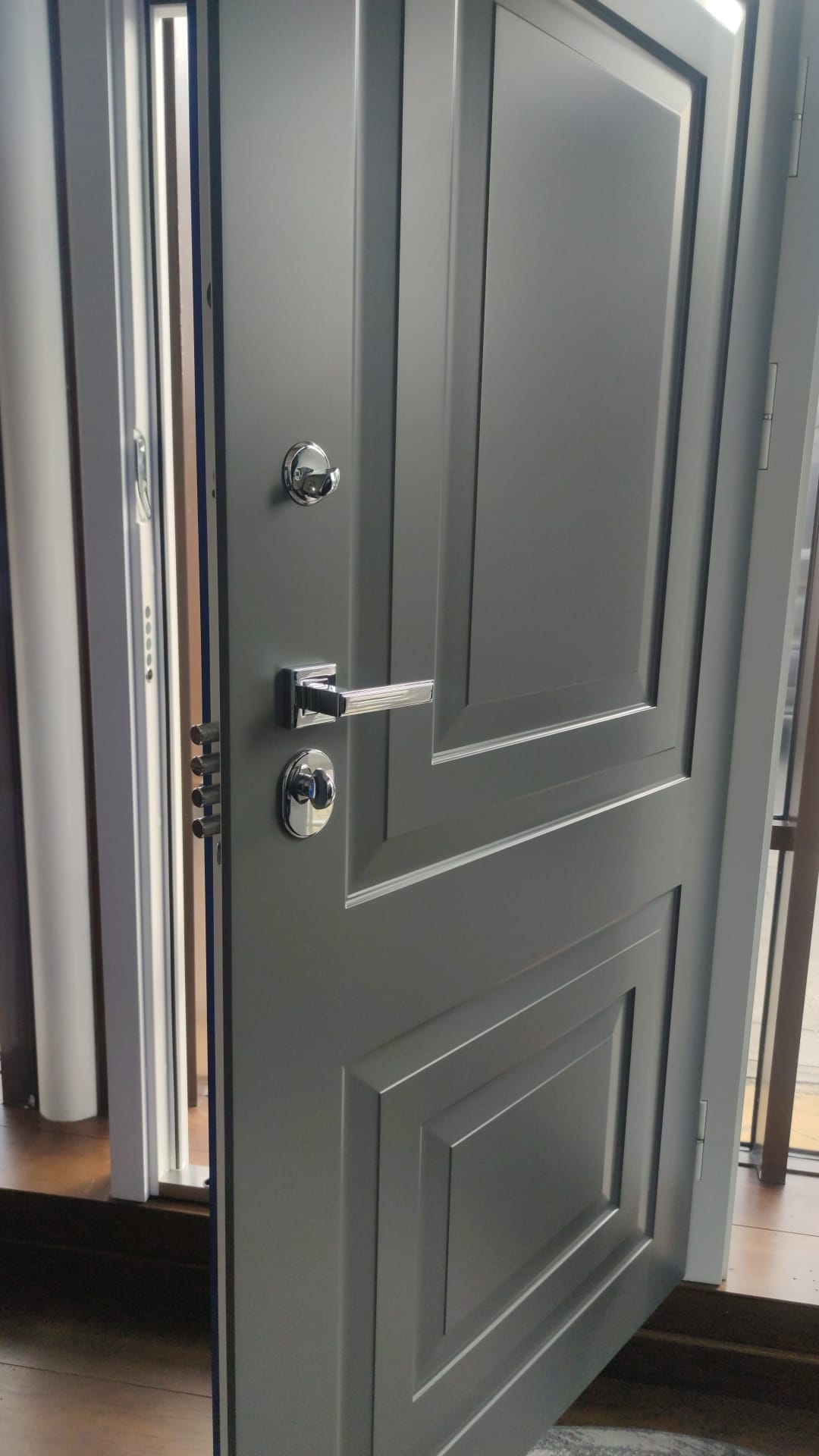
Security
A full certification tier apart
Longevity
Thirty-year steel vs fifteen-year composite
Thermal performance
The thermal break is the whole story
Fire rating
FD30 and FD60 on steel. Rare on composite
Aesthetic flexibility
Moulded panels vs fabricated panels
Cost over time
Lower upfront, higher lifetime
Environmental impact
End-of-life and recyclability
Continue Reading
Related reading
Common Questions
Frequently asked questions
Are steel doors more secure than composite doors?
Yes. Steel achieves LPS 1175 SR3 Enhanced certification (five-minute power-tool resistance, the LPCB police-preferred specification) on every SteelR door, two certification tiers above the PAS 24:2022 baseline most composite doors stop at. PAS 24 tests resistance to a one-to-three-minute casual attack. Every SteelR door is PAS 24 certified, BS EN 1627:2011 RC4 single leaf, unglazed certified as Standard, with SR3 and SR4 Commercial-grade upgrade available. A small number of premium composite doors also offer SR3, but the baseline for the category is PAS 24. For the same house, a steel door is typically a full certification tier above the composite equivalent.
Do steel doors last longer than composite doors?
Yes. Steel: a 25 to 30 year service life with routine maintenance. Composite: a 10 to 15 year typical warranty. Composite GRP skins are subject to fading, cracking under thermal stress and delamination at the edges over time. Steel does not warp, swell, delaminate or fade in the way composite can. The finish is a UV-stable powder coat applied under factory conditions, not a pigmented GRP laminate.
Are composite doors more thermally efficient than steel?
Composite doors typically publish U-values around 1.2 to 1.4 W/m²K. Thermally broken steel doors with a correctly engineered thermal break and insulated core achieve similar or lower U-values. The thermal performance of steel depends entirely on the frame construction. A budget steel door with no thermal break will perform poorly. A thermally broken SteelR door performs comparably to a premium composite and without the skin degradation issues that composite suffers over time.
Can composite doors match a period property as well as steel?
Less faithfully than steel. Composite doors are manufactured from a limited number of moulds, so panel profiles, knocker positions and glazing patterns are fixed by the tooling. A skilled installer can produce a credible period look with the right colour and hardware, but the geometry is constrained. A bespoke steel door is fabricated rather than moulded, so panel proportions, mouldings, knocker placement, letterplate style and sidelight configuration are specified individually to match the property.
Is steel or composite better value over 10 years?
Composite wins on upfront cost. Steel wins on total cost of ownership across the full 25-year horizon. A composite door is lower initial cost. A steel door is higher initial cost and lower total cost of ownership because of the longer service life, lower maintenance requirement, and resistance to finish degradation. On a 10-year horizon the running costs favour steel. On a 25-year horizon the gap widens further, because a composite door will typically need replacement within that period while a steel door will not.
Do home insurers differentiate between composite and steel doors?
Increasingly, yes. Mainstream insurers and high-net-worth specialists in particular recognise the difference between PAS 24 and SR3 certification when assessing residential property risk. Properties with SR3-rated entrance doors may qualify for reduced premiums or are sometimes specifically requested by underwriters at higher property values. Secured by Design accreditation carries additional weight in those assessments. PAS 24-only composite doors meet the regulatory minimum for new builds but do not move the dial on insurer risk profiles in the same way SR3 does.
Is SteelR the right fit
Worth considering SteelR if
- You have lived with a composite door for 8 to 15 years and want the structural next step up
- Your property sits in the upper bracket of the UK market where door lifetime cost favours steel over composite
- Your architect has previously specified composite and wants a higher-tier structural option
- You value longer service life and lower lifetime cost over a lower upfront price
- Your budget sits at the mid-market composite price point, in which case a premium composite is the more honest fit
Bespoke · UK manufactured · BS EN 1627 RC4 · LPS 1175 SR3 / SR4 available
Enquire about a bespoke SteelR door for Steel vs Composite Doors
Free consultation with our design team. No obligation. Every door is manufactured in the UK to your specification. Standard residential spec is BS EN 1627:2011 RC4 single leaf, unglazed. LPS 1175 SR3 and SR4 enhanced and commercial-grade certifications are available on request, with LPS 1673 attack-resistance by enquiry. Installed by our in-house fitters.