What Counts as a "Luxury Front Door" in 2026?
The phrase luxury front door has been diluted by marketing. Most "premium" doors sold in the UK today are mass-manufactured composite or timber products finished to look high-end. That is not what this guide is about.
A genuinely luxury front door in the UK market in 2026 has three defining characteristics:
1. Made to order. No standard size. Designed around the opening, not forced into it. 2. Structurally superior. Steel or solid hardwood frame, insulated core, multi-point locking, security-tested to a recognised standard rather than a manufacturer claim. 3. Finished by hand. Paint applied in a controlled shop environment, hardware specified individually, not plucked from a catalogue.
If a door lacks any of those three, it is a premium-branded standard product. There is a place for those. This guide is not about those.
Why UK Homeowners Are Moving Up-Market on Entrance Doors
Three shifts over the past five years have changed what affluent UK homeowners buy:
Insurance demands have tightened. Insurers increasingly reference security ratings on renewal. PAS 24 is now a minimum expectation on most policies covering properties above £1 million. SR3 (LPS 1175 Issue 8, the LPCB police-preferred specification) is required or heavily incentivised by specialist high-value insurers such as Home & Legacy and Hiscox.
Regulations changed. Approved Document Q makes PAS 24 mandatory on new-build dwellings and conversions. Approved Document B tightened fire rating requirements on entrance doors for flats and HMOs. Standard retail composite doors often fail either or both.
The design language shifted. The 2015-2020 vogue for flush composite doors has given way to a return of architectural detail, period-appropriate proportions and visible craft. Homes at the top end of the market now expect a front door that reads as designed, not ordered.
The net result: the luxury UK front door market has doubled in the last five years, and the tier above mass-market composite is now the fastest-growing segment of the residential door industry.
The Three Credible Material Options at the Luxury Tier
1. Bespoke Steel
The dominant choice at the top of the UK market. A properly manufactured bespoke steel front door uses a welded steel frame, a thermally-broken steel leaf and an insulated core. The face can be panelled, ribbed, flat or ornate. The finish is powder-coated in a paint shop at approximately 200°C, making it resistant to chipping, fading and moisture damage for 20 to 40 years without re-coating.
Steel's defining advantage is structural permanence. A bespoke steel door certified to BS EN 1627:2011 RC4 single leaf, unglazed as Standard with LPS 1175 SR3 Enhanced upgrade available resists attack with hand tools and battery-operated power tools for longer than any timber or composite door without active security specification. SR4 (LPS 1175 Issue 8) Commercial-grade upgrade is available from select UK manufacturers for the highest-risk addresses.
2. Solid Hardwood (Oak, Accoya, Walnut, Mahogany)
A traditional choice for listed buildings and Grade II properties where conservation officers restrict steel or composite. Done properly, a solid hardwood entrance door is a lifetime product. Done poorly, it warps, swells, absorbs water and requires repainting every three to five years. For a head-to-head on the trade-offs, see steel vs timber entrance doors.
The issue is that "done properly" means an Accoya or well-seasoned oak frame, stainless hardware, a triple-rebated frame, marine-grade paint system and a craftsman doing the joinery. Few UK joineries build to that standard at scale. When budget is unconstrained, timber still wins on conservation aesthetics. When budget is the primary constraint, it does not.
3. Composite (only at the true top tier)
There are two credible luxury composite-door makers in the UK and Germany. Products such as the Deuren Endurance and certain Thermo-Pro configurations use a 68mm-thick GRP skin bonded to an insulated core with thermally-broken aluminium edge banding.
These achieve good thermal performance (U-values of 0.8-1.0 W/m²K) and reasonable security (PAS 24, occasionally SR1). They do not compete with steel on security or with hardwood on conservation authenticity, and their lifespan caps around 20 years before the face begins to yellow.
Valid choice for contemporary new-builds where the owner prioritises thermal efficiency over permanence. Not a front-running choice for the luxury tier overall.
What Separates a Luxury Front Door from a Standard One
Security specification (the bit most buyers miss)
Standard composite front doors carry PAS 24 as a marketing line. PAS 24 tests against basic opportunist entry methods for 3 minutes with a screwdriver and bodily force.
Luxury front doors are tested to SR3 or higher. SR3 is LPS 1175 Issue 8 Security Rating 3, the LPCB police-preferred residential specification: resistance to a determined attacker using tools including bolt cutters, hammers, drills and crowbars for a sustained period. SR3 is required by premium UK home insurers and is the police-preferred specification under Secured by Design for high-value residential.
SR4 (LPS 1175 Issue 8 Level 4) is the commercial-grade rating used on data centres, bank vaults and critical infrastructure. A small number of UK residential manufacturers, SteelR among them, now offer SR4 as an upgrade for homes in high-risk postcodes, for jewellery-holding private clients, or for properties with recent burglary history. If your door supplier cannot explain the difference between PAS 24 and SR3, they are not selling in the luxury tier.
Hardware (the visible luxury signal)
Standard front doors come with generic hardware packs: a composite-body handle, a nylon letterbox, a polished-look chrome knocker. Luxury doors specify hardware individually.
Typical luxury-tier hardware choices in the UK:
- Forged brass or solid bronze knockers from British foundries such as Samuel Heath, Croft, or custom-commissioned pieces
- Polished chrome, satin chrome, PVD black or bronze multi-point lever handles
- Biometric fingerprint readers integrated into the leaf (ekey, Bosch)
- Heritage letter-plates in solid brass or bronze, sized to the period
- Concealed hinges rated to the full weight of the steel leaf (often 120-180 kg)
The hardware is not an add-on cost at the luxury tier. It is the single most visible indicator of whether the door is a product or a specification.
Finish and colour
A standard composite door finishes in one of twelve RAL colours chosen from a swatch card. A luxury steel or timber door finishes in any RAL colour, hand-mixed and matched against a physical reference from the surrounding brick, stone, render or window frames.
Dual-colour (different inside and outside) is standard at the luxury tier. A conservation-grey exterior with a clean white interior is common in listed buildings. Any paint company's historic palette can be matched: Farrow & Ball Downpipe, Little Greene Obsidian Green, Edward Bulmer Nile Blue.
Glazing
Luxury doors specify glazing by composition, not by pane count. Typical luxury specifications include:
- Toughened double or triple glazing in the leaf itself, not applied as a sticker
- Argon or krypton fill between panes for thermal performance
- Low-E coatings to reduce heat loss
- Obscure, frosted, reeded or stained-glass options designed per project
- Integrated blinds between panes for privacy without compromising the visible face
Design Styles at the Luxury Tier in 2026
Four design directions dominate the top of the UK market this year:
Contemporary flush
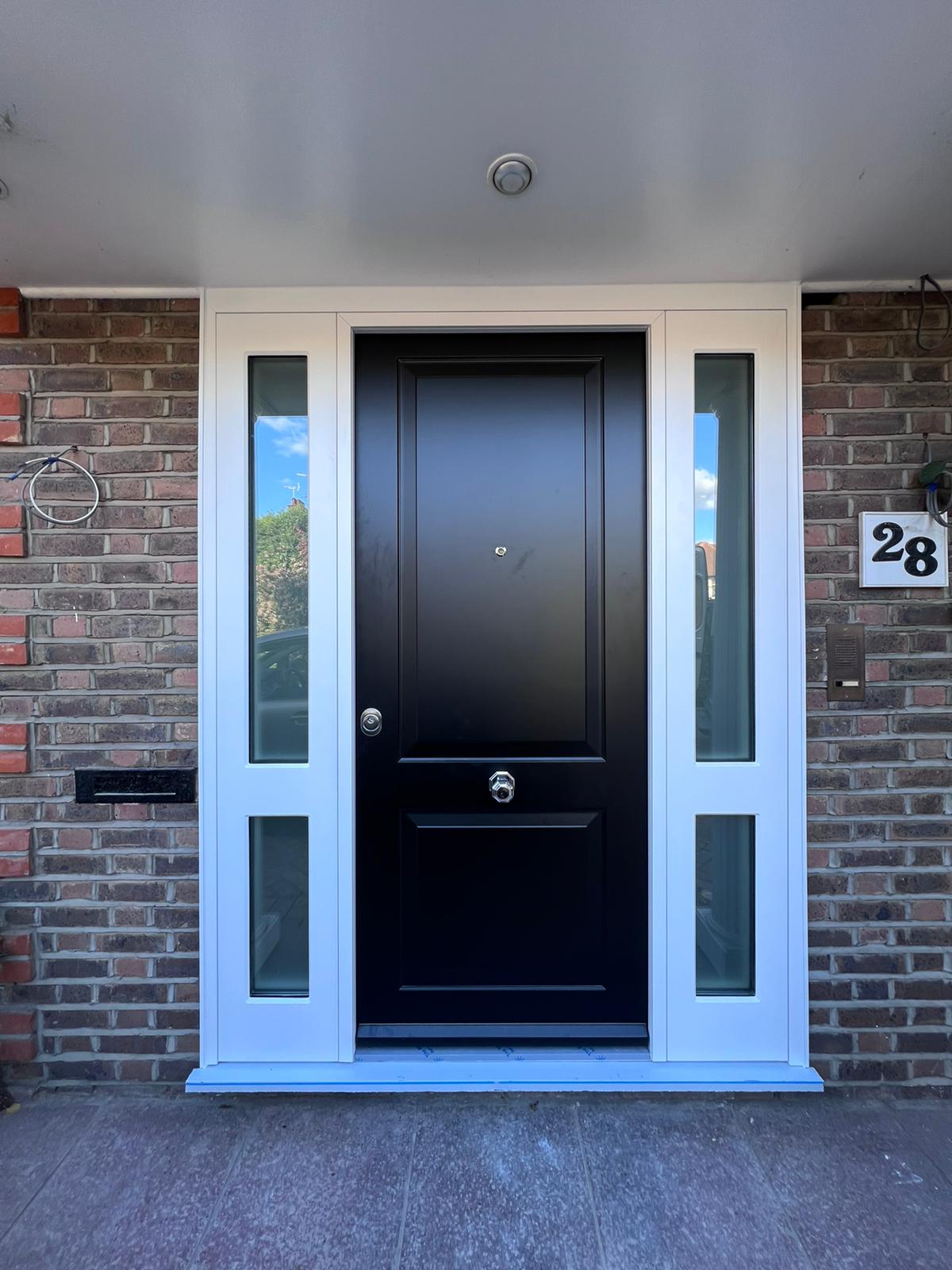
Minimal panels, concealed hinges, a single vertical bar handle running the full height. Works on modern new-builds, converted warehouses, architect-designed extensions. Typically black, charcoal, bronze or anthracite grey. Pairs with large-format paving and minimal landscaping.
Traditional panelled
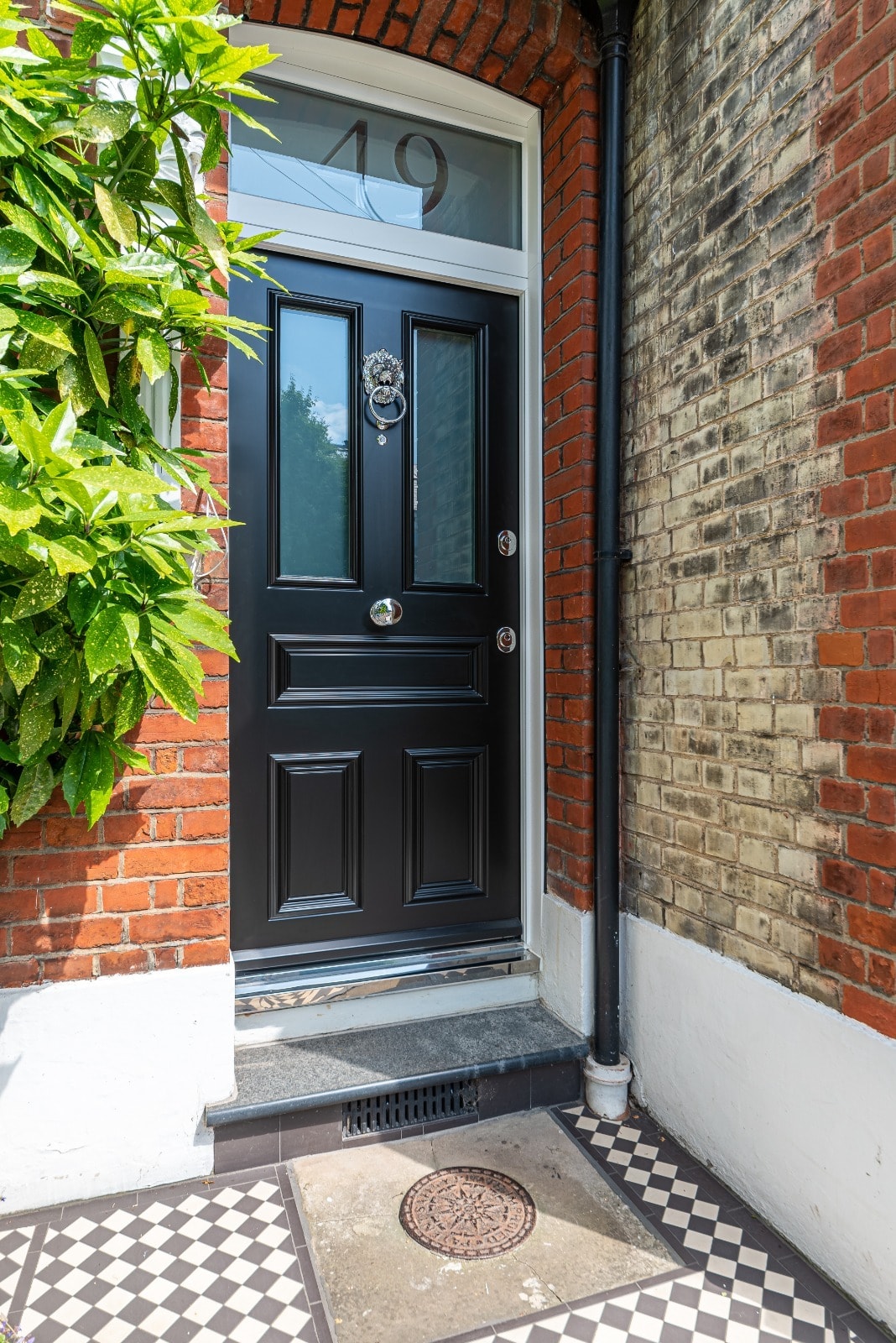
Four-panel or six-panel configurations with raised or flat moulding, brass or chrome door furniture, sometimes a fanlight above. Works on Victorian and Edwardian terraces, Georgian townhouses, country houses. Usually black, navy, deep green or cream.
Ornate heritage
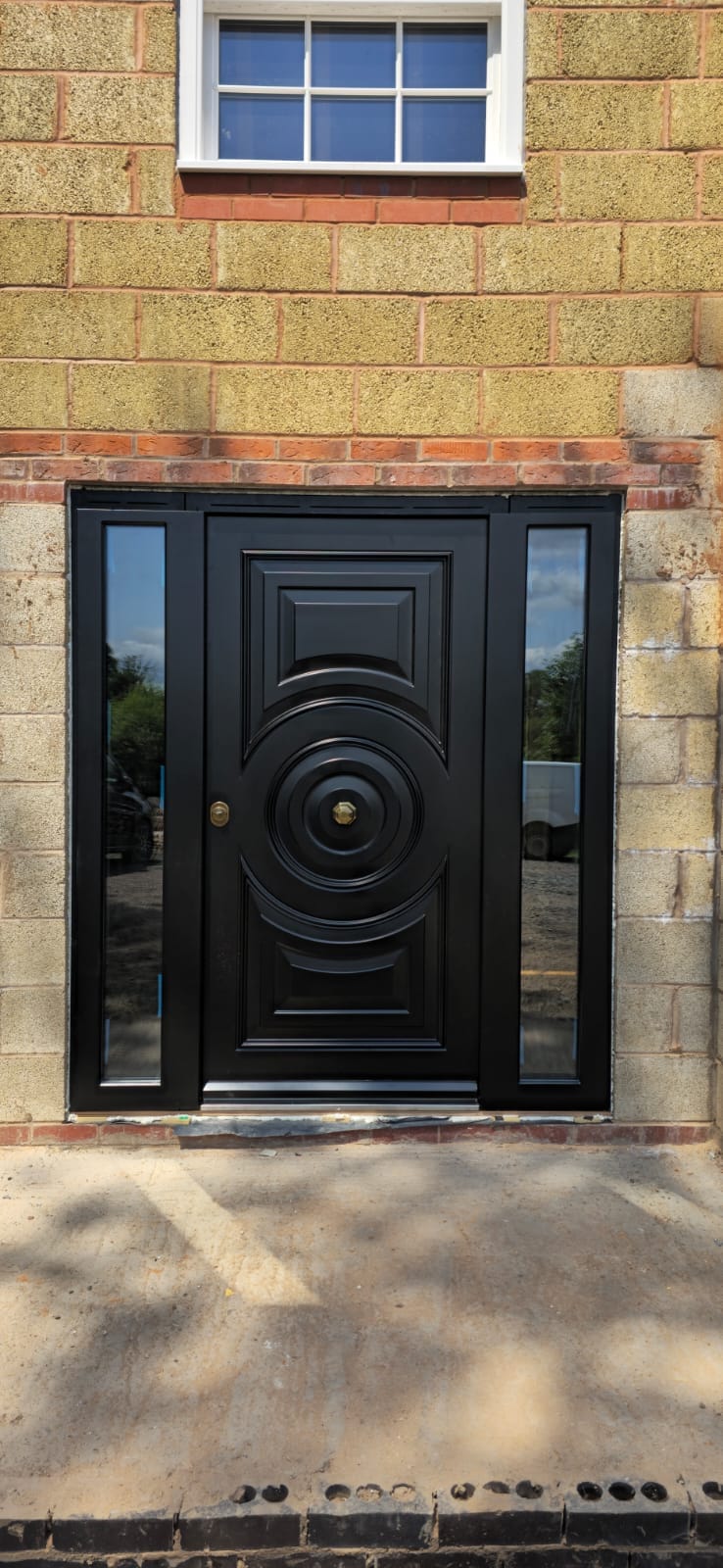
Raised medallion panels, lion-head knockers, stained or etched glass, flanked by obscure sidelights. Works on grand period entrances, manor houses, properties where the front door is the defining architectural feature of the facade. Black, deep red or cobalt dominate.
Double-leaf grand entrance
Paired doors, usually 1800-2400mm wide, either symmetrical panelled or with a vertical geometric inlay. Used on mansion blocks, large detached properties and any entrance where a single leaf would look undersized. Typically black, charcoal or champagne metallic.
Investment Range
The honest answer is that a luxury front door in the UK in 2026 is not a retail product. It is a specification commissioned for a particular home, and its cost reflects the scope: size, materials, hardware, glazing, security rating, finish, and installation complexity.
What we can tell you without a survey:
- True entry-level luxury (single-leaf steel, SR3, bespoke colour, standard hardware) starts well above the composite-door ceiling.
- Architect-specified residential (single-leaf steel, SR3, bespoke design, specified hardware, matched frame) is typically 2 to 3 times a standard composite installation.
- Grand entrance (double-leaf steel, SR3 or SR4, ornate panel design, bespoke hardware, integrated glazing, stone surround integration) is the top tier.
Any supplier quoting a fixed price without seeing the property is not specifying at this tier.
How to Specify a Luxury Front Door (Practical Steps)
1. Commission a site survey first. Any credible supplier will visit, photograph the surround, take full measurements, discuss the property and the brief. No survey = no bespoke.
2. Ask for the security rating in writing. PAS 24 is not the same as SR3. SR3 is not the same as SR4. Get the test certificate, not a marketing claim.
3. Agree the hardware individually. If the quote lists "brass hardware pack", refuse it. Request hardware by part number, finish and supplier.
4. Specify the colour against a physical reference. Deliver a brick sample, a paint chip, a photograph of the surround. Avoid "RAL chart black" or "standard anthracite".
5. Confirm the installation warranty. A luxury front door should carry at minimum a ten-year warranty on the door construction, with separate cover for the decorative finish and hardware components and an option to extend.
6. Ask who installs it. Bespoke doors should be fitted by the manufacturer's own team, not subcontracted to a local joiner. The install is 40% of the finished result.
Common Mistakes UK Homeowners Make
Buying on lead time. A luxury front door typically takes approximately 8 weeks from specification to fitted. Anyone offering same-week delivery is selling a standard product.
Prioritising price over spec. The gap between a premium composite and a bespoke steel door on a period property is visible to every guest who walks through it for the next 30 years. Most of that gap is not profit. It is the survey, the manufacture, the finish and the install.
Ignoring the surround. The best front door looks wrong if installed into an undermaintained or ill-proportioned surround. Brickwork, stone, render, reveals and the threshold all need to be assessed as part of the specification.
Trusting the sample photo. Manufacturers' gallery images are typically of the best possible install in the best possible light. Ask to see installed work photographs from the past 12 months, and if possible to visit one in person.
Using a generalist installer. A bespoke steel entrance door weighs 120 to 180 kg. Fitting it requires steel lintels, level reveals and specialist lifting. A general construction team is the wrong fit. So is a local window installer. SteelR doors are installed only by the in-house team that manufactured them, never subcontracted.
Frequently Asked Questions
What is considered a luxury front door in the UK?
A luxury front door in the UK is one that is made to order (not selected from a catalogue), manufactured from a structurally superior material such as steel or solid hardwood, security-tested to at least LPS 1175 SR3 (Issue 8), finished by hand in any RAL colour, and specified with individually-selected hardware. PAS 24 alone is not luxury-tier; SR3 or SR4 is the threshold.
Are steel front doors more expensive than composite?
A bespoke steel front door typically costs 2 to 3 times a premium composite door for the same opening. The difference reflects the structural material, the hand finishing, the bespoke design, the security rating and the installation warranty. For properties where the front door is a permanent architectural feature rather than a short-term fitting, steel delivers the lower lifetime cost.
What is the best material for a luxury front door in the UK?
For most luxury UK residential projects built or renovated since 2010, bespoke steel is the best combination of security, permanence, design flexibility and maintenance cost. Solid hardwood remains the preferred choice for listed buildings and conservation-area properties where planning restricts non-original materials. Composite is a valid choice only at the true top of the composite market and only for contemporary new-builds.
How long does a luxury front door last?
A bespoke steel front door with a powder-coat finish typically lasts 25 to 40 years with no maintenance beyond hardware cleaning. A well-specified solid hardwood door lasts 40 to 60 years with repainting every 3 to 5 years. A premium composite door typically lasts 15 to 20 years before the face begins to degrade.
Do I need planning permission for a luxury front door?
In most UK properties, no. Replacement of a front door on its like-for-like opening is permitted development and does not require planning permission. The exceptions are: listed buildings (where any exterior change needs listed building consent), conservation areas (where local authority consent is often required), and properties with Article 4 directions in force. A credible supplier will confirm planning requirements during the initial survey.
What security rating should a luxury front door have?
At minimum, LPS 1175 SR3 (Issue 8). This is required or incentivised by most specialist UK high-value home insurers and is the LPCB police-preferred residential specification under Secured by Design. Properties in higher-risk postcodes or holding significant valuables should specify SR4 (LPS 1175 Issue 8 Commercial-grade upgrade) above SR3.
Can I get a luxury front door for a period property?
Yes. Bespoke steel and solid hardwood doors can both be manufactured in period-appropriate proportions, with heritage hardware, sympathetic glazing and conservation-compliant colour palettes. For Grade II listed buildings, hardwood is usually the default choice. For conservation-area properties that are not listed, steel with a panelled face and heritage hardware is increasingly specified.
How long does a bespoke luxury front door take to manufacture?
Approximately eight weeks from agreed specification to fitted installation. The timeline typically breaks down as design sign-off, workshop manufacture, finishing and quality control, then one to three days for installation. Any supplier quoting under six weeks is not specifying a genuinely bespoke product.
Do luxury front doors add value to a property?
Yes. Industry data from UK estate agents consistently shows that a well-specified luxury front door on a period or architect-designed property returns 100 to 300 percent of its installed cost in resale value, particularly in London and the Home Counties where the front elevation heavily influences buyer perception. Beyond resale, the insurance benefits of SR3 certification and the multi-decade service life of bespoke steel make it the lowest lifetime cost option on properties planned for long-term ownership.
Final Thought
A luxury front door is not a cosmetic upgrade. It is the single most visible and most used component of a property's architecture, it carries the primary physical security burden of the home, and it communicates what every guest, delivery driver and casual passer-by understands about the house behind it.
At the luxury tier, specifying one well returns value every day for 25 years. Specifying one poorly leaves you repainting it every third spring and reconsidering your insurance premium every renewal.
The difference is rarely the budget. It is the specification. Take the survey, write the spec, commission the right material, choose the hardware individually and insist on an in-house install team. Everything else is detail.
For the steel-manufacturer shortlist at this tier, see luxury steel front doors UK. London-specific borough coverage and conservation context lives on luxury steel entrance doors London.
---
SteelR manufactures bespoke steel entrance doors at the UK luxury tier. PAS 24 certified, BS EN 1627:2011 RC4 single leaf, unglazed certified as Standard, with LPS 1175 SR3 (LPCB police-preferred Enhanced upgrade), LPS 1175 SR4 D10 Issue 8 (Commercial-grade upgrade) and LPS 1673 attack-resistance (Ultra-high, by enquiry) available on every door. Secured by Design approved, FD30S fire rated, UK manufactured, installed nationwide. Consultations are no-obligation. Visit steelr.co.uk/contact to book a site survey.