Understanding the Gap Between uPVC and Steel
For much of the past three decades, uPVC has been the default choice for replacement front doors across the United Kingdom. It is affordable, widely available and reasonably low-maintenance. For millions of standard residential properties, uPVC has served its purpose.
But an increasing number of homeowners, particularly those investing in renovations, period property restorations or new builds at the higher end of the market, are discovering that uPVC has a ceiling. There comes a point where its limitations in security, design and longevity become difficult to overlook. That is the point at which steel enters the conversation.
This guide provides an honest comparison of steel vs uPVC front doors, covering every factor that matters: security, design, durability, thermal performance, environmental impact and cost. The aim is not to dismiss uPVC entirely, it has its place, but to help you understand exactly what you gain when you upgrade.
What Is a uPVC Front Door?
uPVC stands for unplasticised polyvinyl chloride. It is a rigid plastic compound that is extruded into hollow profiles, reinforced internally with steel or aluminium sections, and assembled into door frames and panels. The surface is typically smooth, white or woodgrain-effect, and requires no painting.
Most uPVC front doors sold in the UK are mass-produced to standard dimensions. They are widely available through national installers, double glazing companies and builders' merchants. Prices typically range from £400 to £1,500 installed, making uPVC the most budget-friendly option on the market.
The material gained dominance during the 1990s replacement window and door boom, and it remains the most commonly installed front door material in Britain today.
Security: The Most Important Difference
This is where the comparison between steel and uPVC is most stark, and it is the single biggest reason homeowners choose to upgrade.
uPVC doors rely on cylinder locks, typically a Euro profile cylinder within a multipoint locking mechanism. The problem is well-documented: standard Euro cylinders are vulnerable to lock snapping, a technique that requires no specialist tools and takes under 30 seconds. While anti-snap cylinders are available, many uPVC doors are still fitted with standard cylinders, and the plastic frame itself offers limited resistance to physical attack.
uPVC panels can be kicked through, levered apart or cut with basic tools. The material simply does not have the structural integrity to resist determined forced entry. Most uPVC doors achieve PAS 24 certification at best, a standard that tests resistance to casual opportunistic attack, not sustained or tooled assault.
Steel entrance doors operate in an entirely different security category. A properly engineered steel door achieves an SR3 security rating under BS EN 1627:2011, which tests resistance to sustained attack using crowbars, drills, angle grinders and other professional-grade tools. The steel leaf, reinforced frame and multipoint locking system work together as an integrated security barrier.
Steel doors that meet SR3 are eligible for Secured by Design accreditation, the official UK police security initiative. This is not a marketing label; it is a recognised standard backed by independent testing and police endorsement.
For properties in affluent areas such as Surrey, Kent and Essex, where burglary targeting of high-value homes is a documented concern, the security gap between uPVC and steel is not a marginal difference, it is a fundamental one.
A steel entrance door is the single most effective physical security upgrade a homeowner can make to their property.
Design: From Limited to Limitless
uPVC front doors are manufactured to standard templates. While the range of styles has improved over the years, the fundamental constraint remains: uPVC is a mass-produced product designed for cost efficiency, not aesthetic distinction.
Design limitations of uPVC include:
- Restricted colour range, typically white, black, grey, green and a handful of woodgrain effects
- Uniform surface texture, smooth plastic finish that lacks depth or character
- Limited panel configurations, standard mould shapes with minimal variation
- No bespoke sizing, doors are manufactured to common opening dimensions
- Plastic hardware, handles, letterboxes and knockers are often plastic or lightweight metal
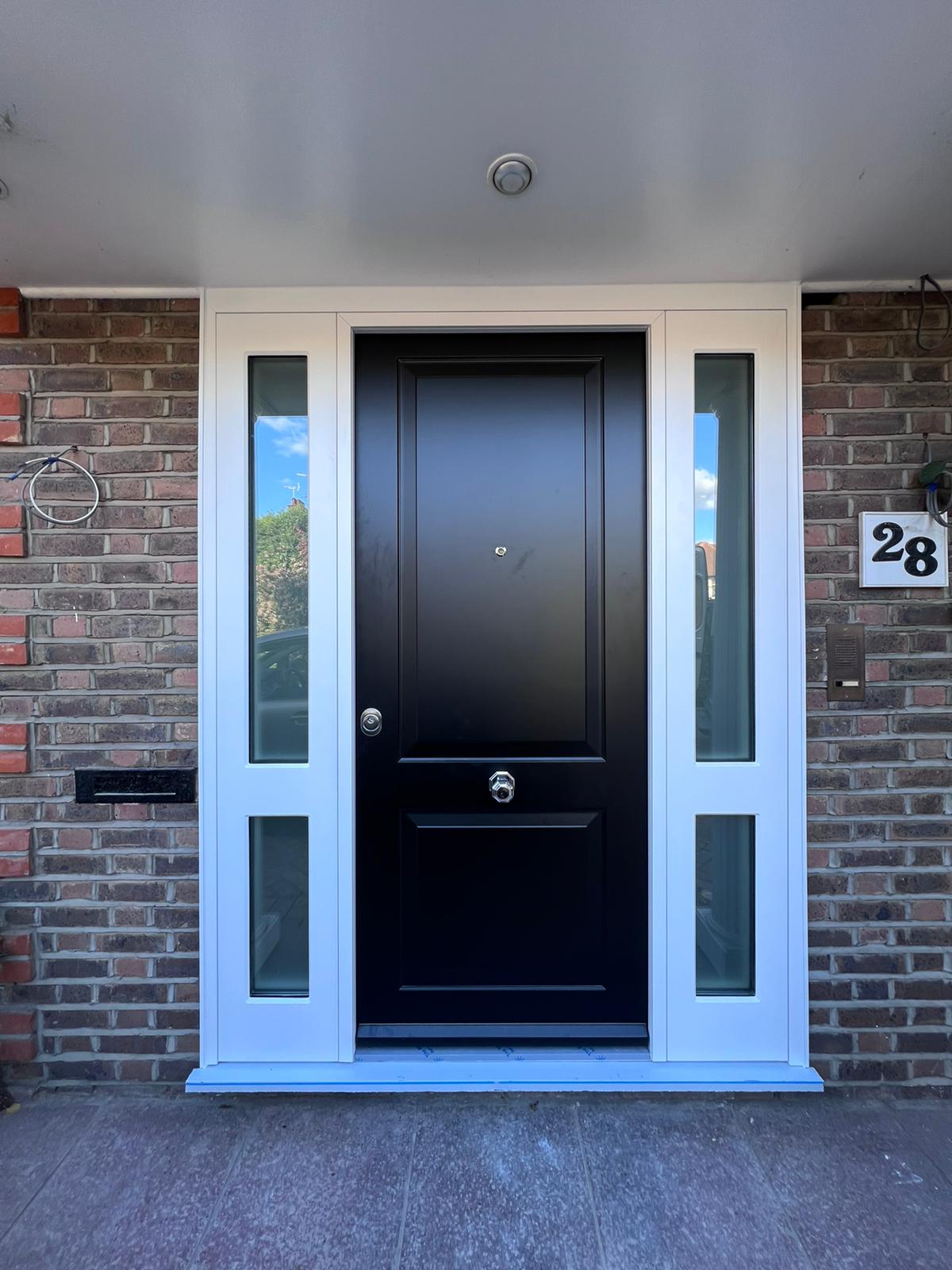
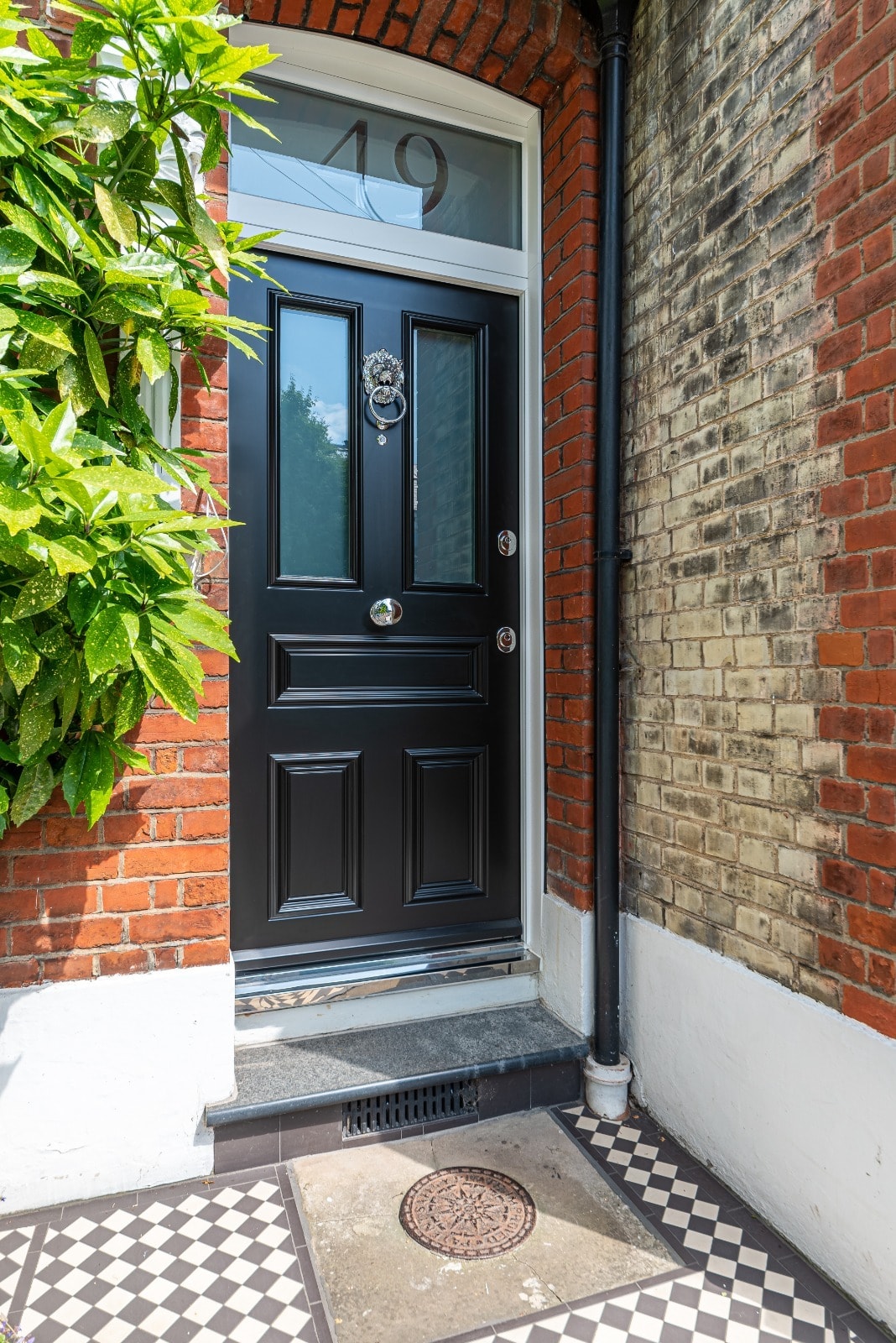
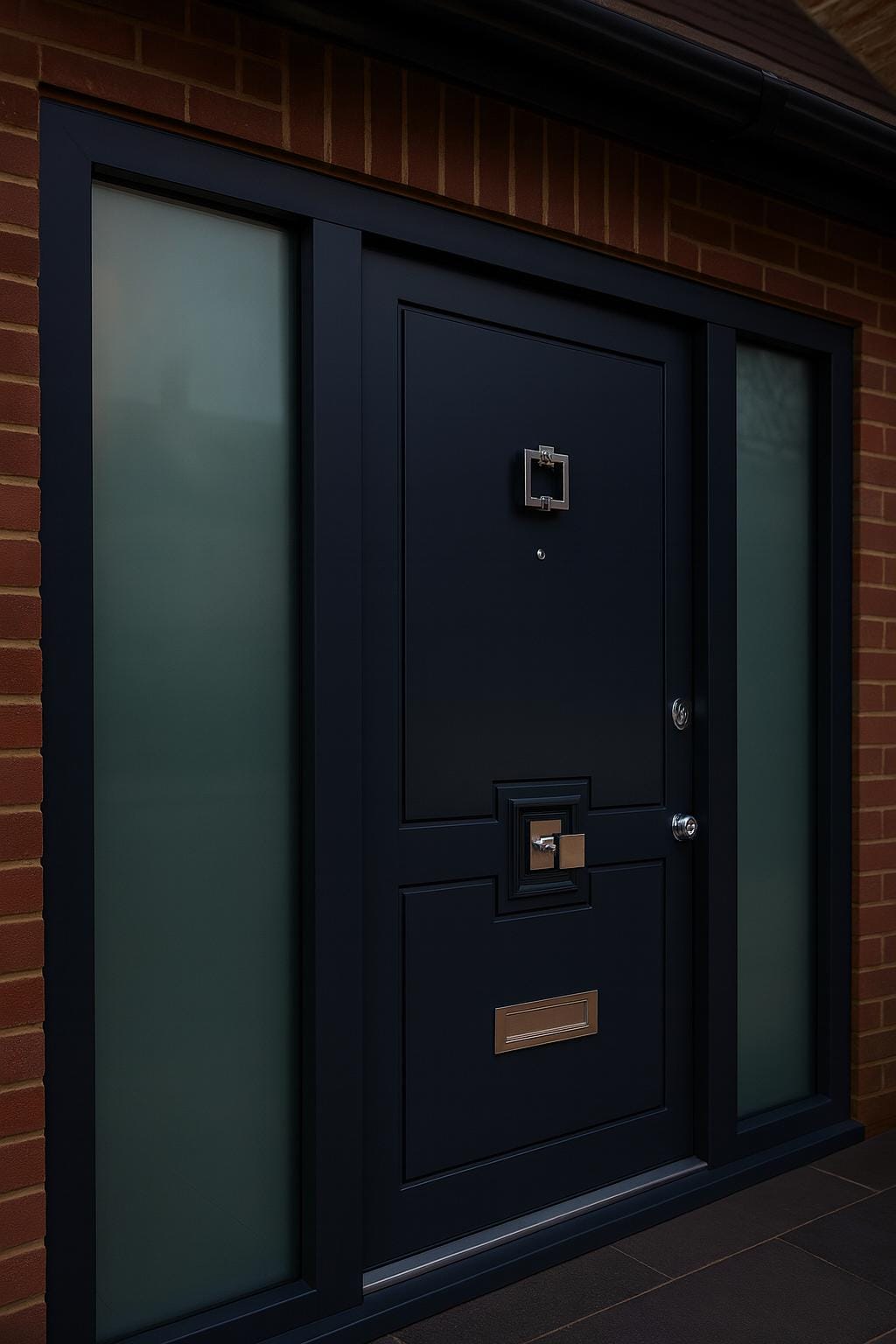
Bespoke steel entrance doors remove these limitations entirely. Every door is designed and manufactured to the exact dimensions, style and specification of the property. The full RAL colour range offers over 200 colours, including dual-colour specification where the exterior and interior are finished in different shades. Panel designs, glazing configurations, decorative mouldings and ironmongery are all specified individually.
Whether the property calls for a Georgian six-panel design with a lion knocker and brass fittings, or a contemporary flush panel with concealed hinges and a minimal pull handle, steel accommodates both with equal precision. Browse the SteelR collection to see the breadth of what is achievable.
The visual difference between a uPVC door and a bespoke steel door is immediately apparent from the kerb. One looks like a replacement; the other looks like it belongs to the architecture.
Durability and Lifespan
uPVC doors have a typical lifespan of 15 to 25 years. Over that period, several issues commonly develop:
- Discolouration, white uPVC yellows with UV exposure; coloured uPVC fades
- Warping, temperature fluctuations cause the plastic profiles to expand and contract, leading to misalignment
- Seal degradation, rubber gaskets harden and crack, allowing draughts and water ingress
- Lock mechanism failure, the lightweight frame and panel flex under repeated use, stressing the locking mechanism
- Panel cracking, impact damage or thermal stress can cause the hollow panels to crack, particularly around glazed units
Once a uPVC door begins to deteriorate, repair options are limited. The material cannot be refinished or restored, replacement is the only solution.
Steel entrance doors are built to last a minimum of 40 to 50 years with proper maintenance. The steel leaf does not warp, bow, twist or deform. A multi-layer paint system provides lasting corrosion protection, and should the finish ever need refreshing, steel can be professionally recoated without replacement.
Hardware components, locks, hinges, handles, are specified for longevity and can be serviced or replaced individually. The door itself remains structurally sound for the life of the building.
A bespoke SteelR door is not a consumable product that requires periodic replacement. It is a permanent architectural element.
Thermal Performance
Modern uPVC doors achieve reasonable thermal performance, with U-values typically between 1.4 and 1.8 W/m2K for a standard panel door. The hollow profiles provide some inherent insulation, and double-glazed units contribute where glass is present.
However, uPVC's thermal performance degrades over time as seals fail and profiles warp. A door that tested well at installation may perform significantly worse after 10 or 15 years in service.
Steel entrance doors with an insulated core achieve U-values typically from 1.5 W/m2K, with thermal-upgrade specifications available achieving as low as 0.8 W/m2K, substantially better than uPVC from day one. More importantly, that performance remains consistent over the full lifespan of the door because the steel frame maintains its dimensional stability. Seals remain properly compressed, and the insulating core does not degrade.
The thermal advantage of steel is not merely a specification figure. It translates directly into lower heating costs, improved comfort at the threshold and compliance with the increasingly stringent requirements of Approved Document L.
Environmental Considerations
The environmental profile of uPVC is a growing concern for homeowners who consider sustainability in their purchasing decisions.
uPVC production involves chlorine chemistry and plasticisers. While modern manufacturing has improved, the material remains difficult to recycle effectively. Most uPVC doors removed during replacement end up in landfill, where the plastic takes centuries to decompose. The industry's recycling rate, while improving, remains well below that of metals.
Steel is one of the most recycled materials on earth. Over 85 per cent of structural steel is recycled at end of life, and recycled steel retains its full structural properties without degradation. A steel entrance door can be recycled completely when it eventually reaches the end of its service life, which, given its 40-to-50-year lifespan, is a considerably longer useful life than uPVC before any recycling question arises.
For homeowners and developers with environmental commitments, the lifecycle comparison strongly favours steel.
When uPVC Makes Sense
This guide would not be honest without acknowledging the scenarios where uPVC remains a reasonable choice:
- Budget-constrained replacements where the priority is functionality at the lowest cost
- Rental properties where investment in premium materials is not justified by the tenancy model
- Standard new builds where the developer specification does not extend to bespoke entrance doors
- Temporary solutions where the property is due for more extensive renovation in the near future
If the entrance door is simply a functional closure, uPVC does that job at a price point that steel cannot match.
When It Is Time to Upgrade
The case for upgrading from uPVC to steel becomes compelling when any of the following apply:
- Security is a priority, you want genuine resistance to forced entry, not just a locked door
- The property has architectural character, a period home, a substantial new build or a renovation that deserves an entrance to match
- Long-term value matters, you want a door that lasts decades, not one that needs replacing in 15 years
- Kerb appeal is important, whether for personal satisfaction or resale value, first impressions count
- You are investing in the property, if the kitchen, bathrooms and landscaping are high-specification, a uPVC front door undermines the overall impression
For homeowners in these categories, the cost difference between uPVC and steel is not an expense, it is an investment in security, quality and lasting value.
Cost Comparison and Value Proposition
A uPVC front door installed sits in the entry-level tier of the market, priced for volume. A bespoke steel entrance door is individually priced after an on-site survey because each door is made to measure with no two specifications alike. The two products are not competing for the same buyer. uPVC is a volume commodity. Bespoke steel is a long-horizon investment.
On a simple cost comparison, uPVC is cheaper at the point of purchase. But cost and value are different calculations.
Over a 40-year period, a homeowner replacing a uPVC door every 15 years will fund two replacements plus the original purchase, with ongoing draught and security issues between replacements. A single bespoke steel door, properly maintained, serves the full 40 years with consistent security, thermal performance and visual impact throughout.
Steel entrance doors also contribute measurably to property value. Estate agents consistently report that a high-quality entrance door is one of the most impactful kerb appeal improvements a homeowner can make. In premium property markets, the presence of a bespoke steel entrance door signals quality throughout the property.
To explore the options available for your property, request a consultation and discuss your requirements with our design team.
Making the Right Choice
The decision between uPVC and steel is ultimately a decision about what you expect from your front door. If you expect it to keep the weather out and lock when you leave, uPVC will do that at a low price. If you expect it to protect your family, complement your architecture, last for decades and make a statement about the quality of your home, steel is the material that delivers.
Every door in the SteelR collection is manufactured to SR3 security standards, Secured by Design accredited and ISO 9001 certified. SteelR offers the full RAL colour range, bespoke sizing and a design process that starts with your property's architecture, not a catalogue. Read our security overview for the full technical detail on what makes a steel entrance door the most secure residential option available in the UK.
Frequently Asked Questions
Is a steel front door worth the extra cost over uPVC?
For homeowners who value security, durability and design, steel represents significantly better long-term value. The higher upfront cost is offset by a lifespan two to three times longer than uPVC, consistent thermal performance and the four-tier security ladder (BS EN 1627 RC4 Standard, with LPS 1175 SR3 Enhanced upgrade and SR4 Commercial-grade upgrade available).
How much more secure is a steel door than uPVC?
The difference is substantial. uPVC doors typically achieve PAS 24 certification, which tests resistance to casual attack. SteelR steel doors are BS EN 1627:2011 RC4 certified as Standard, with the LPS 1175 SR3 Enhanced upgrade available, both of which test resistance to sustained attack with professional tools including crowbars and angle grinders.
Do steel doors rust compared to uPVC?
Modern steel entrance doors are protected by a multi-layer paint system that prevents corrosion under normal UK conditions. The finish is more durable than uPVC, which discolours and degrades with UV exposure over time.
Can a steel door match the low maintenance of uPVC?
Steel doors require minimal maintenance, periodic cleaning and occasional lubrication of hardware. Unlike uPVC, steel does not yellow, warp or develop seal failures, so the maintenance requirement is comparable and the results are far more consistent over time.
Will a steel door improve my property value?
A bespoke steel entrance door is one of the most effective kerb appeal improvements available. Estate agents report that a high-quality front door creates an immediate impression of quality that influences buyer perception of the entire property.
How long does a steel entrance door last compared to uPVC?
A uPVC front door typically lasts 15 to 25 years before needing replacement. A bespoke steel entrance door is built to last 40 to 50 years with proper maintenance, making it a permanent architectural addition rather than a consumable product. For a fuller side-by-side material comparison, see our steel front door vs composite hub page.