The Case for Two Leaves
A double front door makes a statement that a single door cannot. The proportions change, the entrance widens and the arrival experience shifts from functional to architectural. For the right property, a double door is not merely an aesthetic upgrade, it transforms the relationship between the exterior and the interior.
But double doors are not universally appropriate. They introduce structural, security and thermal considerations that do not apply to single doors, and specifying them incorrectly can create more problems than they solve. This guide examines the pros, cons and practical considerations of double front doors, drawing on our experience manufacturing bespoke steel double entrance doors for properties across the United Kingdom.
When Double Doors Work
Double front doors are at their best when the property and the opening support them. The scenarios where double doors genuinely enhance a property include:
Wide entrance openings. Properties with openings of 1400mm or more are natural candidates for double doors. A single door in an opening this wide requires excessive sidelights or filler panels that can look unbalanced. Two leaves divide the space proportionally and create visual symmetry.
Grand architectural proportions. Georgian townhouses in London, substantial detached homes in Buckinghamshire and country houses in Surrey often have entrance porticos, columns or canopies designed to frame a double door. In these settings, a single door looks undersized.
Properties with large entrance halls. When the hallway behind the front door is generous, a double-height space, a wide reception hall or a substantial vestibule, double doors create a proportional transition between outside and inside.
Practical access requirements. Double doors provide a clear opening width that accommodates furniture delivery, wheelchair access, large gatherings and the kind of unrestricted flow between indoor and outdoor entertaining spaces that modern living demands.
The key principle is proportion. Double doors should look as though they belong to the architecture, not as though they have been imposed upon it. When the building's scale justifies the door's scale, the result is architecturally coherent.
When Double Doors Do Not Work
Equally important is recognising the situations where double doors are the wrong choice:
Narrow openings. Attempting to fit double doors into an opening under 1200mm results in two leaves that are too narrow to function comfortably. Each leaf should be a minimum of 600mm wide, and ideally 700mm or more, to look and operate properly.
Exposed positions. Double doors present a wider surface area to wind and weather. In highly exposed locations, hilltop properties, coastal settings or positions facing prevailing winds, the increased wind load on two leaves can cause operational issues and accelerated wear on hinges and seals.
Properties without proportional context. A standard three-bedroom semi-detached house with a modest porch does not benefit from double doors. The scale is wrong, and the result can look incongruous rather than impressive.
Structural Requirements
This is the first practical consideration that many homeowners overlook. A double front door is wider and heavier than a single door, and the structural opening must support it.
Lintel capacity. The opening above the door must be spanned by a lintel capable of supporting the load above while accommodating the wider span. In older properties, the existing lintel may need reinforcement or replacement. In new builds, the lintel is specified as part of the structural design.
Threshold condition. The threshold, the base of the opening, must be level, properly drained and capable of accommodating the wider frame. Steel thresholds with integrated weather bars are standard on bespoke double doors, but the substrate beneath must be structurally sound.
Frame fixing. A double door frame is subject to greater lateral forces than a single door frame, particularly from wind loading. The frame must be securely fixed to the surrounding masonry or structural opening with appropriate fixings at specified centres. The SteelR installation team surveys every opening before manufacture to confirm structural adequacy.
Weight considerations. A pair of bespoke steel entrance doors with full multipoint locking, glazing and decorative panels can weigh in excess of 150kg total. The hinges, frame and threshold must be engineered to carry this load without deflection or binding over the long term.
For properties where structural modification is required, we recommend engaging a structural engineer at the outset. The cost of getting the opening right is modest compared to the cost of remedial work after installation.
Security for Double Doors
Security is the area where double doors require the most careful specification. A double door has two leaves, two sets of hinges and a central meeting point, all of which must be secured to the same standard as a single door.
Active and Passive Leaf
In a standard double door configuration, one leaf is the active leaf, the door you open and close for everyday use. The other is the passive leaf, which remains closed and locked most of the time but can be opened when the full width is needed.
The active leaf operates exactly like a single door, with a full multipoint locking system engaging into the frame at multiple points.
The passive leaf is secured by flush bolts, concealed bolts that shoot into the head of the frame and the threshold, locking the leaf in position. When the passive leaf is bolted, the active leaf locks against it as though it were a solid frame member.
The Central Meeting Point
The junction where the two leaves meet is the critical security detail. In a poorly specified double door, this meeting point is the weak link, the point where forced entry is most easily achieved.
On a properly engineered steel double door, the meeting stile incorporates an interlocking rebate, a stepped profile where one leaf overlaps the other. This prevents the leaves from being levered apart. Combined with the multipoint locking on the active leaf and the flush bolts on the passive leaf, the central meeting point is as secure as any other part of the door.
Every SteelR double door is BS EN 1627 RC4 certified as Standard across the complete assembly (both leaves, both sets of hardware and the central meeting point), with the LPS 1175 SR3 Enhanced upgrade available on every double door. Independently tested under BS EN 1627:2011 and carries Secured by Design accreditation.
Double doors that have not been independently certified as a complete assembly (rather than as individual single-leaf doors) should be treated with caution. Some manufacturers test individual leaves but not the assembled pair, which leaves the central meeting point unverified.
Thermal Considerations with Two Leaves
A double door has more linear metres of seal than a single door. The perimeter seals around each leaf, plus the central meeting seal between the two leaves, create additional potential for heat loss if not properly specified.
High-quality compression seals along every edge, both leaves against the frame and both leaves against each other at the central meeting point, are essential. The seals must maintain consistent compression as the leaves expand and contract with temperature changes.
The insulating core in each leaf should be continuous polyurethane foam with no thermal bridges. A well-specified steel double door achieves a U-value of 0.9 to 1.2 W/m2K per leaf, comparable to a single door. The critical factor is the central meeting seal, this must be as thermally effective as the perimeter seals to prevent a cold bridge down the centre of the door.
Draught performance is tested under BS EN 12207, and a properly manufactured double door meets the same air permeability class as a single door. If a manufacturer cannot provide air permeability test data for their double door configuration, that is a warning sign.
Cost: Double vs Single
A bespoke steel double entrance door typically costs 40 to 70 per cent more than an equivalent single door. The additional cost reflects:
- Two complete door leaves with independent locking hardware
- A wider, more substantial frame with additional fixing requirements
- Flush bolt mechanisms for the passive leaf
- Interlocking meeting stile engineering
- Wider threshold with integrated weather bar
- Additional seals at the central meeting point
- Increased installation complexity, heavier, wider and requiring more precise alignment
The cost premium is not simply double the price of a single door because much of the frame, threshold and installation work is shared. However, it is a meaningful uplift, and the investment should be justified by the property's proportions and the homeowner's requirements.
For properties where the opening width genuinely calls for double doors, the investment is proportionate. For properties where a single door with sidelights would serve equally well, the additional cost may not be justified. We discuss this honestly during our process and will recommend sidelights over double doors where the proportions favour it.
Design Options
The design possibilities for double entrance doors are extensive, and the pairing of two leaves opens up options that a single door cannot achieve.
Matching Pair
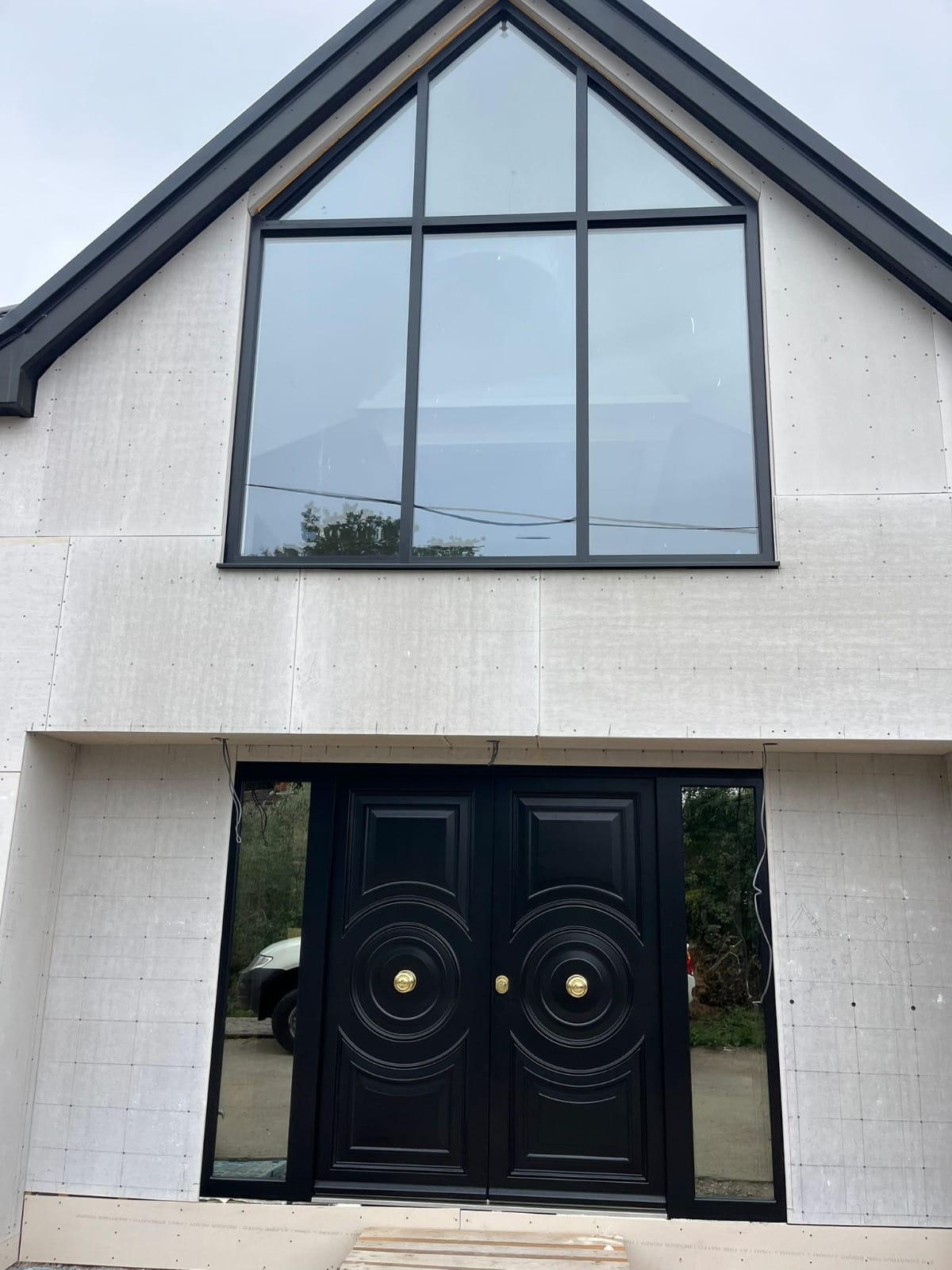
The most common configuration: both leaves share identical panel designs, mouldings and hardware. This creates perfect symmetry and is the natural choice for classical and traditional architecture. Matching double doors with identical six-panel mouldings and centred knockers on each leaf are a hallmark of Georgian and Regency entrances.
Asymmetric Designs
For contemporary properties, an asymmetric configuration can create visual interest. One leaf might incorporate a glazed panel while the other is solid. Alternatively, the active leaf might feature the primary handle and knocker while the passive leaf is clean and uninterrupted. Asymmetric designs work particularly well in London townhouses where the architecture itself is contemporary.
Glazed Double Doors
Both leaves can incorporate glazing, from small vision panels to full-height glass, flooding the entrance hall with natural light. Glazing options include clear, sandblasted, decorative leaded and contemporary etched patterns. The security glass in every SteelR door is laminated to the same standard as the steel panels, maintaining the SR3 rating.
Arched and Shaped Tops
For properties with arched openings, common in Victorian and Edwardian architecture, double doors can be manufactured with shaped top rails that follow the arch profile. This eliminates the need for filler panels or fanlights above the door and creates a clean, integrated appearance.
Browse our collection to see examples of both single and double door configurations, or request a consultation to discuss the right approach for your property.
Access Width: A Practical Advantage
One often-overlooked benefit of double doors is the clear opening width when both leaves are open. A standard single entrance door provides approximately 800 to 900mm of clear opening. A double door with two 700mm leaves provides 1400mm, nearly double the access width.
This matters for:
- Furniture delivery, large sofas, pianos, commercial kitchen appliances
- Wheelchair and mobility access, exceeding Part M requirements comfortably
- Indoor-outdoor flow, opening both leaves for entertaining, particularly where the entrance opens onto a terrace, courtyard or garden
- Moving day logistics, the one occasion every homeowner wishes their door was wider
For properties in Buckinghamshire and Surrey where substantial homes regularly require delivery of oversized furnishings, the practical access advantage of double doors is frequently cited as a deciding factor.
Specifying Double Doors Correctly
The difference between double doors that perform flawlessly for decades and double doors that cause ongoing issues comes down to specification and manufacture. Key points to confirm with any manufacturer:
- SR3 testing on the complete assembly, not just individual leaves
- Flush bolts rated to the same standard as the primary multipoint locking
- Interlocking meeting stile with weather seal and thermal break
- Heavy-duty hinges rated for the weight of each leaf with a safety margin
- Independent weather seals on all four sides of each leaf plus the central meeting point
- Structural survey of the opening before manufacture
Every double door we produce is manufactured to ISO 9001 quality management standards, tested to SR3 as a complete assembly and Secured by Design accredited. The full RAL colour range is available, with dual-colour specification as standard.
Frequently Asked Questions
What is the minimum opening width for double front doors?
We recommend a minimum structural opening of 1400mm for double doors. This allows each leaf to be at least 650mm wide after the frame is installed, which is the practical minimum for comfortable operation and proportional appearance.
Can both leaves of a double door be opened?
Yes. The active leaf opens for everyday use, and the passive leaf can be unbolted and opened when the full width is needed. Flush bolts on the passive leaf are operated from the interior, and the entire opening is accessible within seconds.
Are double doors less secure than single doors?
Not when properly specified. A bespoke steel double door with SR3-rated multipoint locking on the active leaf, rated flush bolts on the passive leaf and an interlocking meeting stile is tested and certified to the same security standard as a single door.
Do double doors let in more draughts?
A well-manufactured double door with continuous compression seals on all edges, including the central meeting point, achieves the same air permeability rating as a single door. Draught issues with double doors are a sign of poor specification or manufacture, not an inherent limitation of the configuration.
How much more do double doors cost than a single door?
Bespoke steel double doors typically cost 40 to 70 per cent more than an equivalent single door. The premium reflects additional materials, hardware and installation complexity. For properties where the proportions genuinely suit double doors, the investment is proportionate to the architectural impact.
Can I have double doors installed in an existing single door opening?
In many cases, yes, but the opening must be widened, which involves structural work including a new lintel. We recommend a structural survey before committing to this approach. For some properties, a single door with sidelights achieves a similar visual width without structural modification. For a wider view of how bespoke configurations are specified, see our bespoke steel front doors UK overview.