The Short Answer
Yes, for the right property and the right homeowner, a bespoke steel entrance door is one of the best investments you can make in your home. But "worth it" means different things to different people, so this article breaks the question down honestly. We will cover what steel does better than the alternatives, address the common concerns, and be straightforward about where steel might not be the right choice.
Durability: The 25+ Year Argument
The single most compelling case for steel is longevity. A properly manufactured and powder-coated steel entrance door will last 25 to 40+ years without structural degradation. The steel itself does not rot, warp, swell, shrink or delaminate. The powder-coat finish is baked onto the surface at approximately 200°C, creating a molecular bond that resists chipping, flaking, peeling and UV degradation far beyond any paint system applied to timber or GRP.
How This Compares
- Composite doors (GRP over foam core): Typical lifespan 10 to 20 years. The GRP skin can fade, crack or delaminate with prolonged UV exposure. The foam core can absorb moisture if the skin is compromised, leading to structural weakness and poor insulation
- Timber doors (hardwood): 15 to 30 years with diligent maintenance. Without regular repainting or re-oiling (every 3 to 5 years), timber begins to deteriorate within 5 to 7 years. Moisture ingress causes swelling, warping, joint failure and eventually rot
- uPVC doors: 15 to 25 years. uPVC becomes brittle with age and UV exposure, yellows over time, and cannot be effectively repaired once the material degrades
A steel door installed today will still be functioning correctly when a composite door installed at the same time has been replaced twice. That is not marketing, it is materials science.
Security: SR3 Rating vs Everything Else
Security is where steel creates the widest gap between itself and competing materials. Every SteelR door is tested and certified to BS EN 1627:2011 RC4 single leaf, unglazed as Standard, with the LPS 1175 SR3 Enhanced upgrade (the LPCB police-preferred residential rating) available on every door.
What SR3 Actually Means
LPS 1175 SR3 certification (Issue 8) requires the complete doorset (leaf, frame, locks, hinges, glazing, fixings) to resist a sustained attack by a skilled operative using power tools including drills, jigsaws, angle grinders and chisels for five minutes against a defined Issue 8 tool catalogue and a specified attack objective. The testing is conducted by independent, UKAS-accredited laboratories on production doorsets, not prototypes. (Note: SteelR's Standard tier is BS EN 1627:2011 RC4, which tests sustained attack with heavy-duty hand tools and battery-operated power tools; LPS 1175 SR3 is the Enhanced upgrade tier.)
How Other Materials Compare
- Composite doors: Most achieve PAS 24 (3-minute resistance to hand tools) or SR1/SR2 at best. The GRP skin offers minimal resistance to cutting or drilling tools. The foam core provides no structural barrier
- Timber doors: Even premium hardwood doors rarely exceed SR1. Timber can be split, chiselled or levered with relatively basic tools. Locking points anchored in timber are inherently weaker than those welded into a steel frame
- uPVC doors: PAS 24 is the typical maximum. The plastic frame and reinforcement are vulnerable to levering and the multi-point locks can be compromised through the frame
For properties in higher-risk areas, or simply for homeowners who value genuine security over minimum compliance, the difference between SR3 and PAS 24 is substantial. You can read the full technical comparison on our security specification page.
Secured by Design Approval
SteelR doors carry Secured by Design accreditation, the official UK police security initiative. This is not a self-declaration. It requires independent verification that the doorset meets police-preferred security standards. Secured by Design approval is increasingly requested by insurers and is a requirement for certain new build developments.
Maintenance: Virtually Zero
This is the benefit that surprises most homeowners. A steel entrance door with a factory-applied powder-coat finish requires no painting, no oiling, no varnishing, no sanding, ever. The only maintenance is occasional cleaning with warm soapy water and a soft cloth.
No Painting
Timber doors require repainting every 3 to 5 years. Each repaint involves sanding, priming, undercoating and applying two top coats. If the paint system has failed and moisture has penetrated, the remedial work is significantly more involved. Over 25 years, you are looking at 5 to 8 complete repaint cycles.
A steel door's powder-coat finish is warranted for the life of the product. It does not peel, flake, chalk, fade or blister. The colour you choose on day one, from over 200 RAL colour options, is the colour you will have in 25 years.
No Warping
Timber and composite doors are dimensionally unstable. Timber swells in wet weather and shrinks in dry conditions. This causes binding (the door sticks in the frame), draughts (gaps appear between the door and frame), lock misalignment, and eventually structural distortion.
Steel does not move. The thermal break construction isolates the inner and outer steel skins, preventing thermal bridging and eliminating the expansion and contraction that plagues other materials. Your door will open and close with the same precision in February as it does in August.
No Swelling
One of the most common complaints about timber front doors in the UK is swelling during autumn and winter. The door becomes difficult to open and close, the locks bind, the draught seals compress unevenly, and the homeowner is left wrestling with their own front door.
Steel is dimensionally inert to moisture. It does not absorb water, does not change shape, and does not respond to humidity. This might sound trivial until you have spent three winters fighting a swollen timber door.
Thermal Performance
A common misconception is that steel doors are cold. Modern steel entrance doors use thermal break construction, the inner and outer steel skins are separated by an insulating core (typically polyurethane or mineral wool) with a non-conductive connection between them. This breaks the thermal bridge and prevents the interior surface from becoming cold.
U-Values in Context
A well-specified steel door achieves U-values of 1.0 to 1.8 W/m²K, which is comparable to or better than:
- Double-glazed windows (typical U-value 1.2 to 1.6 W/m²K)
- Timber doors (typical U-value 1.4 to 2.0 W/m²K)
- Composite doors (typical U-value 1.0 to 1.6 W/m²K)
- The surrounding wall construction in many period properties (solid brick walls: 1.5 to 2.0 W/m²K)
In practical terms, replacing a draughty, poorly sealed old door with a modern thermally broken steel door, with proper seals and an insulated threshold, will noticeably improve comfort and reduce heating costs in the rooms adjacent to the entrance.
Insurance Benefits
Home insurers assess risk partly on the physical security of the property. A door with independently certified security credentials can positively affect your premium:
- LPS 1175 SR3 certification is the LPCB police-preferred residential security tier (with SR4 Commercial-grade and LPS 1673 Ultra-high available as further upgrades)
- Secured by Design approval is recognised by the Association of British Insurers
- Multi-point locking with anti-snap, anti-pick and anti-drill cylinders meets insurer requirements for secure locks
- Some specialist UK home insurers acknowledge LPS 1175 and Secured by Design accreditation in their underwriting. Premium adjustments and reduced theft excesses vary by insurer. Speak to your insurer directly with the certification documentation supplied with the door.
The insurance benefit alone will not pay for the door, but over 25 years the cumulative saving contributes to the overall return on investment. More importantly, a door that resists forced entry prevents the far greater cost, financial and emotional, of a burglary.
Resale Value and Kerb Appeal
Estate agents consistently identify the front door as the single most impactful element of kerb appeal. It is the first thing a potential buyer sees, the first thing they touch, and the first impression of the property's quality.
The Buyer Psychology
A premium steel entrance door communicates:
- Quality, the homeowner has invested in the property thoughtfully, not cheaply
- Security, the property is well-protected, which matters to families and high-value buyers
- Low maintenance, the buyer will not need to deal with repainting or replacement for decades
- Permanence, this is a property built or upgraded to last
In prime property markets, Kensington, Chelsea, Virginia Water, Beaconsfield, a cheap front door on an expensive house is immediately noticeable. It signals compromise, and buyers of premium properties do not want compromise.
The Numbers
Research from the Federation of Master Builders and various estate agency surveys suggests a new front door can return 50 to 75% of its cost in added property value, with premium doors in prime locations potentially exceeding 100% ROI. The return is highest where the existing door is visibly deteriorated, replacing a peeling, warped timber door or a faded composite with a crisp, perfectly finished steel door transforms the entire facade.
Aesthetic Flexibility: 200+ RAL Colours and Beyond
One concern some homeowners have is that steel doors look industrial or commercial. This was perhaps true of steel doors twenty years ago. Modern bespoke steel entrance doors are available in any style, from Georgian six-panel to contemporary flush, from Art Deco sunburst to Victorian ornate.
Colour Options
The RAL colour system offers over 200 standard colours, and we can match to any reference including Farrow & Ball, Little Greene, and conservation-specified heritage palettes. Dual-colour finishing means you can have a heritage-appropriate colour on the exterior and a completely different colour on the interior, a significant advantage for conservation area properties.
Style Range
Browse our collection to see the range of styles available:
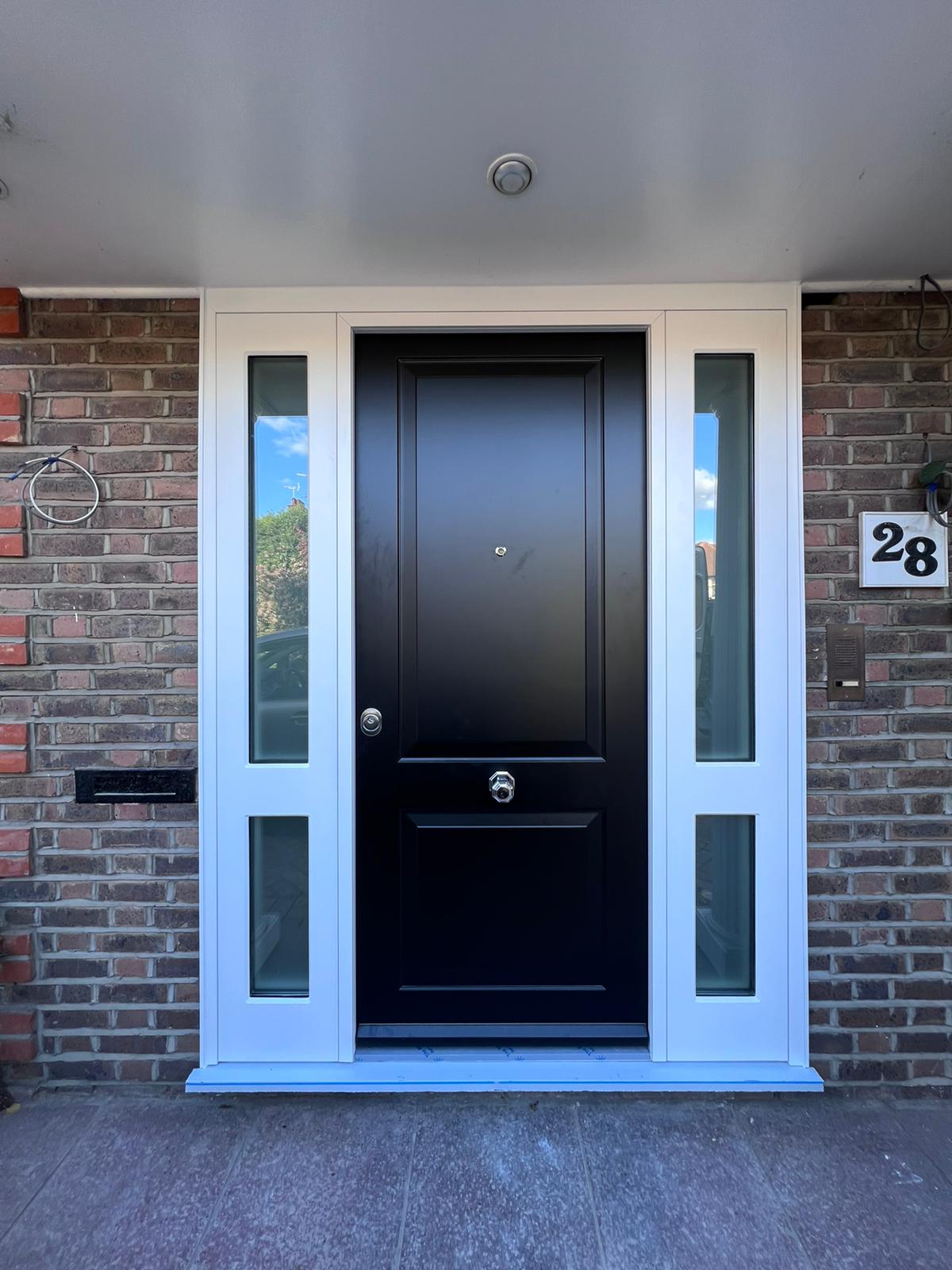
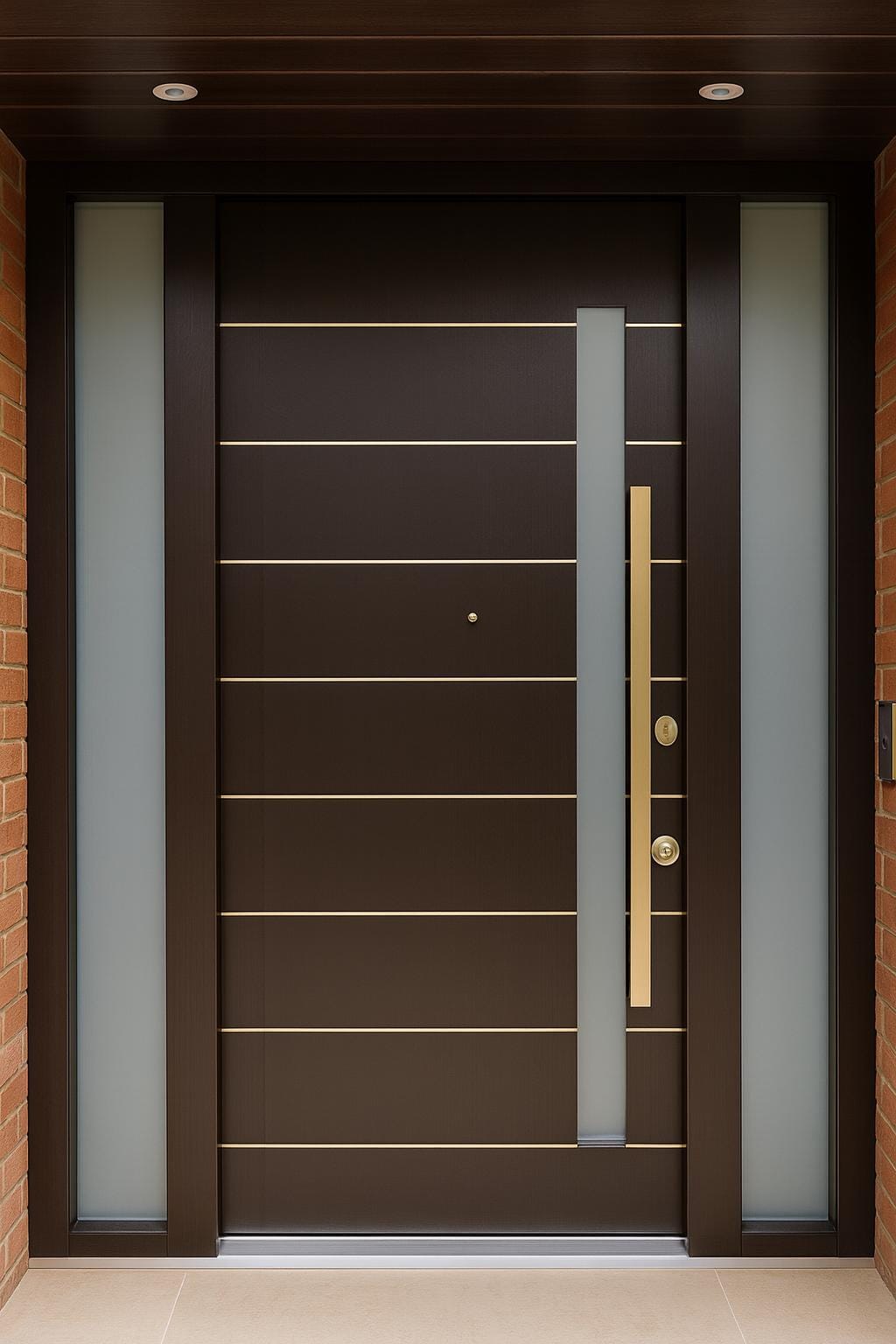
- Contemporary, clean lines, flush panels, horizontal slots, bar handles
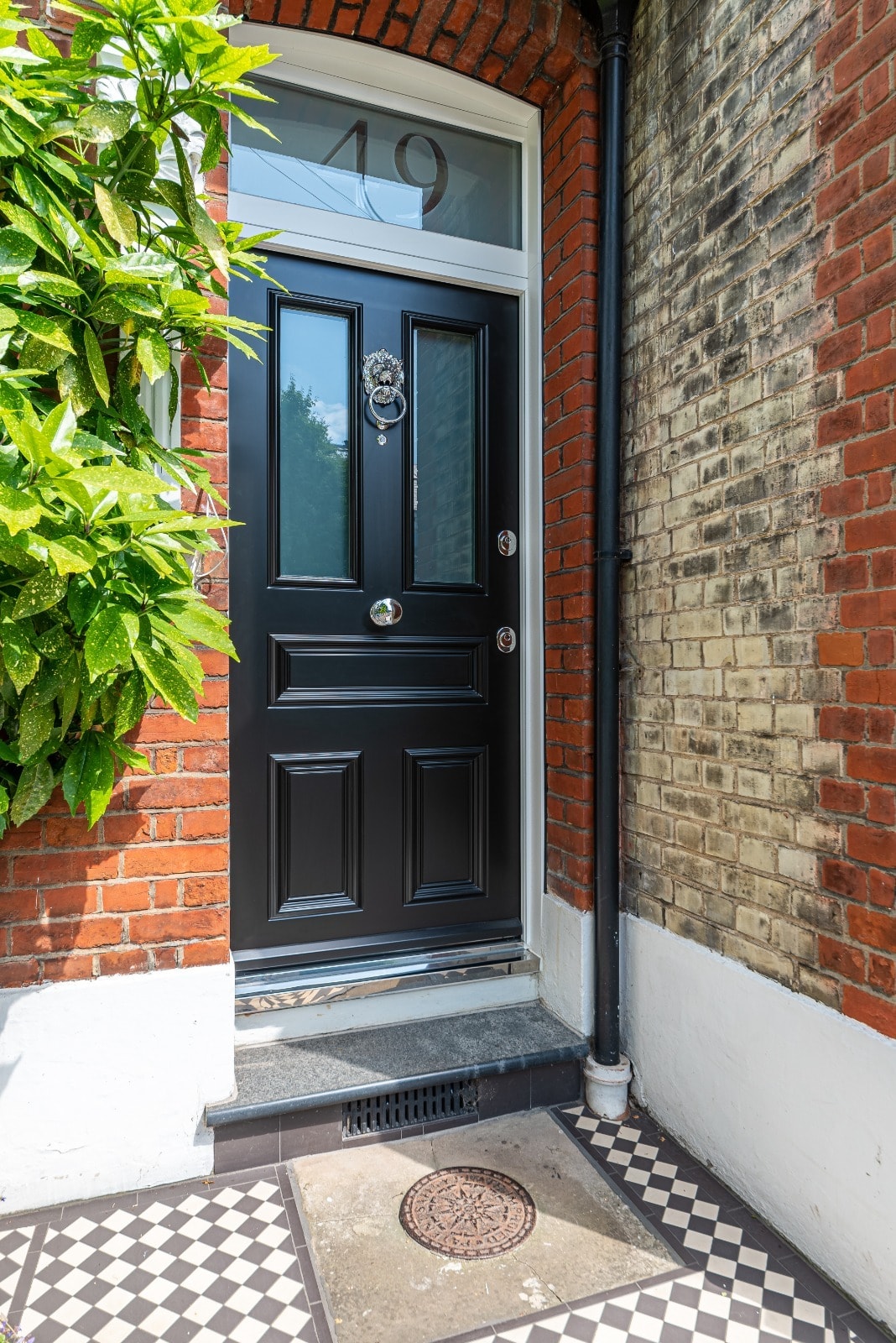
- Traditional, raised panels, fanlights, period-appropriate hardware
- Ornate, decorative medallions, lion head knockers, fluted columns, Art Deco motifs
- Heritage, faithful replication of Georgian, Victorian and Edwardian designs
Every design is manufactured bespoke. If you can draw it, we can build it. There are no catalogue constraints.
Addressing Common Concerns
Do Steel Doors Rust?
No, not if they are properly manufactured and finished. Our doors are constructed from galvanised steel (zinc-coated to prevent oxidation) and finished with a multi-stage powder-coat process:
1. Chemical pre-treatment, phosphate conversion coating for adhesion and corrosion resistance 2. Zinc primer, additional corrosion barrier on all surfaces 3. Powder-coat top coat, electrostatically applied and oven-cured at approximately 200°C
The resulting finish is equivalent to automotive-grade corrosion protection. The powder coat acts as a complete barrier between the steel and the environment. Even in coastal locations with salt-laden air, a properly finished steel door will not rust.
If the powder coat is damaged, by a sharp impact, for instance, the galvanised layer beneath provides secondary protection. Any localised damage can be touched up with matching paint to restore the barrier.
Are Steel Doors Heavy?
Yes, steel doors are heavier than composite or uPVC alternatives, typically 60 to 100kg for a single leaf depending on specification. However, this is managed through:
- Heavy-duty hinges, rated for the door weight with significant margin
- Concealed closers (if specified), hydraulic mechanisms calibrated to the door mass
- Proper installation, professional fitting ensures the door hangs correctly and moves freely
In practice, a well-hung steel door opens and closes with smooth, controlled precision. The weight is actually a positive, it contributes to security (a heavier door is harder to force), sound insulation, and the premium feel that distinguishes steel from lighter alternatives. There is a tangible quality to closing a steel door that a composite or uPVC door simply cannot replicate.
Do Steel Doors Dent?
Steel can dent if struck with significant force by a hard object. However, the steel gauges used in entrance doors, typically 1.2 to 2.0mm, are substantially more resistant to impact than the GRP skins on composite doors (which can crack, chip or puncture) or the thin aluminium skins on some premium alternatives.
In residential use, denting is extremely rare. The scenarios that would dent a steel door, a direct strike with a hammer or heavy tool, would destroy a composite door entirely. For the small number of cases where cosmetic damage does occur, steel can be repaired and refinished. A cracked GRP skin cannot.
Are They Noisy in the Rain?
This is a myth from the era of single-skin steel doors used in commercial and industrial applications. Modern residential steel doors use insulated dual-skin construction, two steel skins separated by a dense insulating core. This construction provides excellent sound insulation. Rain noise on a thermally broken steel door is no different from rain noise on a timber or composite door.
Will They Look Out of Place on My Property?
Only if the design is wrong for the property, which applies equally to composite, timber or any other material. A bespoke steel door designed with sensitivity to the architectural context (correct proportions, appropriate panel layout, period-sympathetic hardware, heritage-appropriate colour) is indistinguishable from a premium timber door at normal viewing distance.
Conservation officers across the UK routinely approve steel doors for listed buildings and conservation areas because the assessment is based on external appearance, not material composition. If a conservation officer cannot tell it is steel, neither will anyone else.
When Steel Might Not Be the Right Choice
We believe in honest advice. Steel entrance doors are not the right choice for every situation:
- Tight budgets, if your budget is under £2,500, a quality composite door may deliver better value than a compromised steel door
- Temporary situations, if you are planning to sell within 1 to 2 years, the ROI calculation changes. A good composite door at half the price might be the pragmatic choice
- DIY installation, steel doors are heavy and require precision installation. If professional fitting is not an option, a lighter door material is safer
- Specific planning restrictions, rare, but some conservation areas or listed building consents may specifically require timber. In most cases, steel that replicates timber appearance is acceptable, but check first
For everyone else, homeowners who value security, durability, zero maintenance and long-term value, steel is the strongest choice in every sense of the word. For a fuller overview of what made-to-measure steel actually involves, see our bespoke steel front doors UK guide.
Making the Decision
If you are considering a steel entrance door, the best next step is a conversation. SteelR offers free consultations with no obligation, we will discuss your property, your requirements and your budget honestly. Use our contact our team to start the process, browse our collection for design inspiration, or call us directly on 0800 861 1450.
Frequently Asked Questions
How long do steel entrance doors actually last?
A properly manufactured and installed steel entrance door will last 25 to 40+ years with no structural maintenance. The powder-coat finish is warranted for the life of the product. The steel structure itself is essentially permanent, it does not rot, warp, swell or delaminate. The limiting factor is typically fashion rather than function; many homeowners replace doors for aesthetic reasons long before the door itself has deteriorated.
Are steel doors more secure than composite doors?
Significantly. Our steel doors are BS EN 1627:2011 RC4 certified as Standard (the European framework for sustained forced-entry resistance, certified against heavy-duty hand tools and battery-operated power tools), with the LPS 1175 SR3 Enhanced upgrade available. Most composite doors achieve PAS 24 (3-minute resistance to basic hand tools) or SR1 at best. The steel frame, welded locking points and laminated security glazing create a doorset that resists forced entry at a fundamentally different level to composite, timber or uPVC alternatives.
Do steel doors need painting or maintaining?
No. The factory-applied powder-coat finish requires no painting, varnishing, oiling or sanding, ever. The only maintenance is occasional cleaning with warm soapy water. This is one of the most significant practical advantages over timber doors, which require repainting every 3 to 5 years, and composite doors, which can fade or discolour over time.
Will a steel door make my house colder?
No. Modern steel doors use thermal break construction with an insulated core, achieving U-values of 1.0 to 1.8 W/m²K, comparable to double-glazed windows and better than many older timber doors. Combined with effective draught seals and an insulated threshold, a steel door improves thermal comfort compared to most doors it replaces.
Can I get a steel door in any colour?
Yes. We offer over 200 RAL colours as standard, plus custom colour matching to any reference including Farrow & Ball, Little Greene and heritage specifications. Dual-colour finishing allows different colours on the exterior and interior faces. Browse the full range on our RAL colours page.