
What insurers typically specify at the front door

When a UK private-client home insurer specifies a minimum security standard at the front door of a high-value residential property, they are typically asking for LPS 1175 SR3 (the LPCB police-preferred Enhanced upgrade) with Secured by Design accreditation, an FD30S fire and smoke rating, and PAS 24:2022 baseline certification. SteelR carries PAS 24, BS EN 1627:2011 RC4 single leaf, unglazed, Secured by Design and FD30S as standard on every door, with LPS 1175 SR3 (Enhanced), LPS 1175 SR4 D10 Issue 8 (Commercial-grade) and LPS 1673 attack-resistance (Ultra-high, by enquiry) available as upgrades. Every certification is independently verifiable on public registers the manufacturer does not control. Every SteelR installation carries an insurance-backed guarantee arranged through the Consumer Protection Association, an FCA-regulated scheme.

Insurance-Approved Steel Front Doors

Insurance-Approved Steel Front Doors for High Net Worth UK Homes

For HNW homeowners, brokers and underwriting referrals

What a UK home insurer is actually asking for when they specify the front door on a high-value property

UK home insurance for high net worth and ultra high net worth households differs structurally from standard personal-lines cover. Sum-insured limits are higher, the schedule of valuable articles is itemised, and the underwriter often warrants minimum security specifications on the property as a condition of binding the cover. The front door is the most frequent warranty-triggered specification: it is the primary physical security boundary, it is what loss-adjusters inspect first after a forced-entry claim, and it is the single item on a property where independent certification is both available and straightforward to verify.

This page explains what UK private-client home insurance underwriters typically reference at the front door, how SteelR's four-tier security ladder maps to those references, and how the chain of certifications and supplier-stability cover can be verified by the underwriter, the broker or the loss-adjuster against independent public records. No insurer is named on this page, no promised premium reduction is quoted, and no third-party endorsement is implied. The information below is the certification framework itself; whether your specific policy treats it as material is a conversation with your broker against the certification references for the door class fitted.

The certifications underwriters reference

LPS 1175, BS EN 1627, Secured by Design, PAS 24 and FD30S, in plain English

Five certifications recur in UK home insurance surveyor reports and broker submissions for high net worth residential risk. LPS 1175 (the Loss Prevention Certification Board scheme, operated by BRE Global, UKAS-accredited) certifies the complete door assembly against a sustained forced-entry attack by a trained tester. Security Rating 3 (SR3) is the LPCB police-preferred Enhanced specification. Security Rating 4 (SR4, D10 Issue 8) is the Commercial-grade certification used on data centres, bank vaults and high-risk commercial premises, available as an upgrade on residential specification. BS EN 1627:2011 RC4 is the European framework for sustained forced-entry resistance, single leaf, unglazed, and is SteelR's Standard residential specification.
Secured by Design is the UK police-preferred accreditation scheme operated by Police Crime Prevention Initiatives. It certifies the complete product family (frame, leaf, locking mechanism, hardware) against an audited specification rather than just a single test. PAS 24:2022 is the UK security baseline required by Approved Document Q of the Building Regulations for new-build dwellings, and is the floor that any compliant front door must meet. FD30S is the 30-minute fire and smoke rating referenced under Approved Document B, the Fire Safety Act 2021 and the Building Safety Act 2022. SteelR carries all five as standard on every door, with the SR3, SR4 and LPS 1673 tiers available as upgrades. For the full standards detail see the security specification page.

What this page is not

A front entrance specification, not a whole-property security audit
This page covers the front entrance door specifically. It does not cover safe rooms or vault rooms inside the property. Those are a related but separate specification, typically commissioned where the underwriter has warranted a fortified secure space for high-value items, fine art, jewellery scheduled at agreed value, or where the household threat profile justifies a retreat space. SteelR manufactures bespoke front entrance doors. Where a whole-property safe-room programme is in scope, that requires a different specialist and a different product family.
Equally, this page does not address shutter systems, window bar specifications, perimeter intrusion detection, or contents-grade safes. Those each involve a different certification framework. The front entrance is the single specification SteelR certifies, and it is the layer most commonly warranted in HNW residential policy schedules. For broader perimeter specifications, engage a property security consultant alongside the front-door installation.
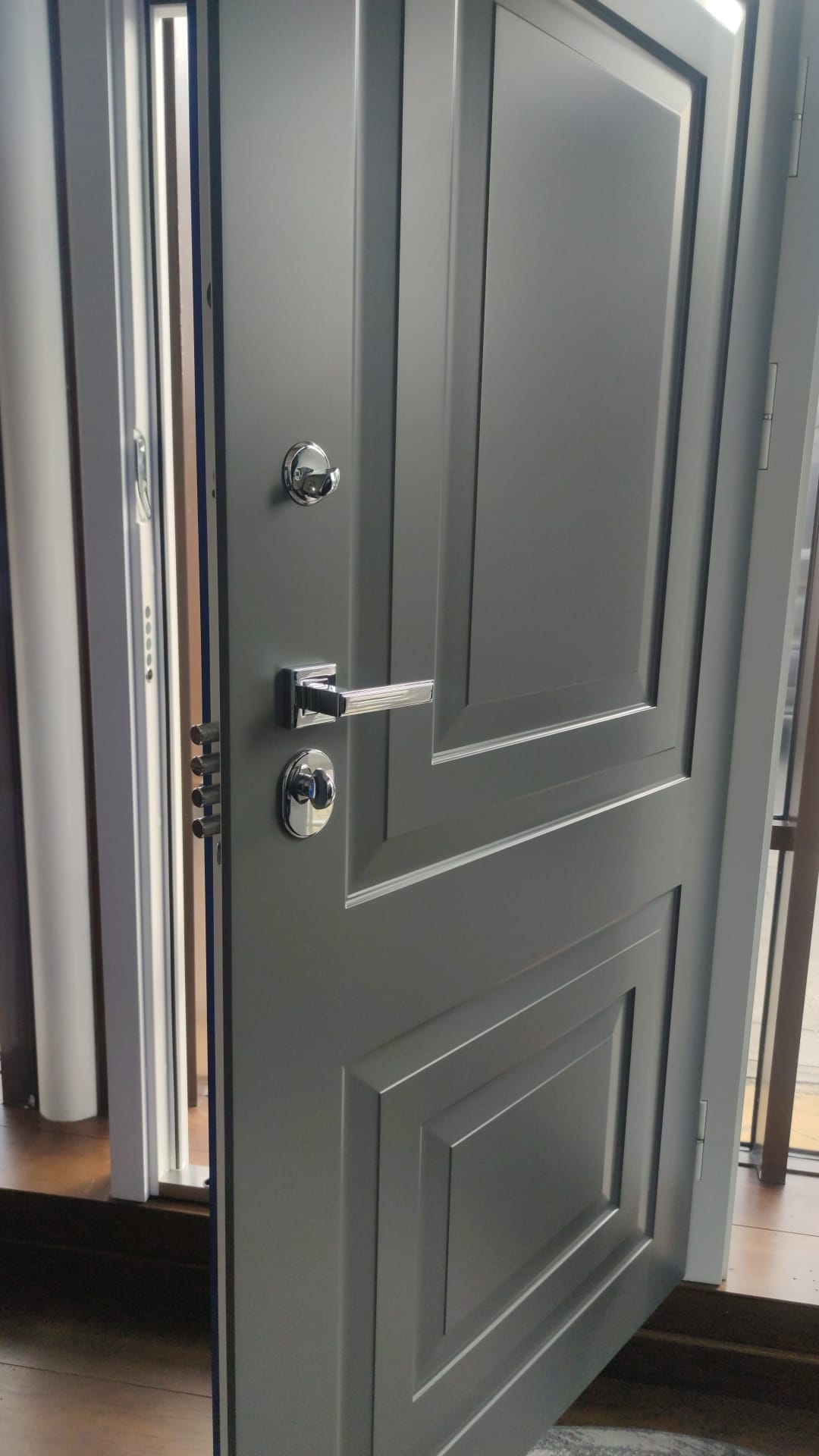
Multi-point chrome locking mechanism on an insurance-specified steel front door

The four-tier ladder mapped to property profile

Standard, Enhanced, Commercial-grade, Ultra-high. Two independent triggers for upgrade

There is no industry-issued matrix that ties a property sum-insured to a specific security tier. Underwriting decisions are policy-by-policy and are influenced by the schedule of valuable articles, the location, the surveyor's report, the claims-history of the postcode, and the threat profile of the household. The bands below describe the pattern SteelR sees most often referenced by brokers on private-client home insurance instructions, not an industry rule. Treat them as a conversation-starter with your broker, not a binding tier.
Two independent triggers move a household up the ladder. The first is sum-insured: the Standard tier (PAS 24 plus BS EN 1627 RC4 plus Secured by Design plus FD30S) is commonly sufficient up to the lower-mid HNW range; LPS 1175 SR3 Enhanced is the middle-tier reference; LPS 1175 SR4 Commercial-grade comes in at the upper end. The second trigger is threat profile, independent of sum-insured. An executive, public-figure, heritage-asset or threat-assessed referral may call for SR4 or LPS 1673 even at a lower sum-insured. The two triggers are not the same conversation. More detail on the upgrade tiers sits on the SR3 page, the SR4 page and the LPS 1673 page. The four-tier ladder explained end to end is on the security page.

How an underwriter verifies the specification

Independent public records, not a vendor-controlled document

Every certification on a SteelR door is held by an independent certification body and listed on a public register the underwriter can query without involving SteelR. LPS 1175 SR3 and SR4 certifications are listed on the LPCB Red Book, searchable by manufacturer, product family and class. Secured by Design accreditation is listed on the SBD public member directory. ISO 9001 UK manufacturing is listed on the BSI public register. The Consumer Protection Association, the scheme behind the insurance-backed guarantee on every SteelR installation, is an appointed representative of CPA Consumer Guard Ltd, authorised and regulated by the Financial Conduct Authority and listed on the FCA register.
The structural advantage for the underwriter is that each link in the certification chain can be verified against records SteelR does not control. Cover bound against the door references those records directly, not a vendor-controlled document the manufacturer could in principle revise. The chain is built to survive loss-adjuster scrutiny at claim time without relying on supplier-side paperwork. On request, the SteelR design team supplies the LPCB certificate references for the specific class fitted to your door, the SBD reference for the product family, and the insurance certificate reference for the IBG once registered after installation completion.
  • LPCB Red Book at redbooklive.com. Search by manufacturer, product family or LPS 1175 class
  • Secured by Design member directory at securedbydesign.com. Search by company
  • BSI public register at bsigroup.com. ISO 9001 and other certified UK manufacturing
  • FCA register at register.fca.org.uk. Lookup for CPA Consumer Guard Ltd, the entity behind the CPA insurance-backed guarantee

Supplier-stability cover

The CPA insurance-backed guarantee, FCA-regulated

SteelR is a member of the Consumer Protection Association, the UK home-improvement trade body authorised and regulated by the Financial Conduct Authority. Every SteelR installation carries an insurance-backed guarantee arranged through the CPA scheme. The IBG provides cover for the manufacturer's written guarantee period, underwritten by an authorised insurer. If the installer ceases to trade during the guarantee term, the IBG steps into the original guarantee terms so the householder is not exposed to a counterparty-failure outcome on a long-tail warranty.
For UK private-client home insurance underwriters, this answers the supplier-stability question on the installer counterparty. The IBG is an FCA-regulated scheme rather than a single-company commitment, and CPA Consumer Guard Ltd is listed on the FCA public register where its authorisation status can be verified independently. The IBG insurance certificate is registered after installation completion and supplied to the householder for the policy file, on request to the broker for inclusion in the schedule.

At claim time

The chain of records the loss-adjuster verifies

If a forced-entry claim arises on the property, the loss-adjuster typically asks for three things at the front door. First, the class of LPCB certification fitted, confirmable against the LPCB Red Book entry for the SteelR product family and the design records for the specific door. Second, the Secured by Design accreditation, confirmable against the SBD public member directory. Third, the IBG status, confirmable against the policyholder's registered insurance certificate and the FCA register entry for CPA Consumer Guard Ltd.
Each link is verifiable against an independent record. The loss-adjuster does not need a single vendor-controlled document to substantiate the specification fitted to the door at the time of the claim. That is the structural difference between a documented specification and an undocumented one, and the difference SteelR is built around at the installation-record level. The design and survey team supplies on request the LPCB certificate references and product-family reference numbers that match the specific door installed at the property.

Why this matters for the broker conversation

Removing the warranty as a binding-stage blocker

The most frequent failure mode at the underwriting referral stage is not the door, it is the audit trail. An underwriter cannot bind cover against a door whose certification cannot be produced on demand. A property warranty written into the policy schedule becomes a coverage gap if a forced-entry claim arises and the door lacks the referenced certification. The chain of independent records on a SteelR door is built to close that audit-trail gap end to end, in a form the underwriter and the loss-adjuster can both verify against LPCB, SBD, BSI and FCA public records.
For the broker, this turns the front-door warranty from a friction point in the binding conversation into an evidenced specification on the schedule. For the homeowner, it turns the front door from a cover-condition into a fitted asset whose specification and supplier-stability cover are independently verifiable. For the underwriter, it turns a property risk into a documentable referral without requiring an additional surveyor visit. None of these are claims about premium reduction; they are claims about removing the most common procedural blocker between an HNW household and the cover they already want to buy.

Common Questions

Frequently asked questions

What does insurance-approved actually mean on a UK steel front door?

There is no single regulator-issued mark called insurance-approved on UK home insurance policy schedules. In practice the term refers to the underlying certifications a UK home insurer treats as evidence that the door meets a sustained forced-entry resistance standard. The benchmarks most commonly referenced by UK private-client home insurance underwriters are LPS 1175 SR3 (the LPCB police-preferred Enhanced specification), BS EN 1627:2011 RC4 single leaf, unglazed (the European framework for sustained forced-entry resistance), Secured by Design accreditation (UK police-preferred), and PAS 24:2022 as the Approved Document Q baseline. SteelR's standard residential specification carries PAS 24, RC4, SBD and FD30S as standard, with LPS 1175 SR3 (Enhanced upgrade), LPS 1175 SR4 D10 Issue 8 (Commercial-grade upgrade) and LPS 1673 attack-resistance (Ultra-high, by enquiry) available on every door.

Will an SR3 specification reduce my home insurance premium?

In most cases the answer is conditional on the underwriter. Named UK private-client home insurance underwriters and Lloyd's-syndicate-backed HNW schemes treat LPS 1175 SR3 with Secured by Design accreditation as a material reduction in forced-entry risk. The reduction usually appears either as a premium adjustment or, more often on a high-sum-insured personal-lines book, as the basis for binding cover that would otherwise be refused or subject to a property warranty. Confirm the position with your broker against the LPCB certification reference for the door class fitted.

Do I need SR4 for a five-million-pound-plus property?

Not automatically. Most named UK HNW underwriters accept LPS 1175 SR3 with Secured by Design at the front door as sufficient evidence at the £1M to £5M sum-insured tier on standard residential risk. SR4 (LPS 1175 D10 Issue 8, the Commercial-grade upgrade used in data centres and bank vaults) becomes the practical specification on two independent triggers. First, a household risk profile that the underwriter flags as elevated, such as an executive, public-figure or threat-assessed referral, independent of sum-insured. Second, a sum-insured tier above £10M where the surveyor's report requests commercial-grade certification. LPS 1673 attack-resistance is the next tier above SR4 and is available by enquiry where a documented threat assessment justifies the Ultra-high tier.

How does an underwriter verify the door specification independently?

Every certification on a SteelR door is held by an independent certification body and listed on a public register the underwriter can query without involving SteelR. LPS 1175 SR3 and SR4 certifications are listed on the LPCB Red Book at redbooklive.com, searchable by manufacturer, product and class. Secured by Design accreditation is listed on the SBD member directory at securedbydesign.com. ISO 9001 UK manufacturing is listed on the BSI public register at bsigroup.com. The insurance-backed guarantee carried on every SteelR door is arranged through the Consumer Protection Association, an appointed representative of CPA Consumer Guard Ltd, authorised and regulated by the Financial Conduct Authority and listed on the FCA register at register.fca.org.uk. The underwriter, broker or loss-adjuster can verify the chain end to end against records SteelR does not control.

What is the typical lead time when an insurer-stipulated installation is in scope?

Standard lead time is eight to twelve weeks from initial brief through survey, design, manufacture and installation. Where a binding underwriting referral is the driver and a cover note is contingent on the door being in place by a specific date, accelerated programmes can sometimes be accommodated. The accelerated path requires the specification to be set during the design consultation rather than at the survey, and is subject to operational capacity in the factory at the time of booking. Discuss the underwriting timeline with the design team at first contact so the programme can be planned against the cover-note deadline.

Is SteelR the right fit

Worth considering SteelR if

  • Your underwriter has warranted a minimum-security specification at the front door as a condition of binding cover
  • Your broker has flagged LPS 1175 SR3, BS EN 1627 RC4 or Secured by Design as the specification threshold for the policy
  • Your sum-insured sits in the HNW or UHNW range and a private-client scheme is in place or being placed
  • Your household risk profile (executive, public-figure, threat-assessed) calls for SR4 Commercial-grade or LPS 1673 attack-resistance, independent of sum-insured
  • You want every certification on the installed door to be independently verifiable from LPCB, SBD and BSI public records, plus FCA-regulated supplier-stability cover through the Consumer Protection Association
PAS 24 CertifiedBS EN 1627 RC4 StandardLPS 1175 SR3 / SR4 AvailableLPS 1673 on EnquirySecured by DesignFD30S / FD60 Fire RatedISO 9001 + ISO 14001Made in Britain

Bespoke · UK manufactured · BS EN 1627 RC4 · LPS 1175 SR3 / SR4 available

Enquire about a bespoke SteelR door for Insurance-Approved Steel Front Doors

Free consultation with our design team. No obligation. Every door is manufactured in the UK to your specification. Standard residential spec is BS EN 1627:2011 RC4 single leaf, unglazed. LPS 1175 SR3 and SR4 enhanced and commercial-grade certifications are available on request, with LPS 1673 attack-resistance by enquiry. Installed by our in-house fitters.

Call us
0800 861 1450
BS EN 1627 RC4 standard · LPS 1175 SR3 / SR4 available · PAS 24 · Secured by Design · UK manufactured · 10-year guarantee

Or request a call-back

No obligation. We respond within 24 hours, weekdays.

Specify against the standards your underwriter references

Request a Consultation