Two Premium Materials, One Important Decision
When homeowners move beyond timber and composite and start looking at premium entrance door materials, the choice usually comes down to two options: steel and aluminium. Both are metals, both are used in high-end residential doors, and both outperform timber and composite in several key areas.
But they are not interchangeable. Steel and aluminium have fundamentally different characteristics, and the right choice depends on your priorities. This guide provides an honest, side-by-side comparison to help you decide.
Security: Steel Wins Decisively
This is the area where the difference between steel and aluminium is most significant.
Steel entrance doors can achieve LPS 1175 SR3 ratings, the LPCB police-preferred specification for sustained forced-entry resistance. SR3 testing subjects the door to a five-minute attack using professional-grade tools including crowbars, drills and angle grinders. The inherent strength of steel makes it possible to achieve this level of resistance without excessive thickness or weight. Every SteelR door ships with BS EN 1627:2011 RC4 as Standard, with LPS 1175 SR3 available as the Enhanced upgrade tier and SR4 as the Commercial-grade upgrade tier.
Aluminium doors are typically tested to PAS 24 or, at best, SR2 (RC2). Aluminium is a softer, less dense metal than steel, which means it deforms more easily under concentrated force. Achieving SR3 with aluminium requires significantly thicker profiles and additional reinforcement, which most residential aluminium door manufacturers do not offer.
For homeowners in high-value properties, whether in Buckinghamshire or Kent, the security difference is a primary consideration.
Thermal Performance: Both Perform Well
Modern steel and aluminium doors both use thermal break technology to prevent cold bridging through the metal frame. The thermal break, typically a polyamide or polyurethane barrier, separates the inner and outer metal skins and provides insulation.
Steel doors with an insulated core achieve U-values typically from 1.5 W/m2K for a solid panel door, with thermal-upgrade specifications achieving as low as 0.8 W/m2K. Aluminium doors with a similar thermal break system achieve comparable U-values, typically in the range of 1.0 to 1.4 W/m2K.
In practice, the thermal performance difference between the two is marginal. Both significantly outperform timber and composite doors, and both comfortably meet the requirements of Approved Document L for new dwellings.
The key differentiator is long-term consistency. A steel door's thermal performance remains constant because the door does not warp or move over time. With aluminium, thermal performance can be affected if the door profile distorts under sustained load or extreme temperature changes.
Weight: Aluminium Is Lighter
This is aluminium's clearest advantage. Aluminium is approximately one-third the weight of steel, which means aluminium doors are lighter to handle, easier to operate and place less stress on hinges and frames.
For very large door configurations, double doors with full-height sidelights, for example, the weight difference can be meaningful. Heavy steel doors require robust, heavy-duty hinges and careful engineering to ensure smooth, long-term operation. A reputable manufacturer will spec these correctly, but it is a factor to be aware of.
That said, the weight of a steel door is also one of its strengths. The solid, substantial feel of a steel entrance door when you open and close it conveys quality and security in a way that a lighter aluminium door cannot replicate. Many homeowners consider this tactile quality an important part of the premium experience.
Design Flexibility: Both Offer Freedom
Both steel and aluminium can be manufactured to bespoke designs, but the range of achievable aesthetics differs slightly.
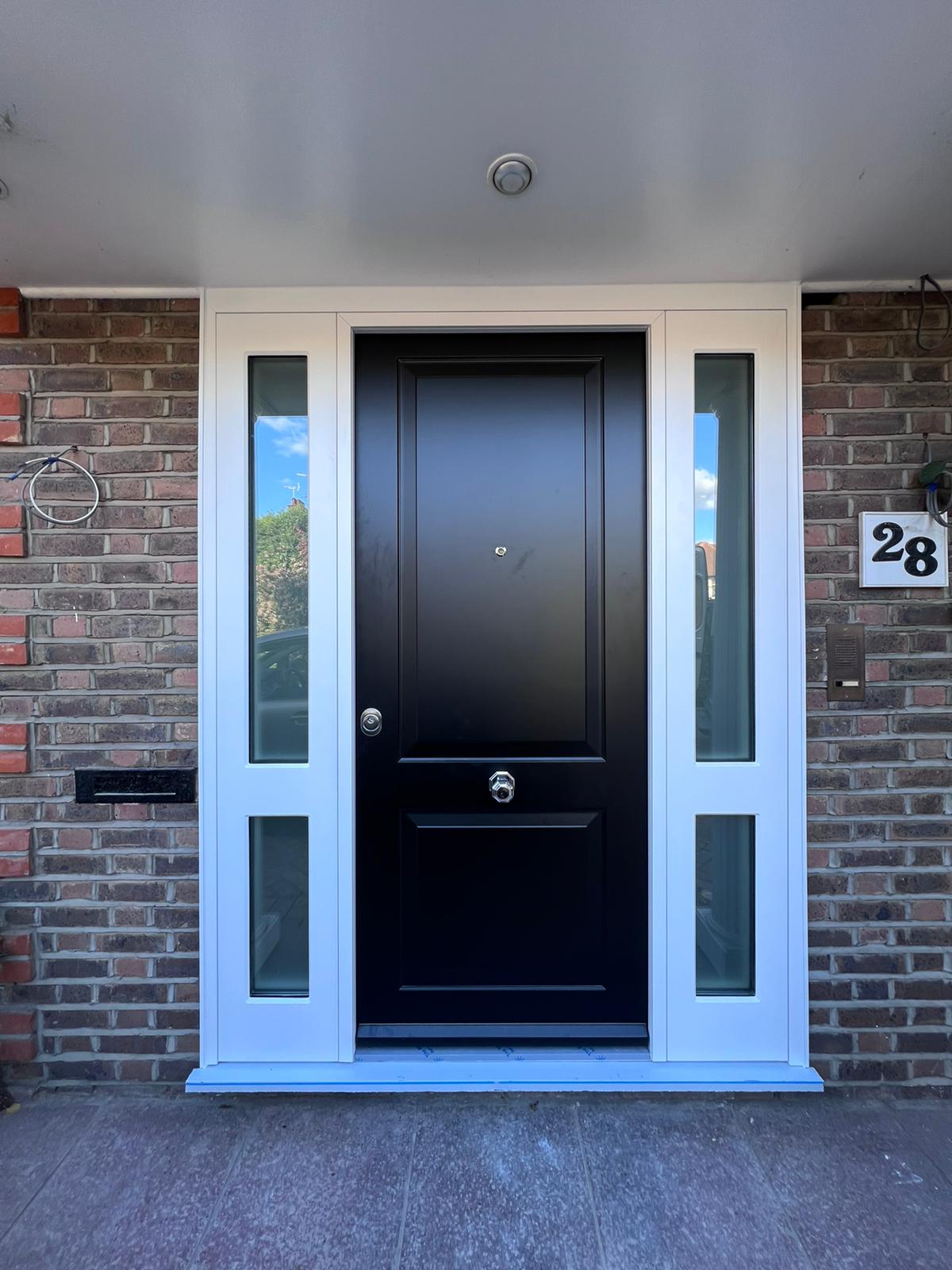
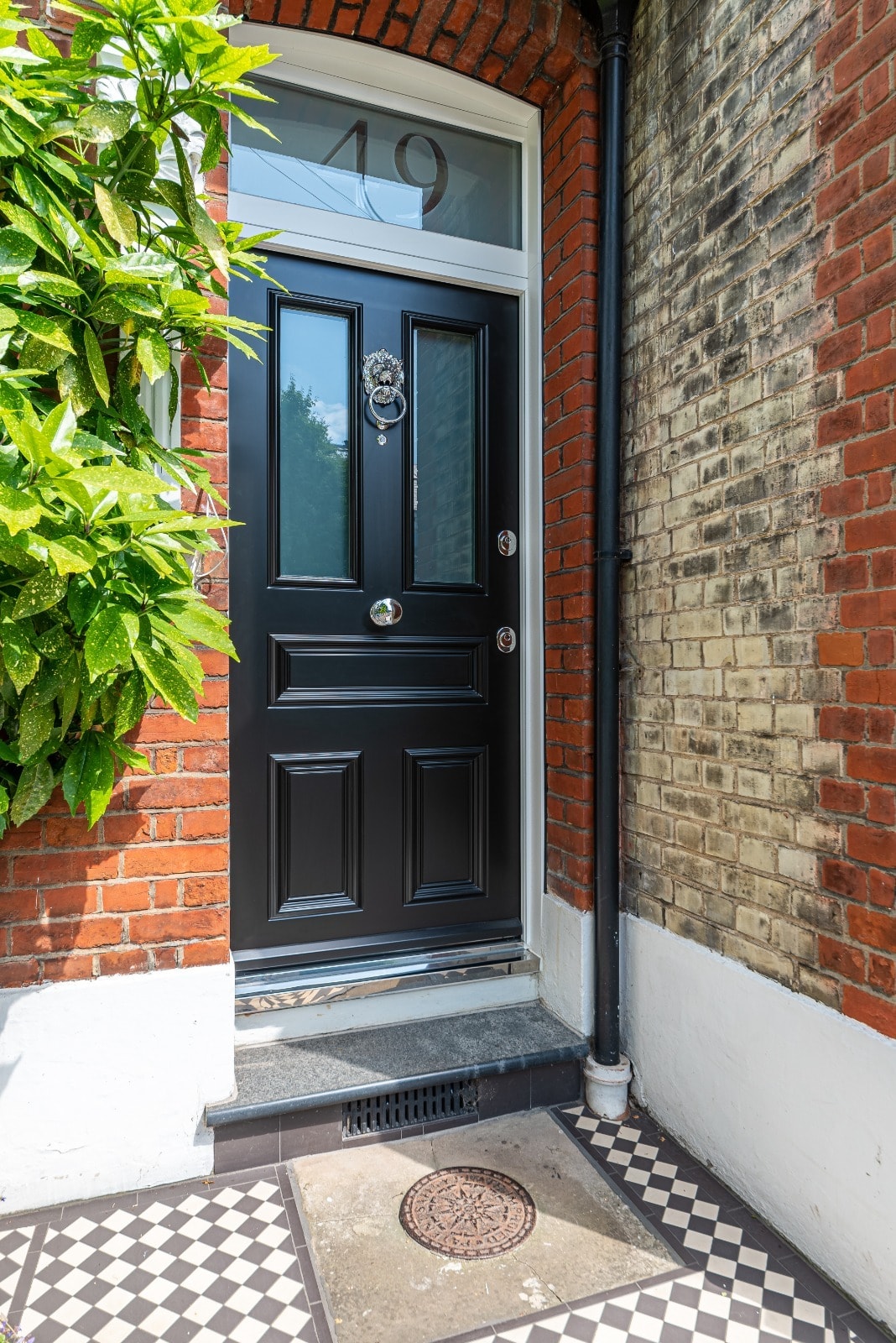
Steel doors excel at: - Traditional and period designs, Georgian panels, Victorian mouldings and ornate detailing are easier to achieve in steel - Decorative hardware, lion knockers, ring knockers and traditional ironmongery complement steel's substantial character - Bold, flat panel designs, steel holds a flat plane exceptionally well, creating crisp, architectural surfaces - Any RAL colour, over 200 options with dual-colour specification
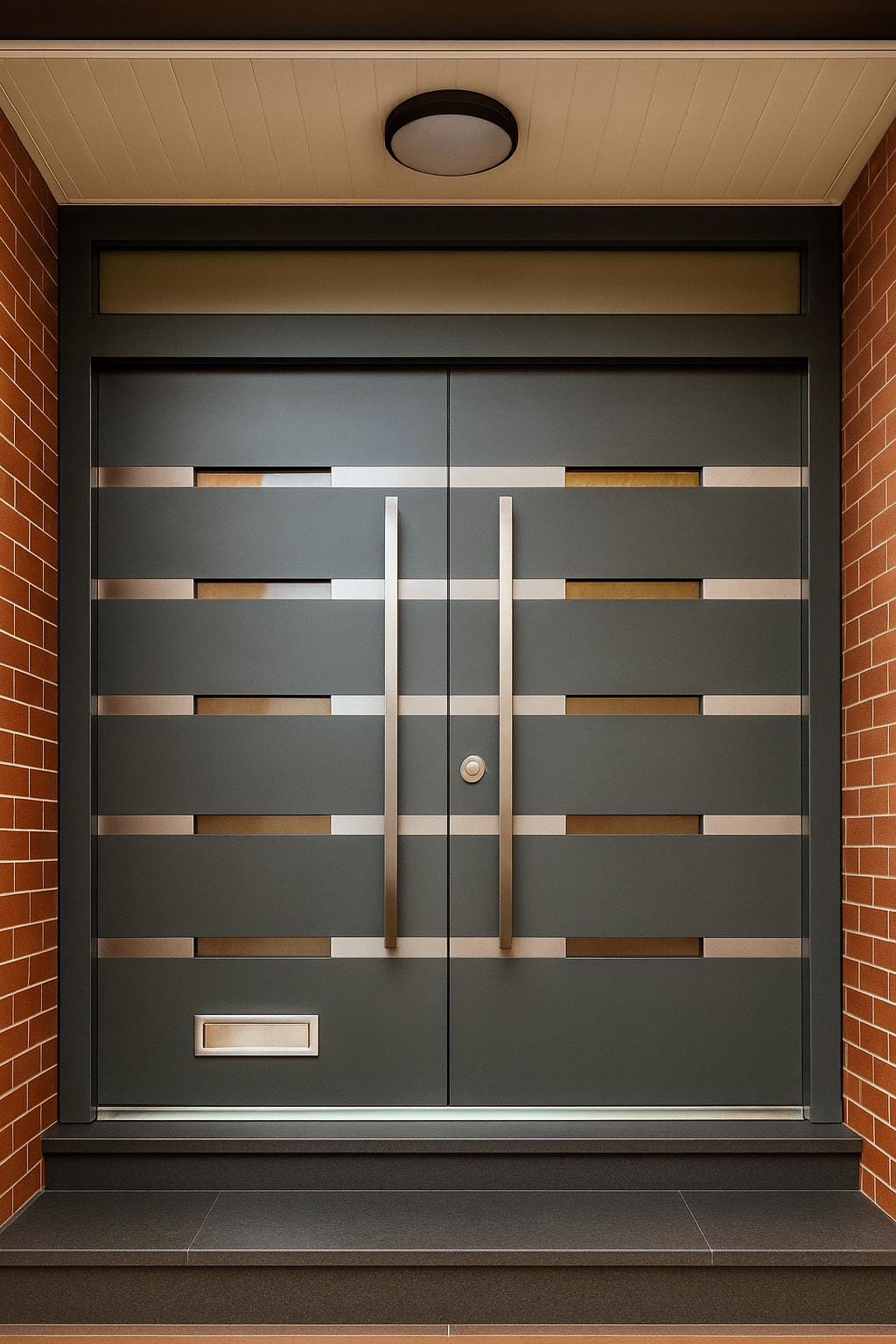
Aluminium doors excel at: - Ultra-slim sightlines, aluminium's strength-to-weight ratio allows thinner frame profiles, maximising glass area - Contemporary minimalist design, clean lines and slim profiles suit modern architectural language - Anodised finishes, aluminium can be anodised to create a distinctive metallic finish that is not available with steel - Very large glazed openings, the lighter weight makes floor-to-ceiling glazed entrances more practical
If your aesthetic leans traditional or you want a door with substantial panel detailing and period hardware, steel is the natural choice. If you want an ultra-contemporary door with maximum glass and minimal frame, aluminium may have the edge.
Longevity and Durability: Steel Has the Edge
Steel is inherently stronger and more resistant to deformation than aluminium. A well-manufactured steel door maintains its shape, alignment and performance for decades. The multi-layer paint system protects against corrosion, and the dimensional stability of steel means the door will not warp, bow or twist over time.
Aluminium is naturally corrosion-resistant due to its oxide layer, which is an advantage in coastal environments. However, aluminium is softer than steel and more susceptible to denting, scratching and surface damage from impact. Over time, aluminium profiles can also suffer from fatigue under repeated stress, particularly around hinge points and locking mechanisms.
For homeowners investing in a door they expect to last 30 years or more, steel's superior structural longevity is a compelling argument.
Cost: Comparable at the Premium End
At the premium, bespoke end of the market, steel and aluminium doors are broadly comparable in price. Both involve bespoke design, precision manufacturing and professional installation. The raw material cost of steel is lower than aluminium, but the additional weight of steel means slightly higher fabrication and installation costs.
The real cost difference often lies in what you get for your money:
- A premium steel door typically includes SR3 security, fire-rated construction, Secured by Design accreditation and heavy-duty multi-point locking as standard
- A premium aluminium door typically includes PAS 24 or SR2 security, thermal break profiles and contemporary hardware
When comparing like for like on security specification, a steel door offers more at the same or lower price point.
Corrosion Resistance: Context Matters
Aluminium has a natural advantage in corrosion resistance. Its oxide layer forms spontaneously and protects the surface without additional treatment. This makes aluminium a strong choice for coastal properties where salt spray is a constant concern.
Steel requires a protective paint system to prevent corrosion. Modern multi-layer coatings are extremely effective, a well-finished steel door will not corrode under normal conditions, but in highly exposed coastal locations, aluminium may have a practical advantage.
For the vast majority of UK properties, including those in London, the Home Counties and inland locations, corrosion is not a meaningful concern for either material when properly finished.
Which Should You Choose?
Choose aluminium if you want ultra-slim sightlines, maximum glass area, lighter weight for very large openings, or if your property is in a highly exposed coastal location.
Choose steel if you want LPCB-certified residential security (BS EN 1627 RC4 as Standard, with LPS 1175 SR3 Enhanced, SR4 Commercial-grade and LPS 1673 Ultra-high available as upgrades on every SteelR door), maximum durability, a substantial tactile quality, traditional or period design options, and a door that will hold its shape and performance for decades without compromise.
At SteelR, we manufacture bespoke steel entrance doors to BS EN 1627 RC4 as Standard, with LPS 1175 SR3 Enhanced upgrade and SR4 Commercial-grade upgrade available on every door. Every door Secured by Design accredited, ISO 9001 certified and designed to your exact specification. Explore our collection to see the range of designs available, or learn more about our approach. Contact us to discuss whether steel is the right choice for your home.
Frequently Asked Questions
Is steel or aluminium stronger for a front door?
Steel is materially stronger. SteelR doors are BS EN 1627 RC4 certified as Standard with LPS 1175 SR3 (five-minute resistance to power-tool attack) available as the Enhanced upgrade tier, while aluminium residential doors typically cap at PAS 24 (three-minute resistance to basic hand tools). For the same frame thickness, steel resists prying, drilling and cutting loads that aluminium cannot. Aluminium's advantages are elsewhere: slimmer sightlines and lighter weight, not structural strength.
Which has better thermal performance, steel or aluminium?
Both can achieve very similar U-values with a properly specified thermal break. Thermally broken steel doors reach 1.0 to 1.4 W/m²K; thermally broken aluminium doors reach 1.2 to 1.6 W/m²K. The thermal break (a non-conductive barrier between inner and outer skins) is the critical component in both. A door without a thermal break, in either material, will under-perform noticeably.
Is aluminium better for coastal or very exposed locations?
Aluminium has the edge in severe coastal exposure because it does not corrode even if the protective finish is breached. Galvanised steel with a powder coat is also highly corrosion-resistant, but if the finish is damaged on a coastal property, the underlying steel can oxidise over very long timeframes. For most UK locations this is a non-issue; for direct saltwater-spray locations it is worth considering.
Are aluminium front doors more expensive than steel?
Not necessarily. Premium aluminium systems (Cortizo, Schüco, Origin) at SR1/SR2 compete on price with mid-range steel doors. SR3-certified steel sits above SR1/SR2 aluminium on price because of the heavier construction and security testing. Like-for-like comparisons are rare because the two materials target slightly different specifications. Compare total installed cost with security rating, U-value and warranty tier made explicit.
Can I get a heritage or traditional design in aluminium?
Heritage replication in aluminium is improving (some manufacturers offer moulded panels), but steel is the default choice for period property replication because the structural reinforcement takes fine moulding detail without distortion. Panel-moulded aluminium looks right from a distance but shows its modern origins under close inspection. Steel, done well, matches historic timber proportions more convincingly.
Which material lasts longer in UK conditions?
Both have long service lives, but steel edges aluminium for long-term dimensional stability. Aluminium can develop minor distortion over 30+ years on very large panels due to thermal expansion. Steel with thermal breaks stays dimensionally stable indefinitely. For a main front door under 1m wide, both will outlast the homeowner. For oversized or double-width configurations, steel is the safer long-term choice. For a wider material comparison framework, see our steel front door vs composite hub page.