The Direction of Entrance Door Design in 2026
The front door has undergone a fundamental shift in status. What was once a functional necessity, something you walked through without thinking, has become one of the most considered architectural elements of a residential facade. In 2026, the entrance door is a design statement, a first impression and, increasingly, a reflection of how seriously a homeowner takes the intersection of aesthetics and performance.
The trends shaping entrance door design this year are defined by a tension between minimalism and drama, between restraint and bold self-expression. What unites them is a shared commitment to quality of execution. These are not trends driven by cost reduction or mass production, they are driven by homeowners, architects and designers who understand that the front door sets the tone for everything behind it.
The entrance door has become the most architecturally significant element of the residential facade, setting expectations for the entire property.
Here are twelve designs that define the direction of modern front doors in 2026.
1. Horizontal Ribbed Panels
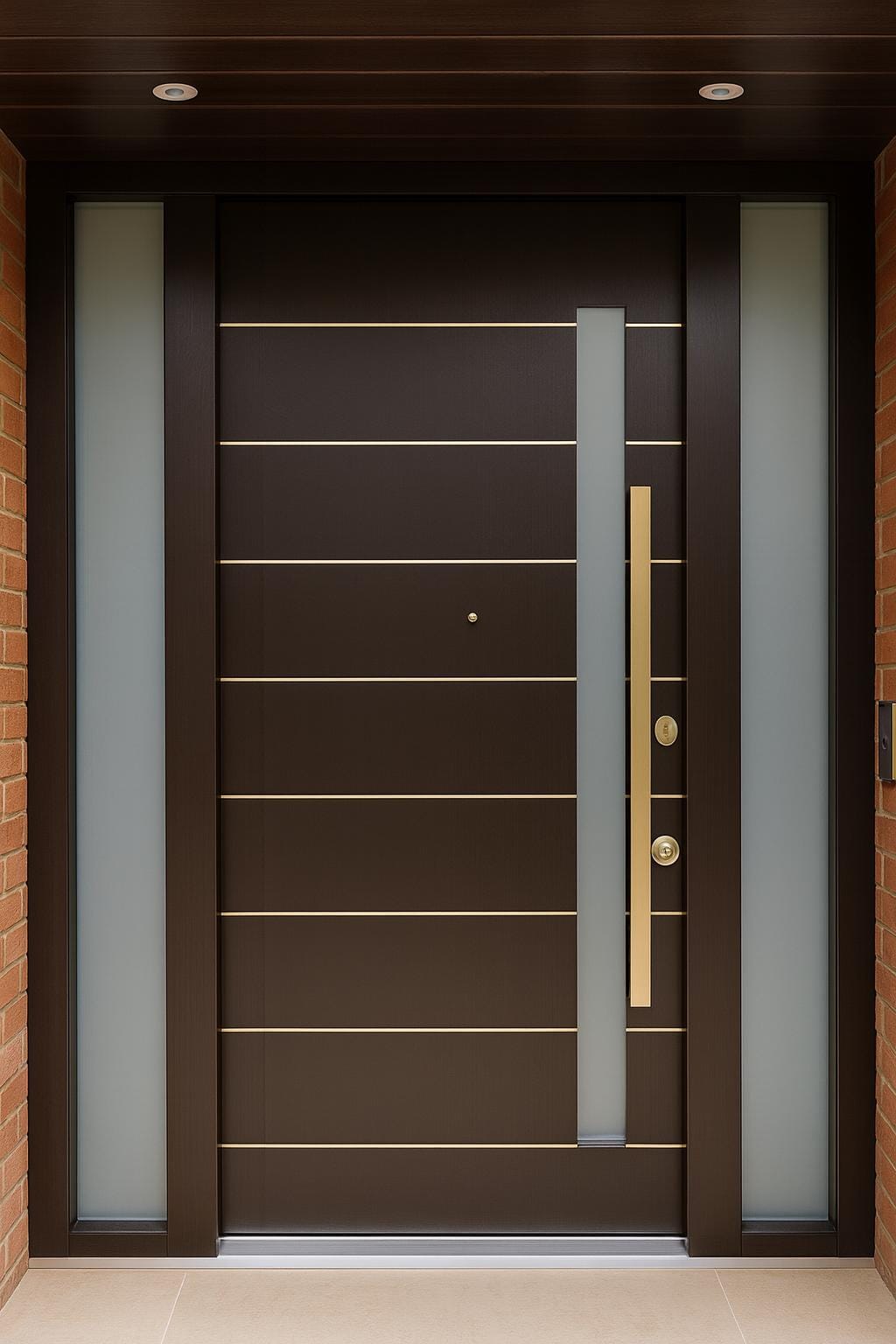
The most prominent surface treatment in contemporary door design. Horizontal ribbed panels, evenly spaced, precisely machined channels running across the full width of the door, create a strong visual rhythm that reads as both modern and tactile. The effect is architectural without being austere, adding depth and shadow play to a flat surface.
In steel, horizontal ribs are pressed or machined into the leaf with a precision that other materials cannot match. The uniformity of spacing and depth is absolute, creating the clean geometric pattern that defines the look. Pair with a minimal bar handle in brushed stainless steel for the definitive contemporary entrance. This design is particularly effective on properties across London and the urban centres of Manchester and Birmingham.
2. Oversized Pivot Doors
The pivot door replaces the conventional side-hung arrangement with a central or offset pivot mechanism that allows the door to rotate around a point within the leaf rather than from its edge. The result is a door that appears to float, opening with a theatrical sweep that conventional hinges cannot replicate.
Pivot mechanisms support significantly larger and heavier doors than standard hinges, making them the natural choice for oversized entrances. A steel pivot door at 2.5 metres tall and over a metre wide creates an entrance of genuine architectural presence. The engineering demands are considerable: the pivot must support the full weight of a steel leaf while maintaining smooth, effortless operation over decades.
3. Concealed Hinges
Where visible hinges once interrupted the plane of the door, concealed hinge systems now allow the door to sit flush with the frame on all sides. The hardware disappears entirely when the door is closed, presenting an unbroken surface that aligns perfectly with the minimalist aesthetic dominating contemporary architecture.
Concealed hinges also deliver a practical advantage: with no exposed hinge pins, there is no external hardware to attack. This makes concealed hinge doors inherently more resistant to hinge-side forced entry. Steel doors are ideally suited to concealed hinge systems because the material provides the structural rigidity needed to support the weight through fewer, internally mounted pivot points.
4. Flush-Face Designs
The flush-face door takes minimalism to its logical conclusion. No raised panels, no applied mouldings, no decorative elements, just a single flat plane of steel finished to perfection. The beauty of a flush door lies entirely in the precision of its manufacture and the quality of its finish. There is nowhere to hide imperfections.
This design demands the dimensional stability that only steel and aluminium can provide. A flush timber door will telegraph warping and movement within months. A flush steel door remains perfectly flat for the life of the building. The finish, whether matte, satin or textured powder coat, becomes the design itself.
5. Statement Colours
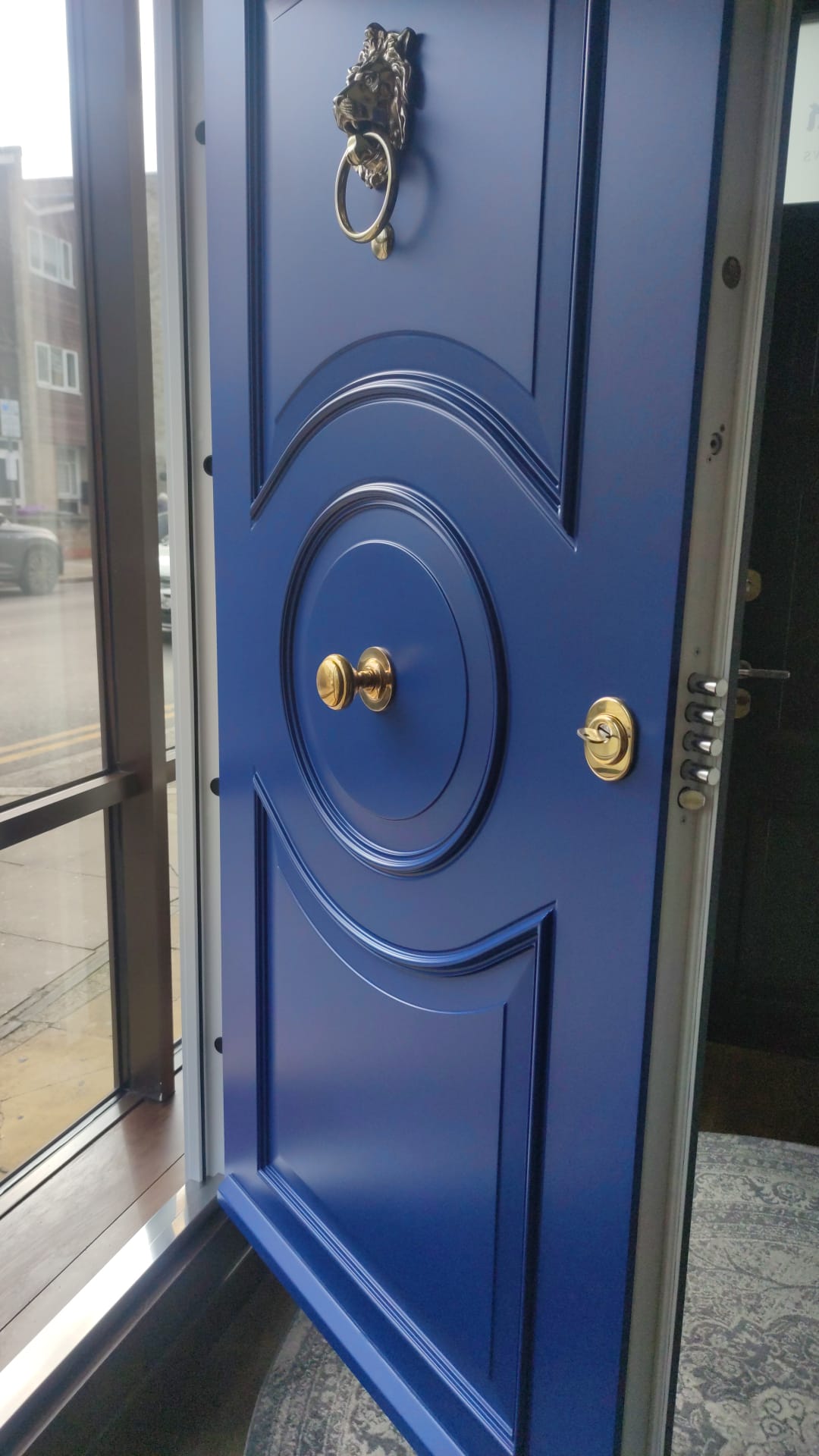
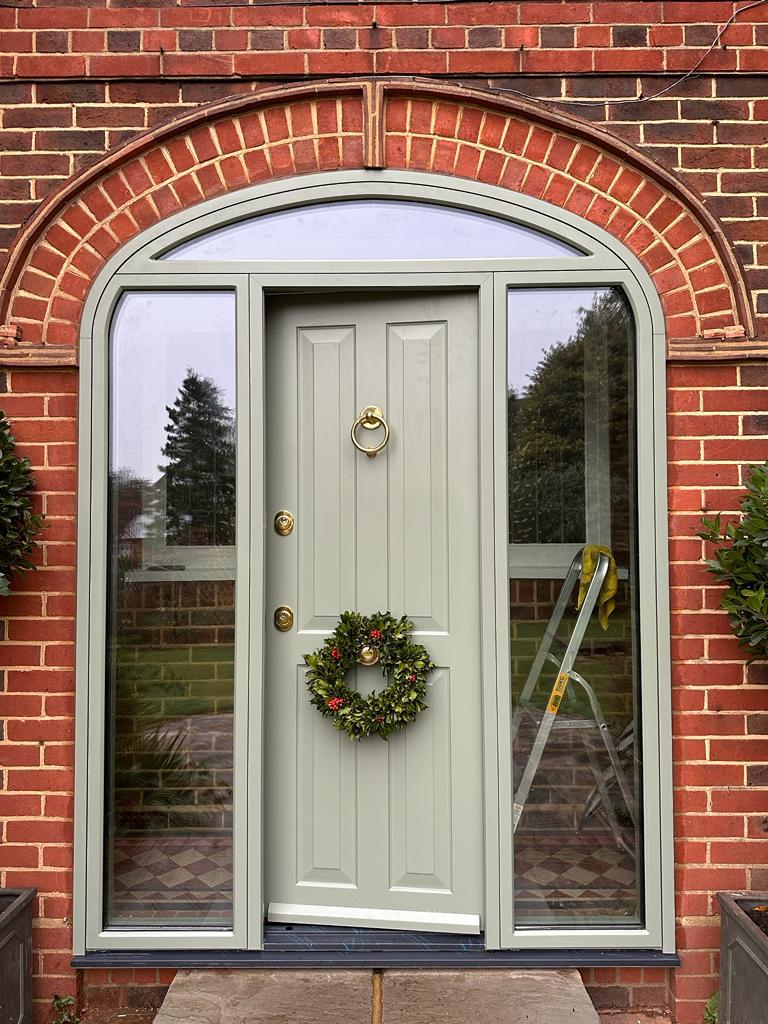
The era of playing it safe with black or white front doors is giving way to a more confident approach. Statement colours, bold ochres, rich terracottas, deep teals, forest greens and warm burgundies, are being used to create focal points on otherwise restrained facades. The front door becomes the accent colour in an architectural composition.
SteelR doors are finished with powder coating, which means the full RAL colour range, over 200 standard colours, is available without compromise. Explore the possibilities in our colour options to find the precise shade that transforms your entrance. Statement colours work best against neutral facades: pale render, natural stone, grey brick or whitewashed surfaces.
Statement colours on entrance doors are the 2026 equivalent of an accent wall, used with precision to create a focal point rather than applied indiscriminately.
6. Mixed Material Compositions
The most sophisticated entrances in 2026 combine materials within a single door composition. Steel paired with natural timber cladding, glass panels, bronze or brass inlays, or stone surrounds creates layered entrances with depth and material interest that no single material can achieve alone.
A steel door with a vertical timber-clad section, for example, combines the security and stability of steel with the warmth and natural texture of wood, without relying on timber for structural performance. Similarly, steel frames with large glazed panels allow natural light into entrance halls while maintaining the security of a fully rated doorset.
7. Frameless Glazing
Glazed panels in entrance doors are nothing new, but the way they are integrated has evolved dramatically. Frameless glazing, where the glass appears to be set directly into the door leaf without visible framing or beading, creates a seamless transition between solid and transparent that reads as a single architectural element.
The technical challenge lies in achieving weather sealing and security without visible framing. In a steel door, the glass is bonded and sealed within a precision-cut aperture in the leaf, with structural silicone providing both adhesion and weatherproofing. The result is a clean, contemporary look that admits light without compromising the integrity of the door. Laminated security glass rated to EN 356 maintains the security specification even in heavily glazed designs.
8. Integrated Lighting
Entrance lighting has traditionally been provided by external fittings, coach lamps, wall sconces, overhead pendants. The 2026 approach integrates lighting into the door assembly itself or its immediate surround. LED strips concealed within the frame reveal, backlit house numbers and illuminated handles or pull bars create entrances that are as compelling after dark as they are in daylight.
Integrated lighting transforms the approach sequence, the experience of arriving at the front door, from a functional necessity into an architectural moment. For properties where the entrance faces north or is recessed within a deep porch, integrated lighting is as practical as it is aesthetic.
9. Textured Surface Finishes
Beyond ribs and panels, the surface of the door itself is becoming a design element. Textured powder-coat finishes, sandblasted effects, hammered metal, fine-grain textures, matte concrete-look coatings, add tactile and visual interest to flat surfaces without applied mouldings or panels.
Steel is particularly receptive to textured finishing because the base material is dimensionally perfect. The texture is applied uniformly across the entire surface without the inconsistencies that affect less stable substrates. The result is a door that invites touch, a quality that elevates the daily experience of entering your home. Browse textured and standard finish options in our collection.
10. Dual-Colour Specification
A single door, two colours. The exterior face finished in one RAL colour, the interior in another, allowing the door to belong to two different design schemes simultaneously. A bold exterior statement (deep navy, racing green, burnt orange) gives way to a calm interior palette (soft white, warm grey, pale oak) when the door is opened.
This specification is increasingly popular among interior designers who want the entrance door to transition between the architectural language of the facade and the decorative scheme of the hallway. Steel doors accommodate dual-colour finishing naturally: each face is powder-coated independently before assembly.
Dual-colour specification allows a single door to serve two design languages, the architectural exterior and the decorative interior, without compromise.
11. Oversized Handles and Pull Bars
Hardware is no longer an afterthought. Oversized pull bars, 600mm, 900mm or even full-height, in brushed stainless steel, blackened bronze or satin brass have become defining design elements in their own right. The handle becomes a sculptural object, a vertical line that anchors the composition of the door.
The proportional relationship between handle and door is critical. A 300mm handle on a 2.4-metre door reads as undersized and timid. A 900mm pull bar in a contrasting finish creates visual weight and intention. For pivot doors and oversized entrances, a full-height handle running the entire edge of the door is the most architecturally resolved solution.
12. Arched Top Profiles
After years of relentless rectangularity, the arch is returning. Arched top profiles, from gentle segmental curves to full semi-circular arches, introduce softness and classical reference into contemporary door design. The arch connects modern minimalism to architectural history, creating entrances that feel timeless rather than trend-dependent.
In steel, an arched profile is manufactured as an integral part of the door and frame assembly, not an applied trim or afterthought. The curve is engineered into the structure, ensuring that weatherproofing, locking engagement and thermal performance are maintained throughout the arch. This is significantly more demanding than producing an arched timber door, where the natural grain direction creates inherent weaknesses in curved sections.
Bringing These Ideas Together
The twelve trends outlined above are not mutually exclusive. The most compelling entrance doors in 2026 combine several of these elements into a cohesive design: a flush-face door in a statement colour with concealed hinges and an oversized pull bar, for instance, or a horizontal ribbed door with frameless glazing and integrated lighting.
The starting point is always the architecture of the property. A design that works brilliantly on a contemporary new build in Manchester may be entirely wrong for a Georgian townhouse in London. The role of the designer is to read the building and specify accordingly.
To explore how these ideas might work for your property, request a consultation and the SteelR design team will develop a concept tailored to your architecture and preferences. Every door in our collection is built to order under ISO 9001 quality management, BS EN 1627 RC4 certified as Standard with LPS 1175 SR3 Enhanced upgrade available, and the full RAL colour range included.
Frequently Asked Questions
What is the most popular modern front door style in 2026?
Horizontal ribbed panel designs are the most requested contemporary style, followed closely by flush-face doors with concealed hinges. Both styles reflect the minimalist architectural direction that dominates current residential design, and both benefit from the dimensional precision that steel construction provides.
Can a modern front door still be secure?
Modern design and high security are not in conflict. A flush-face SteelR door with concealed hinges is BS EN 1627 RC4 Standard certified, with the LPS 1175 SR3 Enhanced upgrade (the LPCB police-preferred residential rating) available, while presenting the cleanest possible aesthetic. Concealed hinges actually enhance security by eliminating exposed hardware. The design language is modern; the protection is uncompromising.
How do I choose the right colour for a modern front door?
Consider the colour of your facade material, the architectural style of your property and the level of contrast you want to create. Neutral facades (white render, grey brick, natural stone) support bold statement colours effectively. The full RAL range of over 200 colours is available, and dual-colour specification allows different colours for exterior and interior faces.
Are pivot doors practical for everyday use?
Modern pivot mechanisms are engineered for daily domestic use and support doors weighing several hundred kilograms. They operate smoothly and require minimal maintenance. The pivot point can be offset to allow a wider opening than a standard side-hung door, which is an advantage in households that frequently move large items through the entrance.
What modern door styles work on period properties?
Arched top profiles, statement colours and oversized hardware can be applied to period properties with outstanding results. The key is proportion: the door must respect the scale and rhythm of the existing facade. A flush contemporary door on a Victorian villa would jar, but a panelled door in a bold colour with an oversized brass pull bar can feel both modern and entirely appropriate.
How much do modern steel entrance doors cost?
Bespoke steel entrance doors are priced according to specification, dimensions, design complexity, glazing, hardware and finishing. As individually manufactured architectural elements, they represent a different category of investment to mass-market alternatives. Request a consultation for pricing based on your specific requirements and design preferences. For the wider context of how design choices fit into a full bespoke specification, see our bespoke steel front doors UK overview.