London's Front Doors Tell a Story
Every London townhouse entrance carries the accumulated weight of architectural history, neighbourhood character and the practical demands of modern urban life. The front door of a Belgravia stucco terrace serves a fundamentally different purpose, aesthetically, culturally and functionally, from the entrance to a Hampstead Arts and Crafts villa or a Shoreditch warehouse conversion. Yet all share the same requirement: a door that honours the architecture while performing to contemporary standards of security, thermal efficiency and durability.
This guide explores front doors for London townhouses across the capital's principal architectural styles, with practical guidance on conservation area compliance, security specification, colour selection and the logistical realities of installation in one of the world's most densely built cities.
Architectural Styles by London Borough
Georgian Townhouses
The Georgian townhouse, built broadly between 1714 and 1830, established the template for London's residential streetscape. These properties are concentrated in Mayfair, Bloomsbury, Marylebone, Greenwich and Islington, though examples appear throughout the capital.
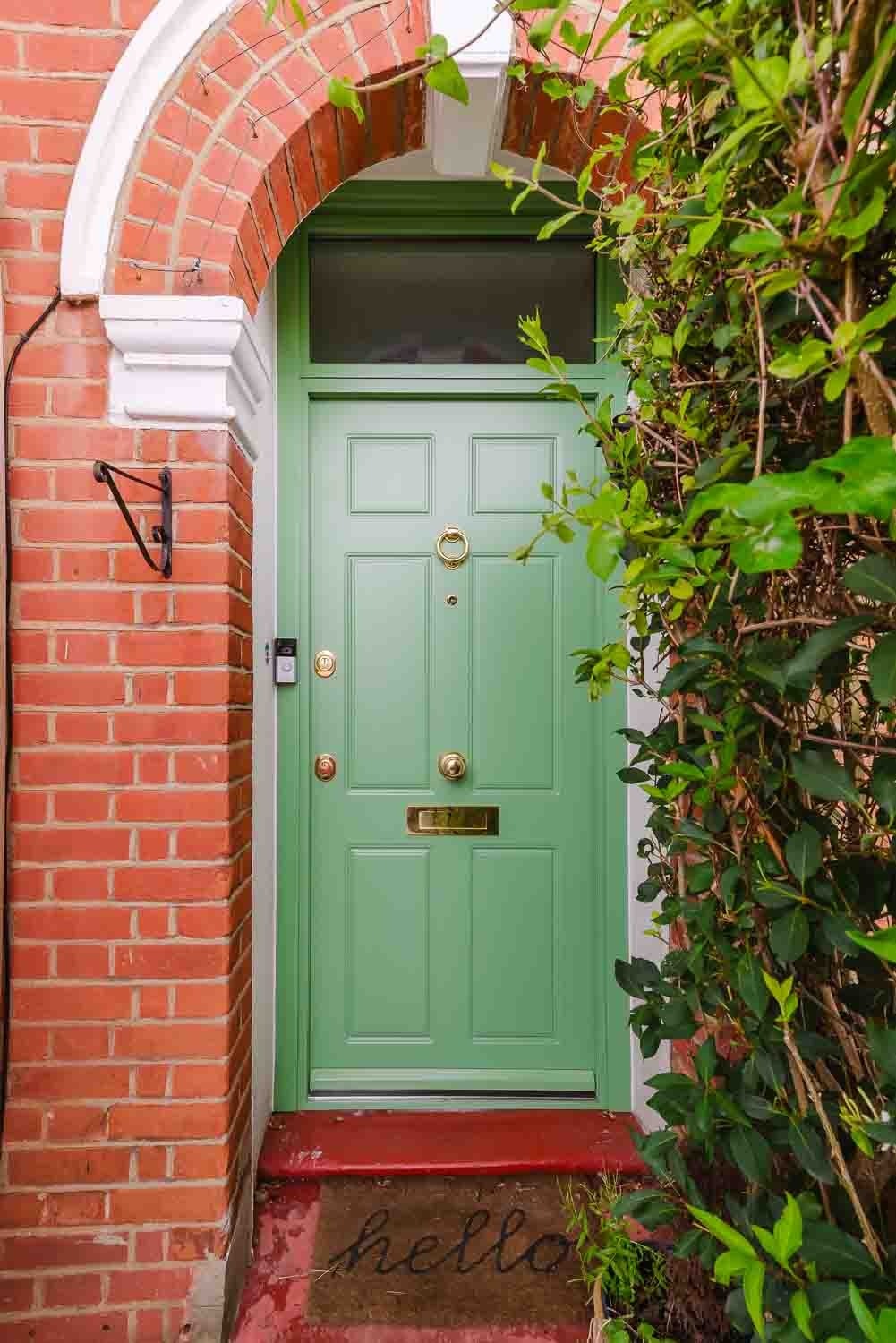
The Georgian front door follows strict proportional rules. A six-panel arrangement is the most common, with the panels diminishing in size from bottom to top in a ratio that reflects classical architectural principles. The door is set within an architrave surround, often with a fanlight above, semi-circular or rectangular, that floods the hallway with natural light.
Polished brass hardware is the historically authentic choice for Georgian entrances. A centrally placed knocker (lion head, urn or ring), a brass letter plate positioned centrally between the middle rails, and individual brass numerals complete the traditional composition. The colours of the Georgian period were limited by the paints available: black, dark green, dark blue and occasionally deep red.
Modern reproductions in steel allow architects and homeowners to recreate the Georgian aesthetic with none of the performance compromises of a period timber door, no warping, no draughts, no vulnerability to forced entry.
Victorian Townhouses
The Victorian era (1837-1901) produced the largest volume of London's residential stock. Victorian townhouses dominate Kensington, Chelsea, Fulham, Clapham, Hackney and vast swathes of outer London.
Victorian front doors are more decorative than their Georgian predecessors. Four-panel doors are common, often with the upper panels glazed, either clear, etched, or in the stained glass that became fashionable from the 1860s onwards. The door surround is typically more elaborate, with columns, pilasters or decorative mouldings. Fanlights are frequently arched rather than rectangular.
Hardware became more varied during the Victorian period. Ornate knockers, decorative finger plates, and elaborate escutcheons reflect the era's enthusiasm for surface decoration. Finishes expanded to include not only brass but also black iron, bronze and, by the late Victorian period, early forms of chrome.
Victorian doors suit a wider range of colours than Georgian examples. Heritage paint ranges from the period include dark red, ochre, deep teal, chocolate brown and the rich blue-blacks that remain popular today. The full RAL range of colour options means every shade can be precisely reproduced.
Edwardian Townhouses
Edwardian properties (1901-1914) are concentrated in suburbs that were developing rapidly in the early twentieth century: Chiswick, Ealing, Muswell Hill, Dulwich and parts of South West London. The Edwardian style is characterised by wider proportions, lighter interiors and a less formal approach to decoration.
Edwardian front doors typically feature a large upper glazed panel, often with Art Nouveau or geometric leaded light designs, above two solid lower panels. The emphasis on natural light distinguishes them from the heavier Victorian approach. Porches are common, either open or enclosed, providing weather protection and a transitional space between street and home.
Hardware is simpler than Victorian examples but retains a crafted quality. Satin brass, early chrome and copper finishes were all in use. Letter plates, pull handles and bell pushes tend towards clean, functional forms rather than elaborate decoration.
Conservation Area Considerations in London
London contains over 1,000 designated conservation areas, and a significant proportion of the capital's townhouses fall within them. Replacing a front door in a conservation area introduces planning considerations that do not apply elsewhere.
What Conservation Area Designation Means for Your Door
In a conservation area, permitted development rights are restricted. Replacing a front door is generally classified as an alteration to the external appearance of a dwelling, which may or may not require planning permission depending on the local authority's Article 4 Directions.
Many London boroughs, including Kensington and Chelsea, Westminster, Camden and Islington, have Article 4 Directions that specifically remove permitted development rights for changes to front elevations, including door replacement. In these areas, planning permission is required to change your front door, even if the replacement is identical in design.
Navigating the Approval Process
The key to a successful application is demonstrating that the replacement door is sympathetic to the character of the conservation area. In practice, this means:
- Matching the architectural period, a Georgian-style door for a Georgian property, a Victorian design for a Victorian terrace
- Appropriate materials, planning officers generally accept high-quality reproductions in modern materials provided the external appearance is authentic. Steel doors that faithfully replicate period panel arrangements and moulding profiles are routinely approved
- Correct proportions, the door must fit the existing opening without modification to the surround, fanlight or any decorative elements of the elevation
- Appropriate colour, some conservation areas have colour restrictions. Check the conservation area appraisal document for guidance
- Hardware consistency, period-appropriate hardware in suitable finishes strengthens the application
Pre-application advice from the local planning authority is available for a modest fee and provides early clarity on any likely objections. For complex cases, a heritage statement prepared by a conservation specialist can support the application. SteelR routinely supports homeowners through London borough conservation processes by supplying scaled elevation drawings, RAL colour samples and material specifications appropriate to each application.
Security Needs for London Properties
London's property security landscape is distinct from the rest of the UK. Higher property values, greater density and the particular pattern of urban burglary create requirements that a generic approach to door security does not adequately address.
The London Burglary Profile
Metropolitan Police statistics consistently show that London boroughs experience higher rates of residential burglary than the national average. Prime central London boroughs, Westminster, Kensington and Chelsea, Camden, see particular concentrations, with properties targeted for high-value contents including art, jewellery and luxury goods.
The method of entry matters for specification purposes. Forced entry through the front door remains the most common approach, but London properties also face risks from lock snapping, cylinder manipulation and, in some cases, key theft. An SR3-rated steel doorset addresses all of these attack vectors through its tested resistance to physical force, tool-based attack and lock manipulation. Every SteelR door ships with BS EN 1627 RC4 as Standard, with LPS 1175 SR3 available as the Enhanced upgrade tier and LPS 1175 SR4 (D10 Issue 8) as the Commercial-grade upgrade tier for the highest-risk addresses.
Specifying Security for London Townhouses
For London townhouses in prime postcodes, the recommended security specification is:
- LPS 1175 SR3 as the Enhanced upgrade tier (the LPCB police-preferred residential rating), resisting sustained professional attack
- Secured by Design accreditation, police-approved security performance, recognised by insurers
- Anti-snap, anti-pick, anti-bump cylinder, to TS 007 three-star or equivalent
- Multi-point locking, minimum five-point engagement for SR3
- Hinge-side security bolts, preventing door removal even if hinges are defeated
This specification satisfies the requirements of high-value home insurers and provides genuine, tested protection. Review our security overview for the full range of certifications our doors carry.
Popular Colours and Hardware for London Townhouses
Colour trends vary markedly across London, reflecting both architectural context and neighbourhood character.
Prime Central London
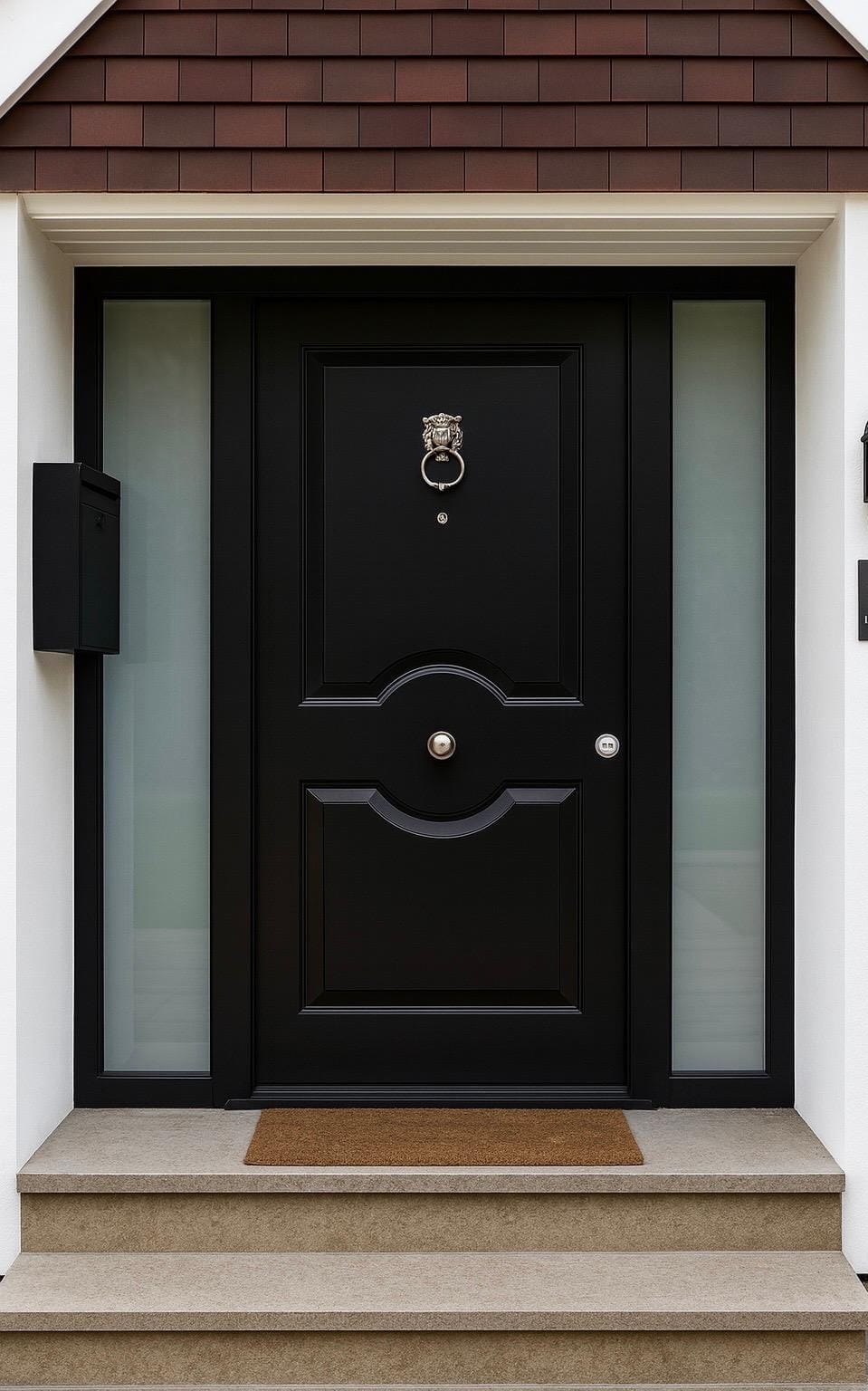
Mayfair, Belgravia and Knightsbridge favour black, very dark navy and deep racing green. These colours respect the formality of the stucco terraces and create a crisp contrast against white or cream facades. Polished brass hardware is the dominant choice, reinforcing the traditional, establishment character of these streets.
West London
Kensington, Chelsea, Notting Hill and Holland Park display greater colour confidence. Rich blues, sage greens, burgundy and even carefully considered bold colours appear on doors throughout these neighbourhoods. Hardware is more varied, satin brass, polished chrome and matt black all feature, often chosen to complement the specific door colour rather than defaulting to a single finish.
South West London
Wimbledon, Barnes, Putney and Richmond tend towards understated elegance. Dark grey, navy, muted green and black predominate. Satin chrome and matt black hardware suit the area's blend of Victorian, Edwardian and interwar architecture.
North London
Hampstead, Highgate and Muswell Hill embrace heritage colours, deep reds, forest green, dark blue, that complement the Arts and Crafts and Victorian architecture prevalent in these areas. Bronze and antique brass hardware feels particularly appropriate.
Browse our collection to see how different colour and hardware combinations work across a range of architectural styles.
Access and Installation Challenges
Installing a steel entrance door in a London townhouse presents logistical challenges that do not arise in suburban or rural settings. Planning for these at the outset prevents delays and additional costs.
Physical Access
Many London townhouses have restricted access: narrow streets, no front garden, shared front paths, basement areas with limited headroom, and upper floors reached only by internal staircases. A steel doorset weighing 120-250 kilograms cannot simply be carried through a narrow Victorian hallway.
Installation planning must consider:
- Delivery vehicle access, width restrictions, parking permits, loading bay availability and time-of-day restrictions in central London
- Lifting and positioning, mechanical lifting may be required for upper-floor installations or properties with steps and narrow approaches
- Temporary works, protecting adjacent properties, managing pedestrian access during installation, and providing temporary weather protection if the old door is removed before the new one is fitted
Permits and Notifications
Central London installations frequently require:
- Parking suspension, to secure space for the delivery vehicle. Apply through the local borough at least two weeks in advance
- Scaffold or hoarding licence, if temporary protection of the pavement is required
- Building control notification, if the installation involves structural alterations to the opening
- Party wall notification, if the doorset is adjacent to or within a party wall (uncommon for front doors but relevant for some configurations)
Working with Listed Buildings
A small but significant number of London townhouses are individually listed. Replacing the front door of a listed building requires Listed Building Consent, a more rigorous process than standard planning permission. The application must demonstrate that the replacement preserves or enhances the building's special interest. Detailed drawings, material specifications and a heritage impact assessment are typically required.
Steel doors that faithfully replicate the original design, proportions and detailing can secure Listed Building Consent. The argument is strengthened by the security, thermal and durability advantages that a modern steel door provides over a deteriorating timber original.
Working with Freeholders and Management Companies
Many London townhouses have been converted into flats. Where this is the case, the front door, whether to the building as a whole or to individual flats, may fall under the control of the freeholder, a management company, or a residents' management company.
Before specifying a door replacement:
- Check the lease, the lease will specify whether the front door is the responsibility of the leaseholder or the freeholder, and whether alterations require consent
- Obtain written consent, even if the lease permits alterations, obtaining formal written consent from the freeholder or management company avoids future disputes
- Coordinate with other leaseholders, in buildings with shared entrance doors, all leaseholders may need to agree on the specification and share the cost
- Consider communal fire requirements, flat entrance doors and communal entrance doors in converted buildings are subject to fire safety requirements that may mandate specific ratings
The freeholder's consent is a legal prerequisite, not a courtesy. Proceeding without it can result in enforcement action, remediation at the leaseholder's cost, and difficulties when selling the property.
The London Townhouse Standard
A bespoke steel entrance door for a London townhouse should deliver on every dimension simultaneously: architectural authenticity, conservation area compliance, SR3 security performance, thermal efficiency exceeding Building Regulations, and the material durability to withstand decades of urban use without deterioration.
Every SteelR doorset is manufactured under ISO 9001 quality management and finished in any RAL colour, achieving this standard while offering the design freedom to respect Georgian, Victorian, Edwardian or contemporary architecture with equal conviction. The result is an entrance that serves the property, the street and the homeowner for generations.
Frequently Asked Questions
Do I need planning permission to replace my front door in London?
It depends on whether your property is in a conservation area and whether the local borough has issued an Article 4 Direction covering front elevation changes. In boroughs such as Kensington and Chelsea, Westminster and Camden, planning permission is typically required. Check with your local planning authority before proceeding.
What is the best front door colour for a London townhouse?
The most appropriate colour depends on the architectural period and neighbourhood context. Black remains the most popular choice across prime central London. Dark navy, racing green and charcoal are strong alternatives. Heritage and muted tones suit Victorian and Edwardian properties, while bolder colours work well in neighbourhoods like Notting Hill where colourful facades are part of the character.
How do you install a heavy steel door in a London terrace with limited access?
Installation planning begins with a detailed site survey that assesses delivery vehicle access, path widths, steps and any obstructions. Parking suspensions are arranged in advance. Specialist lifting equipment is used where manual handling is not feasible. The installation team works to a pre-agreed method statement that accounts for the specific access constraints of each property.
Can a steel door replicate the look of a period timber door for conservation approval?
Yes. Bespoke steel doors can faithfully reproduce Georgian, Victorian and Edwardian panel arrangements, moulding profiles and proportions. The external appearance is indistinguishable from timber at normal viewing distances. Planning officers routinely approve steel door replacements in conservation areas where the design is sympathetic to the architectural character.
What security rating should I specify for a London townhouse?
For properties in prime London postcodes, an SR3-rated doorset certified to LPS 1175 provides the highest level of tested residential security. Combined with Secured by Design accreditation and anti-snap, anti-pick cylinders, this specification meets the requirements of high-value home insurers and provides genuine protection against the burglary methods most common in London.
Do I need freeholder consent to replace my flat entrance door?
In most cases, yes. The lease will specify responsibility for the door and whether alterations require consent. Even where the lease is ambiguous, obtaining written consent from the freeholder or management company before proceeding is strongly advisable. Flat entrance doors may also be subject to fire safety requirements that mandate specific ratings. For a borough-by-borough specification overview covering Belgravia, Mayfair, Hampstead and beyond, see our luxury steel entrance door London hub.