Getting Front Door Specification Right From the Start
For property developers, the front door is where compliance, security, kerb appeal and long-term build quality converge. It is one of the most visible elements of any new build and, simultaneously, one of the most heavily regulated. Getting the specification wrong can mean failed building control inspections, delays to completion and remedial works that erode margins.
The best front doors for new builds are not simply the most attractive or the cheapest. They are doors that satisfy every relevant section of the Building Regulations in a single, tested product, while delivering the aesthetic quality that sells homes at premium prices.
This guide covers the regulatory requirements, material options and practical considerations that developers and their architects should address when specifying entrance doors for UK new build projects.
Building Regulations: The Three Parts That Matter
Three sections of the Building Regulations directly affect front door specification for new builds in England and Wales. Each imposes specific performance requirements, and the specified door must satisfy all three simultaneously.
Part Q: Security
Approved Document Q (Security in Dwellings) was introduced in 2015 and requires all new dwellings to have entrance doors that resist unauthorised entry. The minimum standard is PAS 24:2022 (or its predecessor PAS 24:2016), which tests doors for resistance to physical attack using common burglary tools.
PAS 24 is a baseline. For developments targeting Secured by Design accreditation (increasingly requested by planning authorities and valued by buyers), the door must meet PAS 24 as a minimum, but higher tiers such as BS EN 1627:2011 RC4 (SteelR Standard) and LPS 1175 SR3 (Enhanced upgrade, the LPCB police-preferred specification) demonstrate a substantially greater level of security. RC4 tests sustained forced attack with heavy-duty hand tools and battery-operated power tools, placing it several categories above the Part Q minimum.
Developers building in Surrey, Kent and Essex are seeing growing demand for Secured by Design specification, particularly on premium residential schemes where buyers expect security performance to match the asking price. Every SteelR door ships with BS EN 1627 RC4 as Standard, with LPS 1175 SR3 available as the Enhanced upgrade tier. That combination satisfies both the Approved Document Q baseline and the higher security expectations of premium buyers in a single specification.
Part L: Energy Efficiency
Approved Document L governs the conservation of fuel and power. For entrance doors, the key metric is the U-value, the rate of heat loss through the door assembly, measured in W/m²K. The lower the value, the better the thermal performance.
The current requirement for new build entrance doors is a maximum U-value of 1.8 W/m²K, though most quality steel and composite doors comfortably exceed this. Premium steel doors with insulated cores and thermal break technology achieve U-values typically from 1.5 W/m²K, with thermal-upgrade specifications available achieving as low as 0.8 W/m²K, contributing positively to the dwelling's overall SAP calculation.
With the Future Homes Standard expected to tighten energy performance requirements further from 2025, specifying doors with strong thermal performance now avoids the risk of products becoming non-compliant before the development completes. A well-specified entrance door contributes to the overall energy efficiency of the building envelope and can improve EPC ratings.
Part B: Fire Safety
Approved Document B covers fire safety and is particularly relevant for flatted developments. Flat entrance doors opening onto communal areas must be FD30S rated (thirty minutes fire resistance plus cold smoke resistance). Buildings over 30 metres require FD60S.
For developers building houses, Part B requirements for the entrance door are less onerous, but any dwelling with an integral garage requires an FD30 self-closing door between the garage and the habitable space. For comprehensive guidance on fire ratings, see our guide to fire rated doors.
Secured by Design: The Developer Advantage
Secured by Design (SBD) is the official police security initiative that sets standards for the built environment. Achieving SBD accreditation for a new development is not a legal requirement, but it delivers tangible commercial advantages.
Many local planning authorities now include Secured by Design as a condition of planning approval, particularly for larger residential schemes. Even where it is not a formal condition, SBD accreditation is a strong differentiator in marketing, buyers understand that a Secured by Design home has been built to resist crime from the ground up.
For the entrance door specifically, SBD requires PAS 24 certification as a minimum. However, specifying doors with higher security ratings, such as SR3, exceeds the SBD requirement and provides a premium selling point. Homebuyers in affluent areas are increasingly security-conscious, and the ability to state that a development features SR3-rated steel entrance doors is a meaningful competitive advantage.
SBD accreditation also has a proven impact on insurance premiums for homeowners, which can be highlighted in sales materials. Developments that achieve SBD status typically experience lower crime rates, supporting long-term community satisfaction and reducing post-completion management issues.
Bulk Specification: Commercial Considerations
Developers purchasing entrance doors at volume have leverage that individual homeowners do not. The key considerations for bulk specification include consistency of quality across the development, lead times that align with the build programme, and the ability to offer buyers a degree of personalisation without disrupting manufacturing efficiency.
Consistency Across Plots
A development looks its best when the entrance doors share a coherent design language while allowing individuality between plots. Working with a manufacturer that offers a full RAL colour range and bespoke panel configurations means each plot can have a distinct colour or detail while maintaining consistent quality, security ratings and thermal performance.
Browse our collection to see the range of styles and configurations available for development specification.
Lead Times and Programme Alignment
Bespoke steel doors have longer lead times than off-the-shelf composite alternatives, typically around 8 weeks from order to delivery. For developers, this means the door specification needs to be confirmed during the early construction phases, not left as a late-stage decision. The benefit is that each door arrives as a complete, tested assembly ready for installation, reducing on-site labour and the risk of incorrect component assembly.
Buyer Personalisation
Offering plot purchasers a choice of door colour or hardware finish is a proven upselling tool. When working with a bespoke manufacturer, the cost of varying colour between plots is minimal, each door is individually finished regardless. This allows developers to offer a "door upgrade" or colour selection as part of the buyer specification process, adding perceived value with limited additional cost.
Door Materials: Choosing for New Builds
The three primary materials for new build entrance doors in the UK are steel, composite and aluminium. Each has distinct characteristics that suit different development types.
Steel Entrance Doors
Steel doors represent the highest specification option. They achieve SR3 security ratings, FD30 or FD60 fire ratings and excellent thermal performance in a single product. The design flexibility is unmatched, any RAL colour, dual-colour finishes, bespoke panel designs, decorative glazing and period-appropriate or contemporary hardware.
For premium developments where the asking price reflects quality throughout, steel entrance doors are the appropriate specification. SteelR's bespoke service is built around this segment. Every door is manufactured in the UK to the developer's individual plot specification, with the same SR3 security and FD30S fire rating across the scheme.
Composite Doors
Composite doors, a GRP skin over a foam or timber core, are the volume choice for mainstream new builds. They meet PAS 24 and Part L requirements, are available in a reasonable range of colours and styles, and are competitively priced. For standard housing developments at mid-market price points, composite doors are a practical choice.
The limitations emerge at the premium end: restricted customisation, lower security ratings than steel, no inherent fire rating and a shorter lifespan. For developments where the entrance door needs to justify a premium price tag, composite may fall short.
Aluminium Doors
Aluminium entrance doors offer a contemporary aesthetic with slim sightlines. They achieve PAS 24 certification and good thermal performance. However, aluminium does not achieve SR3 security ratings, is not inherently fire rated and offers less panel design flexibility than steel. Aluminium doors suit specific architectural styles, particularly minimalist contemporary designs, but are not as versatile across development types.
Specifying for Different Property Types
The right entrance door specification depends on the type of property being developed. What works for a premium detached house in the home counties differs from what is appropriate for an urban apartment block.
Detached and Semi-Detached Houses
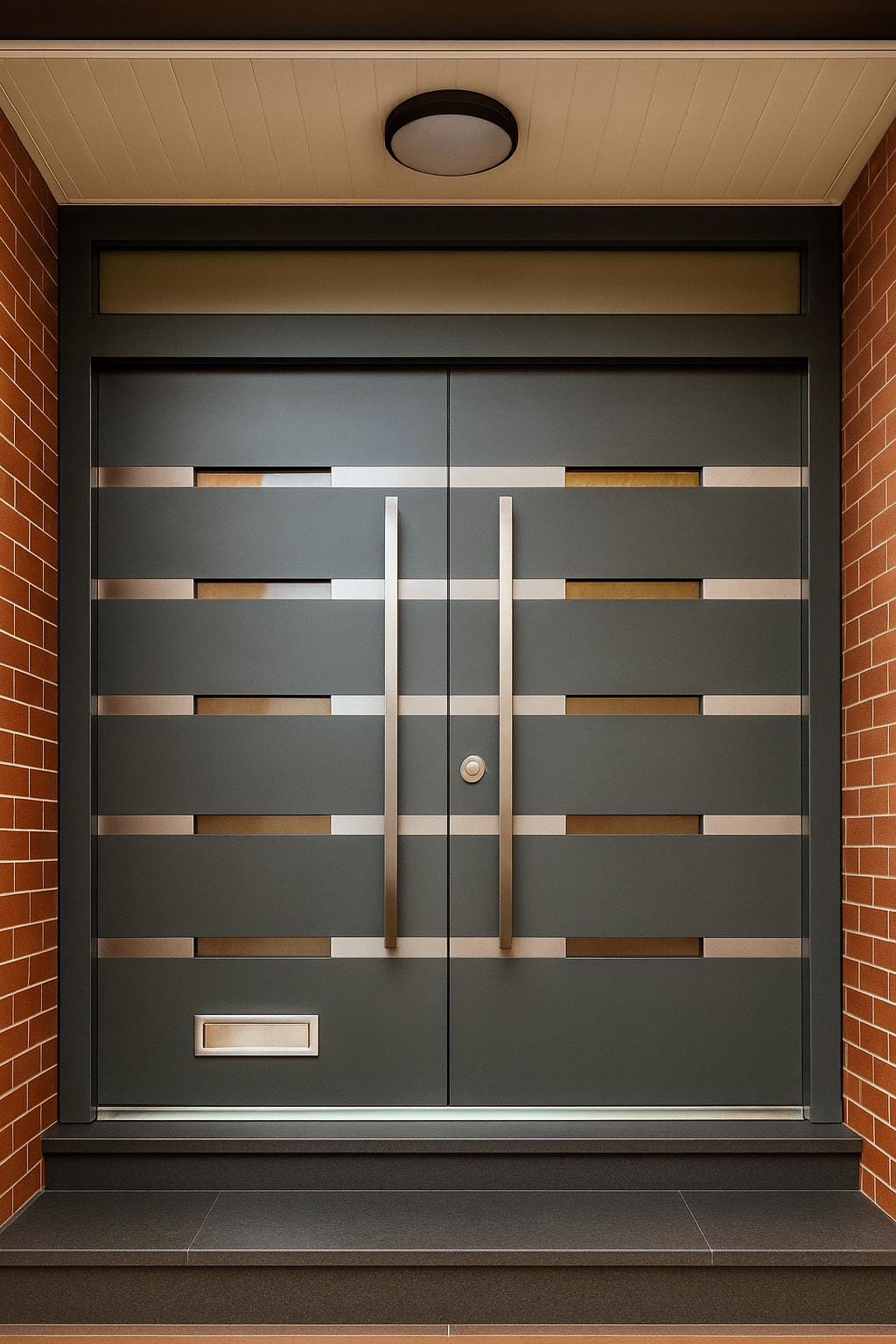
For individual houses, the entrance door is a design statement. Buyers are choosing the property for its character, and the front door sets the tone. Bespoke steel doors in architecturally sympathetic designs, whether contemporary horizontal lines or traditional panelled configurations, add genuine value. Security is a primary concern for detached properties, making SR3-rated steel doors a natural fit.
Apartment Blocks and Flatted Developments
Flat entrance doors must meet Part B fire safety requirements (FD30S minimum). They also need to satisfy Part Q security standards. For communal entrance doors to the building, the specification should address both security (access control integration) and durability (high-traffic use). Steel doors excel in all three areas, and their longevity reduces lifecycle replacement costs for the management company.
Mixed-Use Developments
Where residential units sit above commercial premises, fire safety requirements are typically more stringent. FD60 specification may be required for doors on certain floors or in proximity to commercial units. Steel doors can achieve FD60 without significant changes to their external appearance, maintaining design consistency across the building.
Working With Architects
The most successful door specifications emerge when the architect engages with the door manufacturer early in the design process. This allows the door design to respond to the architecture, matching proportions, materials and the overall design intent, rather than being a compromise fitted to an opening designed without consideration for the door.
For architects specifying steel entrance doors, the key parameters to establish early include the structural opening size (steel doors are heavy and may require reinforced surrounds), threshold detailing (particularly for level-access compliance under Part M), hardware positions relative to the facade composition, and glazing configurations that complement the fenestration strategy.
Request a consultation to begin a conversation about specification for your development.
Warranty and Aftercare
Developers should scrutinise the warranty provisions for entrance doors as carefully as they do for any other building component. The relevant questions include the length of the warranty, what it covers (finish, hardware, locking mechanism, core integrity), whether it is transferable to the homebuyer and what the manufacturer's track record is for honouring claims.
ISO 9001 certified manufacturers operate under documented quality management systems that provide traceability from raw materials through to the finished installation. This certification is not a marketing badge, it means that every door produced is subject to consistent quality controls and that the manufacturing process is regularly audited by an independent body. SteelR's UK manufacturing facility operates under ISO 9001, with every doorset traceable from raw steel through to the installed product.
For developers, specifying from an ISO 9001 manufacturer provides an additional layer of protection against defect claims and demonstrates due diligence in the supply chain.
The Bottom Line for Developers
The entrance door is where regulatory compliance and commercial value meet. A door that satisfies Part Q, Part L and Part B in a single tested product, while delivering the design quality that sells homes, is not an expense. It is an investment in build quality, sales velocity and long-term reputation.
Developers who specify premium entrance doors consistently report that the uplift in perceived value exceeds the additional cost. The front door is the first thing a prospective buyer touches. It sets expectations for everything behind it. For a complete breakdown of the Approved Document Q baseline that every new-build door must meet, see our PAS 24 steel entrance door specification.
Frequently Asked Questions
What security standard do new build front doors need to meet?
Under Approved Document Q, all new build entrance doors in England and Wales must meet PAS 24:2022 as a minimum standard for resistance to unauthorised entry. Secured by Design developments require PAS 24 as a baseline, though specifying higher tiers such as BS EN 1627 RC4 (SteelR Standard) or LPS 1175 SR3 (Enhanced upgrade) provides substantially greater security and commercial differentiation.
Do all new build front doors need to be fire rated?
Not all new build front doors require a fire rating. Standard houses generally do not need a fire rated front door unless there is an integral garage (which requires an FD30 connecting door). Flat entrance doors opening onto communal areas must be FD30S rated. Buildings over 30 metres require FD60S.
Can developers specify different door colours for each plot?
Yes. When working with a bespoke manufacturer that offers the full RAL colour range, specifying different colours for individual plots adds minimal cost because each door is individually finished. This allows developers to offer buyer personalisation, a proven method of increasing perceived value and buyer satisfaction.
What U-value do new build entrance doors need to achieve?
The current requirement under Approved Document L is a maximum U-value of 1.8 W/m²K for entrance doors. However, with the Future Homes Standard tightening energy requirements, specifying doors with U-values well below this threshold (premium steel doors typically achieve from 1.5 W/m²K, with thermal-upgrade options as low as 0.8 W/m²K) provides future-proofing and improves the dwelling's SAP calculation.
How far in advance should developers order bespoke entrance doors?
Bespoke steel entrance doors typically have lead times of around 8 weeks from confirmed order to delivery. Developers should confirm door specifications during the early construction phases, ideally at first fix stage, to ensure doors arrive in time for second fix installation without causing programme delays.
Is Secured by Design accreditation worth pursuing for new developments?
Secured by Design accreditation delivers measurable benefits including planning advantage (many authorities require or encourage it), marketing differentiation, reduced crime rates on completed developments and lower homeowner insurance premiums. The additional specification cost is typically modest, particularly when SR3-rated doors are specified as part of a premium package.