Your Front Door Is Your First Line of Defence
According to UK police data, approximately 70% of domestic burglaries involve entry through a door, with the front door being the most commonly targeted entry point. Choosing the right front door is not just an aesthetic decision, it is one of the most important security investments you can make for your home.
But with so many materials, lock types, security ratings and marketing claims to navigate, how do you identify which door will genuinely protect your family and property? This guide cuts through the noise and explains exactly what to look for.
Door Materials: Ranked by Security
Not all door materials are created equal. Here is how the main options compare, ranked from least to most secure:
uPVC: Lowest Security uPVC doors are lightweight, inexpensive and widely installed across the UK. However, they offer the weakest physical resistance of any door material. The plastic frame and multi-chamber construction can be forced, flexed or levered open with basic tools. If home security is a priority, uPVC should be replaced.
Timber: Moderate Security Solid hardwood doors (oak, iroko, sapele) offer reasonable resistance to casual attack, but timber has inherent weaknesses. The wood around lock keeps and hinges is the failure point, it splits under concentrated force. Even high-quality timber doors can typically be breached in under 30 seconds with a crowbar. Softwood doors are significantly weaker again.
Composite: Good Security Composite doors combine a reinforced core (typically timber or insulating foam) with a GRP (glass-reinforced plastic) skin. The better composite doors achieve **PAS 24** certification, which tests resistance to manual attack with light tools. PAS 24 is a respectable standard that meets building regulations, and composite doors represent a solid mid-range security option for most homes.
Aluminium: Very Good Security Premium aluminium doors can achieve **SR2 (RC2)** security ratings, offering resistance to attack with simple tools for 3 minutes. Aluminium is stronger than timber and composite, and its metal construction provides better resistance to cutting and drilling. However, aluminium is a softer metal and has limitations at higher security levels.
Steel: Highest Security Steel entrance doors represent the pinnacle of residential door security. A bespoke steel door can achieve **LPS 1175 SR3** (the LPCB police-preferred residential rating). The Issue 8 test subjects the door to sustained attack using professional-grade tools including crowbars, drills and angle grinders for 5 minutes against a defined attack objective. No other residential door material achieves LPS 1175 SR3.
Understanding Security Ratings: SR1 to SR5
The European standard BS EN 1627:2011 defines resistance classes that specify what level of attack a door can withstand:
- SR1 (RC1), Resists bodily force only (kicking, shoulder-barging). No tools. The minimum standard.
- SR2 (RC2), Resists casual attack with simple tools (screwdrivers, pliers, wedges) for 3 minutes. The most common rating for premium aluminium and reinforced composite doors.
- LPS 1175 SR3 (Issue 8). Resists experienced attack with heavy-duty tools (crowbars, drills, angle grinders) for 5 minutes. The LPCB police-preferred residential rating. Only achievable with steel construction. SteelR offers this as the Enhanced upgrade tier above the BS EN 1627 RC4 Standard.
- SR4 (RC4), Resists experienced attack with power tools (reciprocating saws, impact drills) for 10 minutes. Government and commercial applications.
- SR5 (RC5), Resists attack with high-powered tools (disc cutters, drilling machines) for 15 minutes. Embassy, military and high-security commercial use.
For residential properties, SR3 is the benchmark for premium security. Homeowners in high-value areas such as London, Virginia Water and Beaconsfield increasingly specify SR3 as a baseline requirement.
Lock Types: What to Look For
The lock is only as good as the door it is fitted to, but the locking system is still a critical component:
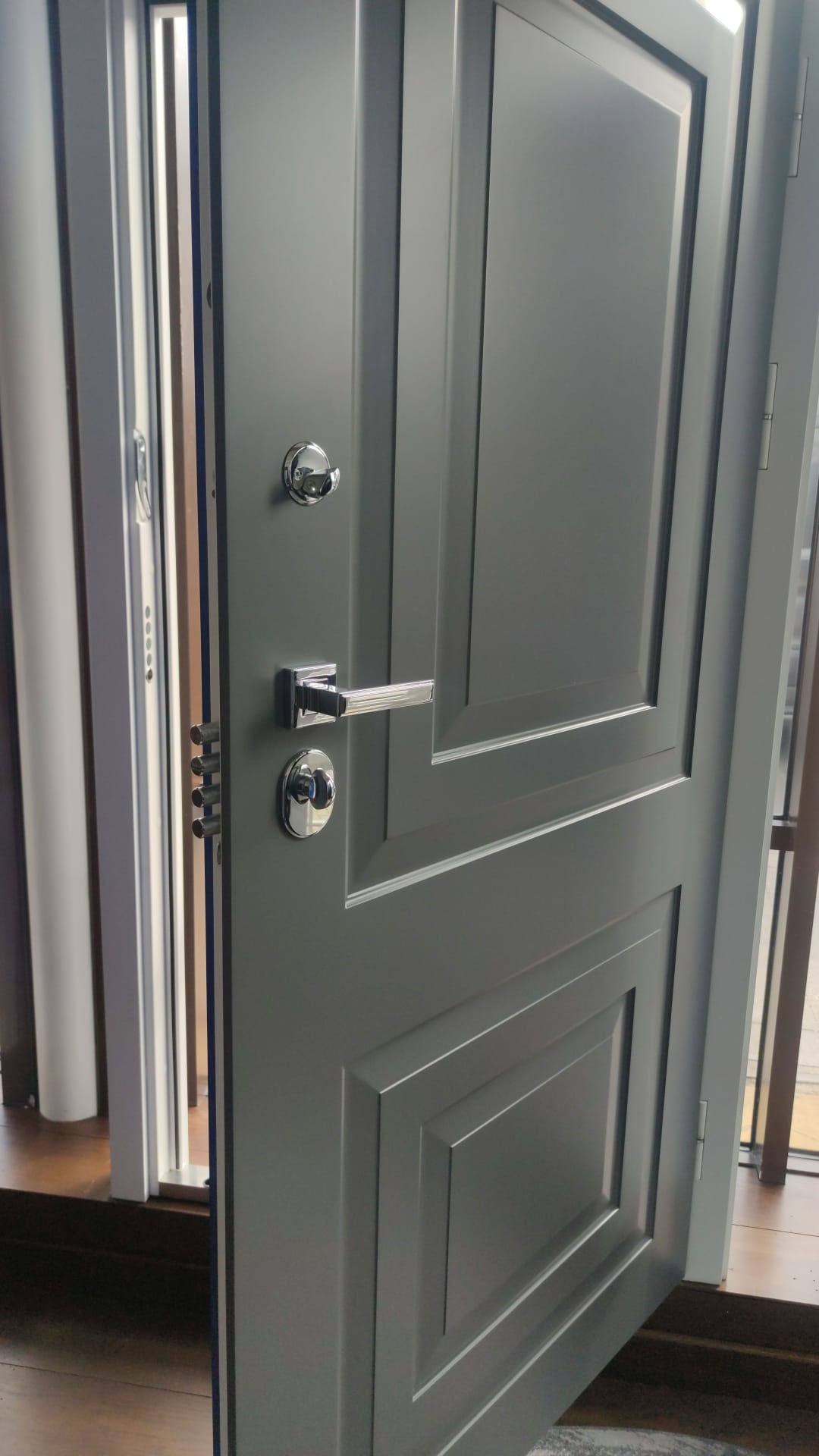
Multi-Point Locking The door should engage at **multiple points** along the frame, typically 3, 5 or 7 locking points. Multi-point systems distribute the locking force across the full height of the door, making it far harder to force open than a single deadbolt.
Anti-Snap Cylinders Standard euro cylinders are one of the most exploited weaknesses in UK residential doors. A burglar can snap a standard cylinder in seconds using pliers or a mole wrench. **Anti-snap, anti-pick, anti-bump and anti-drill cylinders** are essential. Look for cylinders rated to **TS007 3-star** or equivalent.
BS 3621 and Above **BS 3621** is the minimum lock standard that most UK insurers require. It tests the lock's resistance to picking, drilling and key security. For premium security, look for locks that exceed BS 3621 and are integrated into the door's overall security-rated system.
Deadlocks vs Latch Locks A **deadlock** (or deadbolt) is a lock that can only be opened with a key, it cannot be pushed back with a credit card or similar tool. For maximum security, the primary lock should be a deadlocking mechanism, with additional hookbolts and compression bolts at secondary locking points.
Hinges: The Overlooked Weakness
Many homeowners focus on locks and forget hinges. A door is only as secure as its weakest point:
- Dog bolt hinges, also called security hinges, these have interlocking bolts that engage when the door closes, preventing the door from being lifted off its hinges even if the hinge pins are removed
- Concealed hinges, hidden from the exterior, making them impossible to attack from outside
- Heavy-duty specification, hinges must be rated to carry the weight of the door for the lifetime of the installation. Undersized hinges sag over time, creating gaps and misalignment that compromise both security and weather sealing
On an SR3-rated door, the hinges are part of the tested system. They are not an afterthought, they are engineered and tested alongside the door, frame and locking mechanism.
Glazing: Beautiful but Vulnerable
Glazed panels add natural light and design interest to an entrance door, but they also represent a potential security weakness:
- Standard glass can be smashed to reach the locking mechanism. If your door has glass panels within arm's reach of the lock, standard glass is a serious vulnerability
- Laminated glass holds together when broken, making it much harder to breach. For security-rated doors, laminated glazing is the minimum standard
- Security-rated glazing is independently tested to match the door's resistance class. An SR3 door requires SR3-rated glazing, glass that resists attack with the same tools and for the same duration as the steel panels
Never assume that a security-rated door automatically includes security-rated glazing. Always confirm the glazing specification.
The Frame Matters as Much as the Door
A common mistake is focusing entirely on the door leaf and ignoring the frame. The strongest door in the world is useless in a weak frame:
- The frame must be constructed from the same or equivalent material as the door
- Frame fixings must anchor securely into the structural wall, not just plasterboard or mortar
- The frame must be part of the tested security system. An SR3 door must be installed in an SR3-tested frame to maintain the rating
- Poorly fitted frames with gaps or flex provide leverage points for forced entry
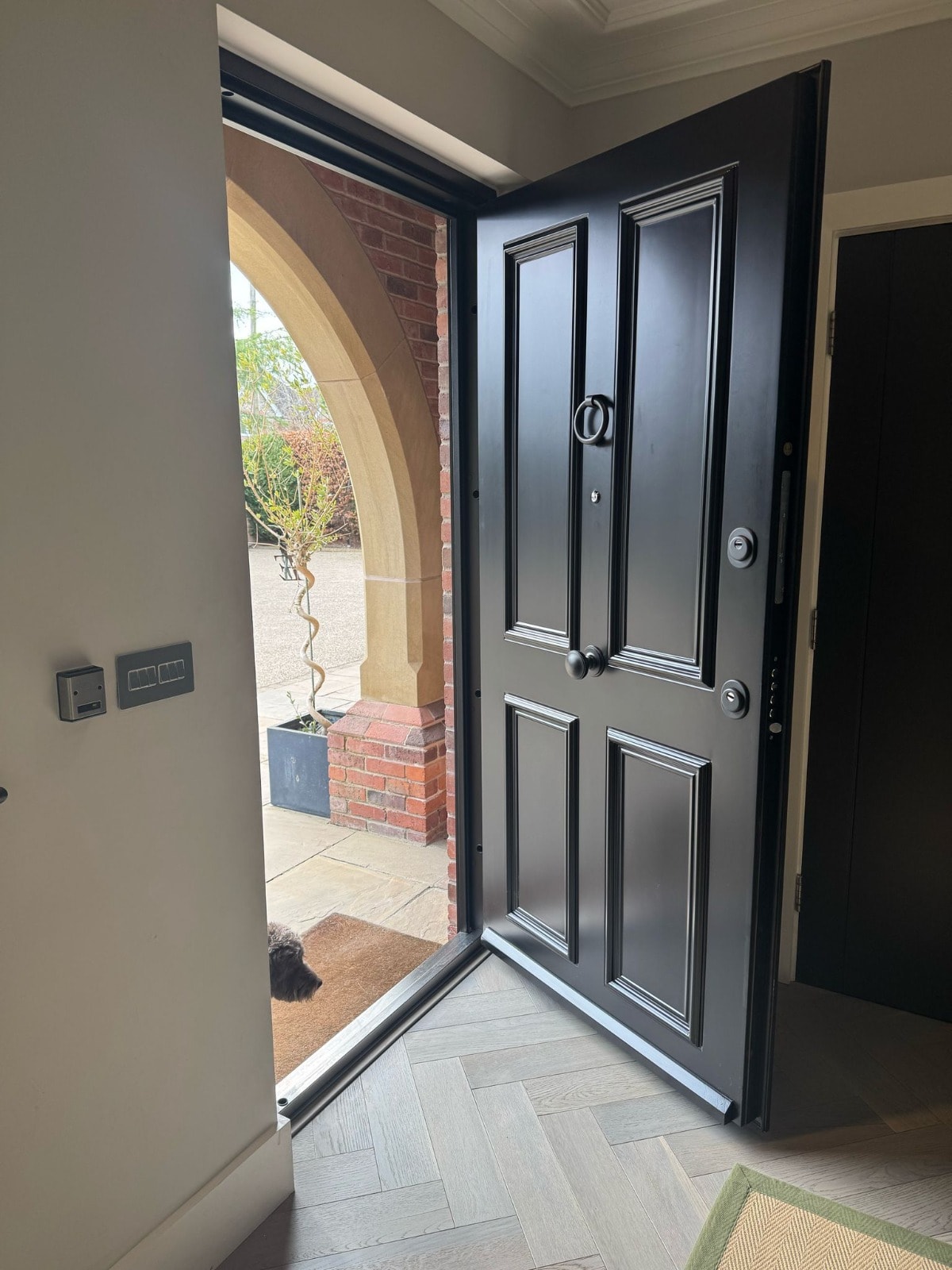
At SteelR, every door is supplied as a complete doorset, door, frame, locking system, hinges, glazing and hardware, all tested together as a single security system. Learn more about our process.
Secured by Design: The Police Standard
When evaluating front door security, look for Secured by Design accreditation. This is the official UK police security initiative, and products carrying the mark have been independently assessed and approved by police crime prevention officers. Research shows that properties built to Secured by Design standards experience up to 75% less burglary.
Secured by Design assesses the complete doorset, not individual components. It also requires ongoing manufacturing audits, ensuring the door you receive matches the door that was tested.
Making Your Decision
The best front door for home security combines:
- Steel construction for maximum physical resistance
- SR3 security rating under BS EN 1627:2011
- Multi-point locking with anti-snap cylinders
- Security-rated glazing matched to the door's resistance class
- Heavy-duty, tested hinges integrated into the doorset
- Secured by Design accreditation for police-approved security
- Professional installation to maintain the tested specification
At SteelR, every entrance door meets all of these criteria as standard. Whether you are securing a London townhouse or a country home in the Home Counties, we ship BS EN 1627:2011 RC4 single leaf, unglazed as Standard on every door, with LPS 1175 SR3 (LPCB police-preferred Enhanced upgrade), LPS 1175 SR4 D10 Issue 8 (Commercial-grade upgrade) and LPS 1673 attack-resistance (Ultra-high, by enquiry) available as further tiers. For a full technical breakdown of the SR3 tier, see our SR3 residential steel door page; for the higher tiers, see our SR4 and LPS 1673 pages. Explore our collection to see the range of designs, then contact us to discuss your security requirements.
Frequently Asked Questions
What makes a front door genuinely secure in the UK?
A genuinely secure front door meets three criteria. First, it carries independent certification to a recognised standard (LPS 1175 SR3 is the LPCB police-preferred residential rating, sitting above the BS EN 1627 RC4 baseline). Second, the whole doorset is tested as a unit: leaf, frame, hinges, locking and glazing. Third, it is installed correctly into a suitable substrate by trained fitters. Marketing claims without an accompanying test certificate and accredited installer do not indicate security; paperwork does.
Which material makes the most secure front door?
Steel is the consistent leader for SR3 residential certification, and the only material that reaches the SR4 (Commercial-grade) and LPS 1673 (Ultra-high) tiers above it. Timber doors rarely reach SR3 due to the heavy engineering required, composite doors typically cap at PAS 24, and aluminium residential doors also cap at PAS 24. Solid hardwood doors with steel-reinforced cores and security-rated glazing can reach SR3 but are expensive and niche. For UK homeowners targeting any of the LPCB-certified residential tiers (SR3 Enhanced, SR4 Commercial-grade, LPS 1673 Ultra-high), steel is the default and most cost-effective choice.
What is a multi-point locking system and why does it matter?
A multi-point locking system engages the door into the frame at multiple points simultaneously (typically three to five), not just the cylinder. When you turn the key or lift the handle, shoot-bolts and hooks engage along the edge of the door, distributing security load and eliminating single-point failure. An anti-snap cylinder prevents the primary attack method used in UK burglary: snapping the cylinder to turn the lock.
Does glazing weaken a front door's security?
Only if unspecified. Laminated security glazing tested to BS EN 356 withstands repeated impact and resists being smashed through. For SR3 certification, the glazing must match the door's resistance class. A door with ordinary single glazing undermines the specification, regardless of how strong the leaf is. Any sidelights and fanlights should also match the doorset's security rating.
How long does a burglar take to defeat a standard UK front door?
A standard uPVC or composite door rated to PAS 24 is tested against three minutes of basic tool attack. In real-world burglary attempts using common entry methods (cylinder snapping, lever attack on the frame), many PAS 24 doors fail in under a minute. SR3-rated doors withstand five minutes of power-tool attack in laboratory conditions, far exceeding the effort threshold of a typical opportunistic burglar.
Is it worth paying for an SR3 door for a standard terraced house?
For most homeowners, upgrading from PAS 24 to SR3 is worth it if the budget allows. The incremental cost over a quality PAS 24 door is modest compared to the increase in resistance. Insurance premium benefits, peace of mind and deterrent value all contribute to the return. SR3 is particularly worth specifying in areas with above-average burglary risk, for homes with a previous attempted entry, and for any property holding high-value contents.