What Does Bespoke Actually Mean?
The word bespoke is used freely in the door industry, often to describe products that are anything but. A truly bespoke entrance door is designed and manufactured to the exact specifications of a single project, not selected from a catalogue of pre-made options with a few cosmetic adjustments.
The distinction matters. Many manufacturers offer what might more accurately be called "semi-custom" or "made-to-measure" doors: a standard design adapted to fit a non-standard opening. The door leaf design, panel layout and hardware positions remain fixed. Only the outer dimensions change.
A genuinely bespoke door starts from a blank sheet. The proportions, panel configuration, glazing pattern, colour, hardware and every structural detail are determined by the client and their architect, not constrained by what happens to be in the manufacturer's standard range.
A bespoke entrance door is designed around your property. A standard door asks your property to accommodate it.
Why Standard Sizes Rarely Fit Quality Properties
The UK door industry works to a set of common sizes, with the most prevalent being 2085mm x 920mm for a single leaf. These dimensions serve the volume housebuilder market, where speed and cost efficiency dictate that every opening is cut to the same template.
For period properties, architect-designed homes and high-end renovations, standard sizes present several problems:
Non-Standard Openings
Victorian, Edwardian and Georgian properties were built to no standardised dimensions. Doorways in a Chelsea townhouse or a Kensington villa may be wider, taller or differently proportioned to anything available off the shelf. Arched openings, fanlights and deep reveals add further complexity.
Forcing a standard door into a non-standard opening requires adaptation, typically through the use of fillers, reducers or oversized frames. The result is a door that does not sit properly in its architectural context, with visible compromises at the edges.
Proportional Integrity
Architecture is fundamentally about proportion. The relationship between door width and height, between panel sizes, between glazed and solid areas, these ratios determine whether a door looks considered or compromised. A standard door placed in a Georgian surround designed for different proportions will look exactly what it is: a compromise.
Properties in conservation areas across Beaconsfield and the wider Home Counties face this challenge frequently. The original doorways were built to proportions that pre-date modern standardisation, and replacing them with something off the shelf diminishes the character of both the door and the facade. Every SteelR doorset is manufactured to the surveyed dimensions of the individual opening, with no standard sizing imposed.
Double Doors and Sidelights
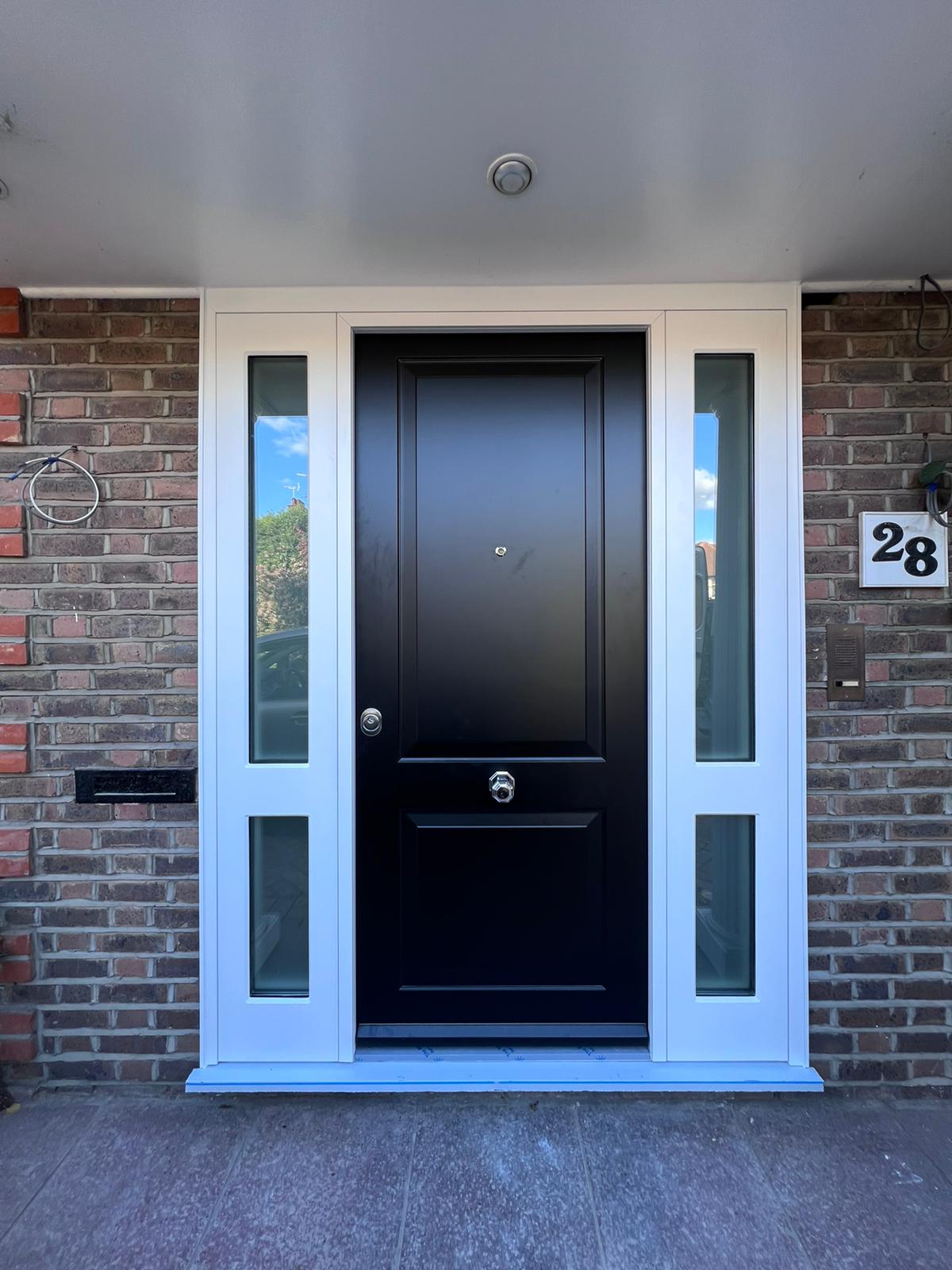
The standard size issue becomes more acute with double doors and configurations incorporating sidelights. The ratio between the two leaves, or between the main door and its sidelights, must be carefully considered to avoid an unbalanced appearance. This is essentially impossible when working from a fixed product range.
Customisation Options for Bespoke Entrance Doors
A bespoke process opens every aspect of the door to specification. Understanding what can be customised, and why each decision matters, helps you make choices that serve both the aesthetic and functional requirements of your property.
Dimensions and Configuration
The starting point is the opening itself. A bespoke manufacturer will survey the existing aperture (or work from architectural drawings for new-build projects) and design the doorset to fit precisely. This includes:
- Single leaf doors to any width and height within structural limits
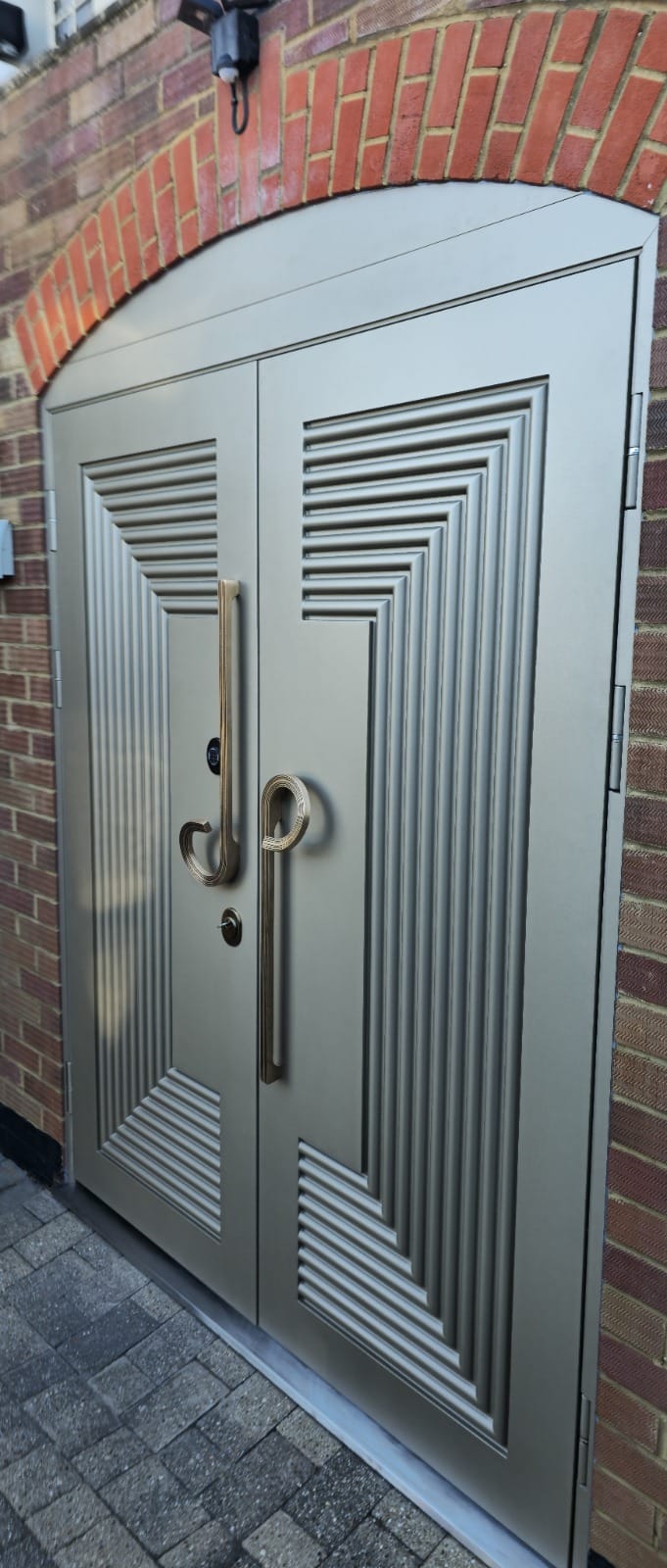
- Double leaf configurations with equal or unequal leaf widths
- Sidelights, single or double, glazed or panelled, at any width ratio
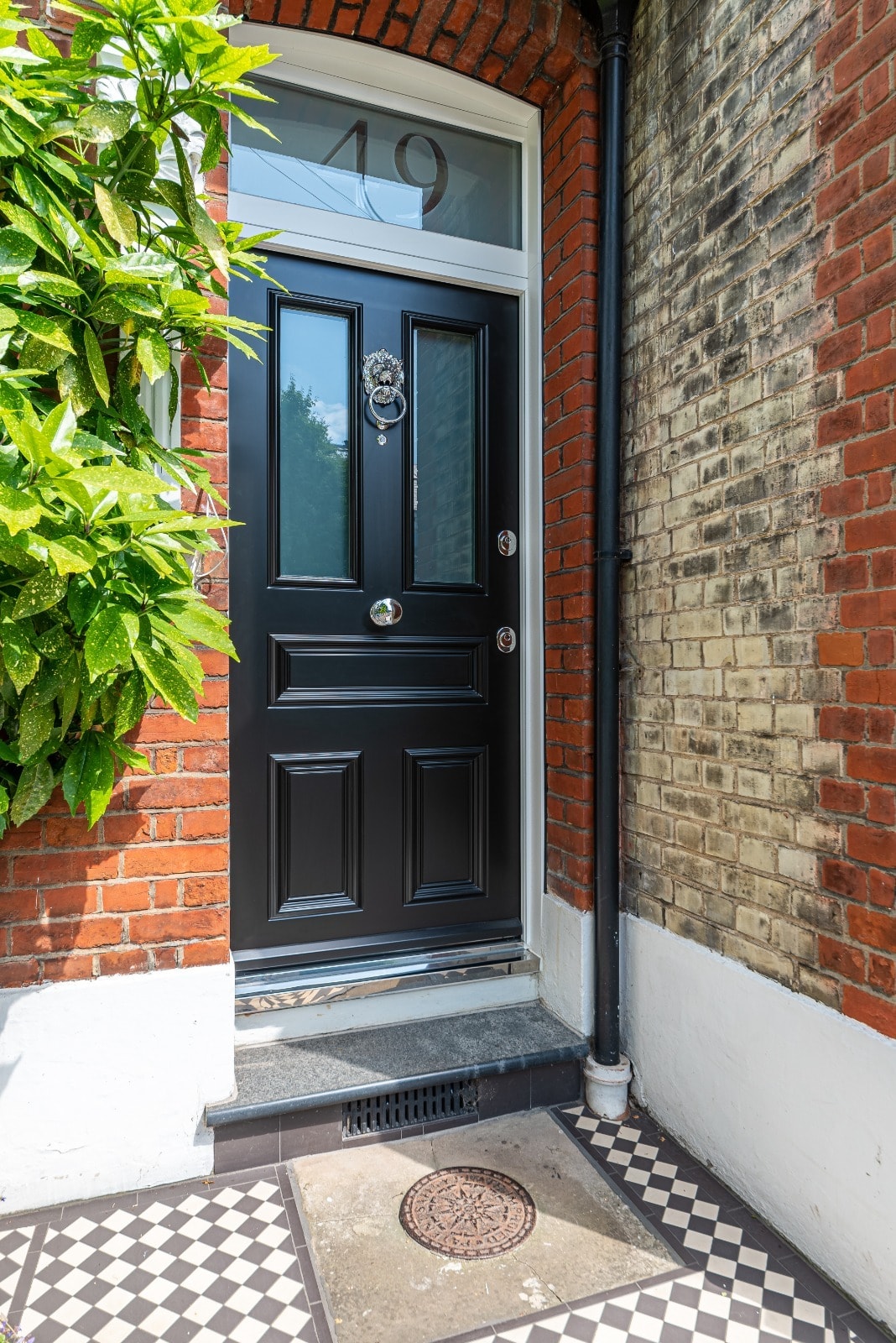
- Fanlights and transoms, rectangular, arched or custom geometries
- Arched tops, true radius, segmental, Tudor or Gothic arch profiles
Colour and Finish
Colour is one of the most impactful design decisions. A bespoke steel entrance door can be finished in any shade from the full RAL colour range, over 200 standard colours plus the extended RAL Design system of nearly 2,000 shades. This means your door can be specified to match existing paintwork, complement brickwork or stonework, or make a deliberate contrast statement.
Dual-colour finishing allows different colours on the exterior and interior faces. A deep heritage green on the outside with a warm off-white interior, for example, lets the door work in two entirely different design contexts.
The finish itself is a factory-applied polyester powder coating, cured at high temperature for exceptional durability. Unlike painted timber, which requires maintenance every few years, a powder-coated steel door retains its colour and finish with minimal upkeep, a practical advantage that is easy to underestimate until you have lived with a door that demands annual attention.
A bespoke steel entrance door can be specified in any RAL colour, with dual-colour options for exterior and interior faces.
Glazing
Glazing options range from fully solid panels to extensive glass areas, with several intermediary configurations:
- Clear glass, maximises light transmission and views
- Obscured and textured glass, maintains privacy while admitting light
- Leaded and stained glass, period-appropriate for Victorian and Edwardian properties
- Geometric patterns, Art Deco, contemporary linear and abstract designs
- Toughened and laminated safety glass, required by Building Regulations and advisable for security
- Double-glazed sealed units, thermal performance with a U-value that contributes to the overall energy efficiency of the doorset
The glazing pattern itself can be custom-designed. Rather than selecting from a catalogue of standard patterns, a bespoke process allows you to commission a glazing design that references architectural details from your property or neighbourhood.
Hardware
The choice of door hardware, handles, knockers, letterplates, numerals and hinges, has a disproportionate impact on the finished appearance. Bespoke specification means:
- Material choice, solid brass, stainless steel, chrome, bronze or black iron
- Finish matching, hardware can be specified to match or complement the door colour and other external metalwork
- Period-appropriate detailing, lion head knockers, doctor's knockers, ring pulls, thumb latches
- Contemporary options, minimal pull handles, flush pulls, integrated finger grooves
- Locking systems, multi-point locking as standard, with options for smart lock integration, keypad entry and biometric access
The Design Process: From Concept to Installation
Understanding our process helps set expectations for timeline, involvement and cost. A bespoke entrance door is not an impulse purchase, it is a considered investment that follows a structured path from first conversation to final installation.
Stage 1: Initial Consultation
The process begins with a conversation about your property, your requirements and your aesthetic preferences. This may involve a site visit to assess the existing opening, photograph the architectural context and take preliminary measurements. For new-build projects, we work directly from architectural drawings.
This is the stage at which to share reference images, discuss materials and establish the broad direction of the design. If you have a clear vision, we refine it. If you are exploring options, we guide you through the possibilities.
Stage 2: Design Development
Based on the consultation, we produce detailed design drawings showing the door in elevation, including panel layout, glazing configuration, hardware positions and colour. Revisions are part of the process. Most clients go through two or three iterations before the design is finalised.
At this stage, we also confirm the technical specification: security tier (BS EN 1627 RC4 as Standard, with LPS 1175 SR3 Enhanced upgrade or SR4 Commercial-grade upgrade where the brief calls for it), fire rating where required, thermal performance targets and any specific compliance requirements for planning or building control.
Stage 3: Survey and Specification
Once the design is approved, a detailed site survey establishes the precise dimensions, reveals any structural considerations and confirms the installation method. The final specification document captures every detail of the doorset, dimensions, materials, colour (RAL reference), glazing specification, hardware selections and locking system.
Stage 4: Manufacture
The door is manufactured in our ISO 9001 certified facility. Every doorset is fabricated, welded, finished and assembled by hand. Typical lead time for a bespoke steel entrance door is approximately 8 weeks depending on complexity. This is not a delay, it is the time required to build something properly.
Stage 5: Installation
Installation is carried out by SteelR's own fitting team, not subcontracted. A bespoke door demands precision installation to perform correctly, both in terms of security and weatherproofing. The installation typically takes a single day, and the old door is removed and disposed of as part of the service.
To begin the process, you can request a consultation at any stage, even if your plans are still forming.
Investment vs Cost: Reframing the Conversation
A bespoke steel entrance door is more expensive than a standard composite or timber alternative. That statement is straightforward and requires no qualification. The relevant question is not whether it costs more, but whether the additional investment is justified.
What You Are Paying For
The price of a bespoke entrance door reflects:
- Design time, hours of consultation, drawing and revision by experienced designers
- Material quality, heavy-gauge steel, high-security locking systems, quality glazing units and premium hardware
- Skilled fabrication, hand-welded construction by experienced craftspeople in an ISO 9001 facility
- Finishing quality, factory-applied powder coating with colour-matching precision
- Certification, independently tested to SR3 and Secured by Design standards
- Installation, fitted by the manufacturer's own team, not a third-party contractor
The Long-Term Calculation
A well-specified bespoke steel door has a functional lifespan measured in decades, not years. Unlike timber doors that require regular repainting and maintenance, or composite doors that can fade and warp over time, a powder-coated steel door retains its appearance and performance with minimal ongoing attention.
When assessed over a 25-year period, a reasonable expectation for a quality steel entrance door, the annual cost of ownership compares favourably with cheaper alternatives that may need replacing once or twice within the same timeframe.
A bespoke steel entrance door typically outlasts two or three composite replacements, making the long-term cost of ownership comparable or lower.
Property Value
An entrance door is the single most visible element of a property's facade. Estate agents consistently identify the front door as one of the most impactful factors in kerb appeal, the immediate impression a property makes on a prospective buyer. A bespoke, high-quality entrance door enhances that impression in a way that a standard product cannot.
For properties in premium locations, Chelsea, Kensington, Beaconsfield and comparable areas, the entrance door sets the tone for the entire property. It communicates quality, attention to detail and a refusal to compromise. These are the qualities that high-end buyers are looking for.
Lead Times and Planning
Realistic lead times for a bespoke steel entrance door:
- Initial consultation to design approval: 2 to 4 weeks, depending on revision cycles
- Site survey: typically 1 week after design sign-off
- Manufacture: approximately 6 weeks depending on complexity
- Installation: 1 day on site
The total timeline from design sign-off to installed door is typically approximately 8 weeks. If you are working to a fixed completion date, for a renovation, a property sale or a seasonal deadline, plan accordingly and begin the process early.
Browse our collection for design inspiration, request a consultation to begin a conversation about your project, or read our broader bespoke steel front doors UK overview for the full specification picture.
Frequently Asked Questions
How much does a bespoke steel entrance door cost?
Pricing depends on configuration, size, security tier (BS EN 1627 RC4 Standard, LPS 1175 SR3 Enhanced upgrade or SR4 Commercial-grade upgrade), fire rating, glazing, hardware specification, RAL colour and design complexity. Each door is individually priced after an on-site survey because no two specifications are alike. We provide a detailed written quotation following an initial design consultation, with a breakdown of every specification choice. Single-leaf, double-leaf and sidelight configurations are all costed against your specific brief rather than a published list.
Can a bespoke door match my existing architectural style?
Yes. That is precisely the point. A bespoke door can replicate period details, panelling profiles, glazing patterns, arched tops, decorative ironmongery, while incorporating modern security, thermal performance and weather resistance. The design process exists to achieve this balance.
What maintenance does a bespoke steel entrance door require?
Minimal. The powder-coated finish is resistant to fading, chipping and corrosion. An occasional wipe with a damp cloth and mild detergent is sufficient. Moving parts, hinges and locks, benefit from annual lubrication. There is no requirement for repainting.
Can I change my mind during the design process?
Design revisions are a normal and expected part of the bespoke process. Changes to colour, glazing, hardware and panel layout can be accommodated up until the point of manufacture. Dimensional changes require a new survey.
Do bespoke doors meet Building Regulations?
Every SteelR bespoke entrance door meets or exceeds all applicable Building Regulations, including Approved Document Q (security), Part L (thermal performance) and Part B (fire safety) where required. BS EN 1627 RC4 certification, Secured by Design accreditation and ISO 9001 manufacturing are standard, with LPS 1175 SR3 (Enhanced) and SR4 (Commercial-grade) upgrades available.
Is a site visit necessary before ordering?
For replacement doors, yes. The survey establishes precise dimensions, identifies any structural issues with the existing opening and confirms the best installation approach. For new-build projects where accurate architectural drawings are available, a site visit may not be required until the pre-installation stage.