Your Front Door Sets the Tone
The colour of your entrance door is one of the most impactful design decisions you can make for the exterior of your home. It is the focal point of your property's facade and contributes significantly to kerb appeal and first impressions.
With a bespoke steel door, you are not limited to a handful of standard colours. SteelR doors can be finished in any colour from the RAL Classic range, over 200 options, with the possibility of dual-colour specification (a different colour inside and outside).
The Most Popular Door Colours in the UK
Black (RAL 9005 / RAL 9017) Black remains the most popular choice for entrance doors in the UK. It works with virtually every architectural style, from Georgian townhouses to contemporary new builds. Black conveys elegance, authority and timelessness.
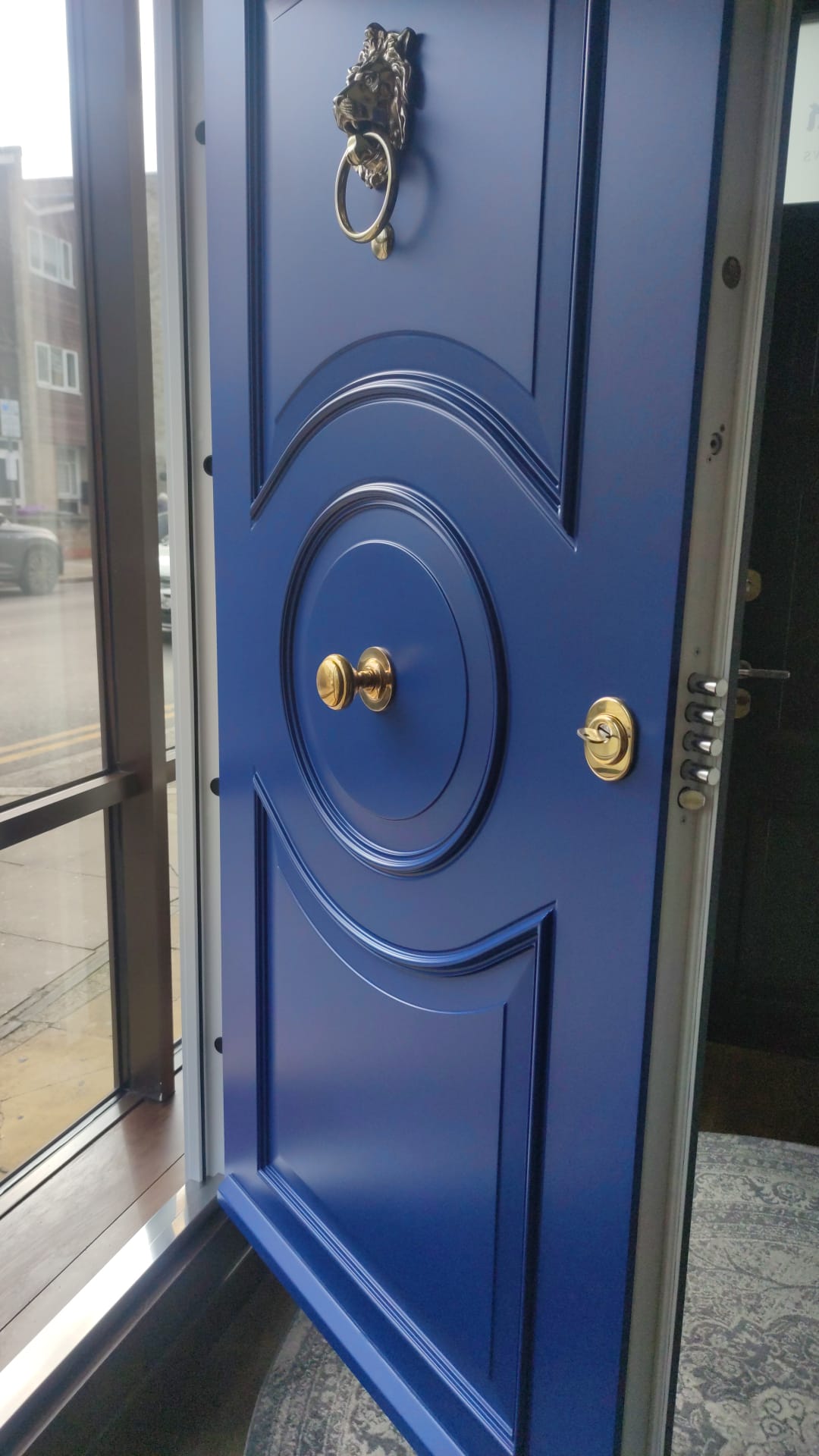
Navy Blue (RAL 5011 / RAL 5004) Navy has emerged as one of the most sought-after door colours in recent years. It offers the sophistication of black with added warmth and character. Navy works particularly well with brass hardware and stone or brick surrounds.
Sage Green (RAL 6021 / RAL 7033) Sage and muted green tones have surged in popularity, especially for period properties and homes with natural landscaping. Green creates a welcoming, organic feel and pairs beautifully with both chrome and brass hardware.
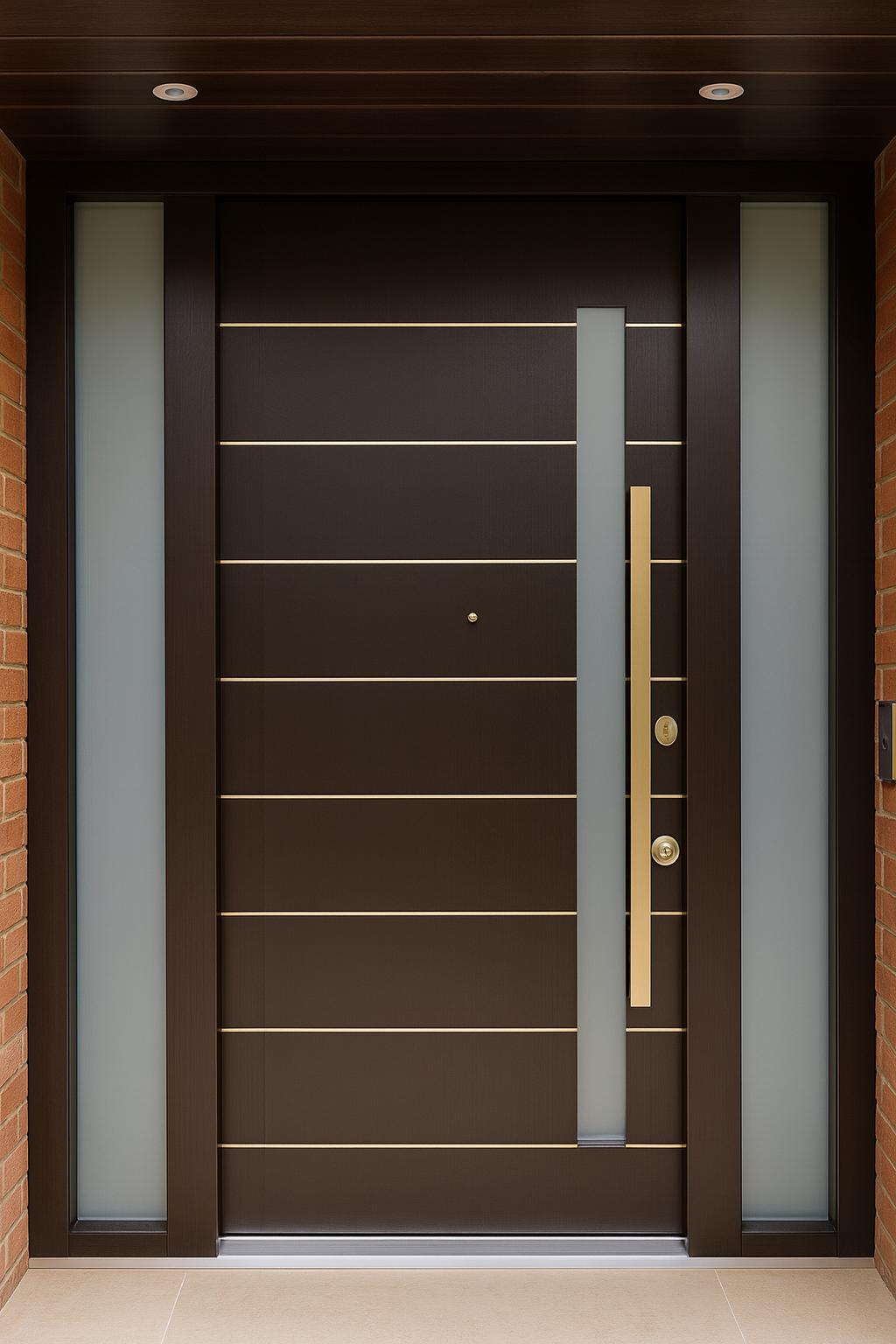
Anthracite Grey (RAL 7016) A modern alternative to black, anthracite grey is popular for contemporary properties. It has a softer appearance than pure black and works well with aluminium window frames and minimalist architecture.
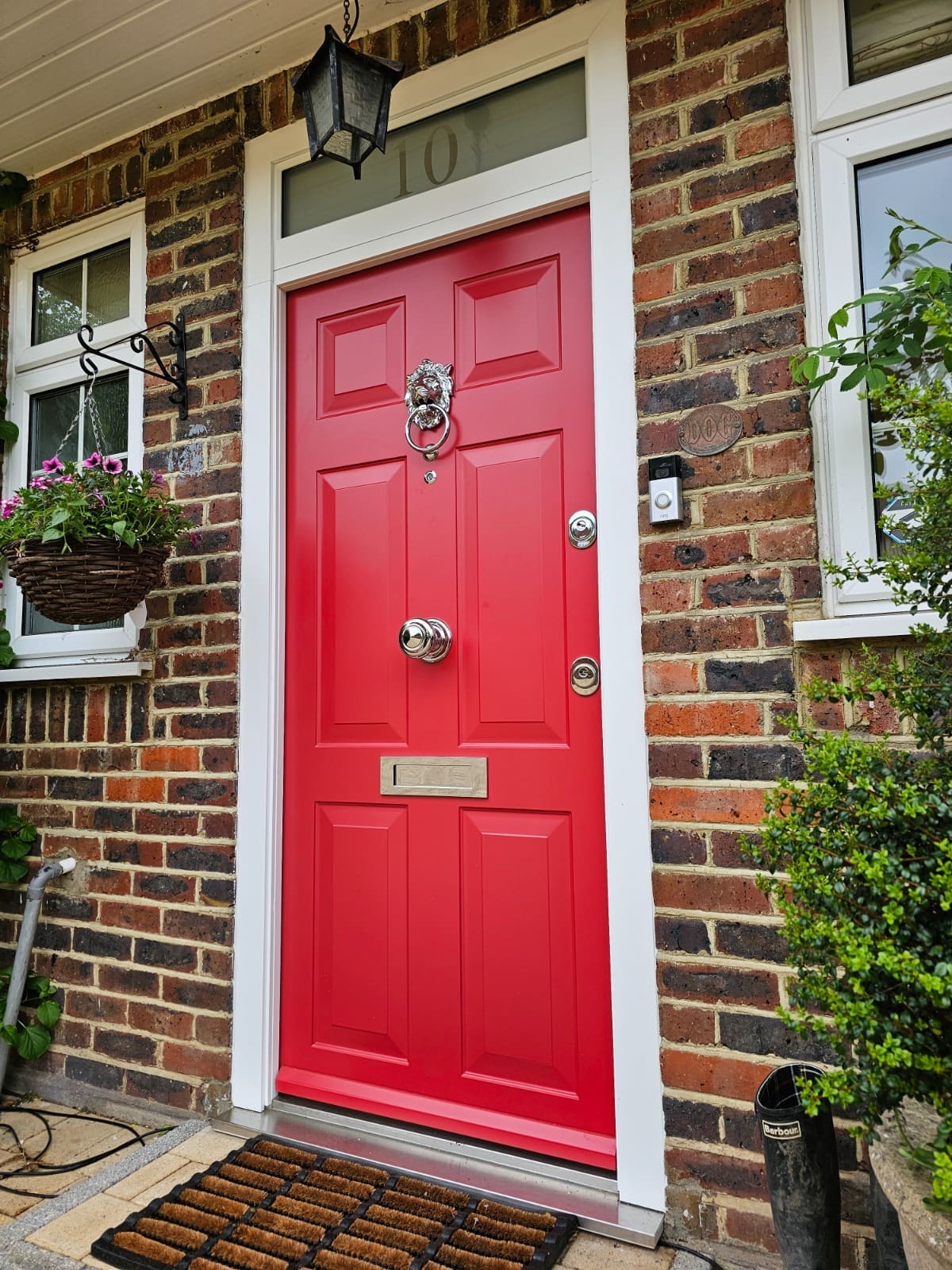
Heritage Colours For [listed buildings and period properties](/blog/best-front-doors-period-properties), heritage colours like cream (RAL 9001), olive (RAL 6003) and deep red (RAL 3011) can complement historical architectural details while meeting [conservation area requirements](/blog/conservation-area-door-requirements-uk).
How to Decide
Consider your property style - **Georgian/Victorian:** Black, navy, dark green or heritage colours - **Edwardian:** Deep reds, olive, forest green - **Contemporary:** Anthracite grey, charcoal, bold accent colours - **Country/Rural:** Sage, olive, cream, muted natural tones
Consider your surroundings Look at your brickwork, stone, render and roof colour. Your door should complement, not clash. Warm-toned bricks (red, orange) pair well with cooler door colours (navy, grey, sage). Cool-toned bricks (grey, buff) work with warmer options (cream, olive, walnut).
Consider your hardware The hardware finish affects the overall look. Brass suits traditional and warm colour schemes. Chrome and satin nickel suit contemporary and cool palettes. Black hardware creates a seamless look on dark doors. For a deeper guide on pairing finishes with door colour, see our [front door hardware finishes guide](/blog/front-door-hardware-finishes-brass-chrome-black).
Request a RAL sample Colours on screens never match real life. Before committing, request a physical RAL colour sample to view against your property in natural daylight.
Dual-Colour Doors
With a bespoke steel door, you can specify different colours for the interior and exterior. This means your door can match your exterior facade on the outside while complementing your interior hallway decor on the inside, giving you the best of both worlds.
Colour by Property Type
Georgian townhouses Georgian proportions demand restraint. The architecture is symmetrical, the panel count is usually six, and the fanlight above the door is part of the composition. Colours that work:
- Black (RAL 9005): the default for London's Georgian stock, particularly across Kensington and Chelsea. Pairs with brass ironmongery and a painted stucco frontage.
- Oxford blue (RAL 5003): a dignified alternative that reads almost black at distance and reveals its depth up close.
- British racing green (RAL 6009): traditional, confident, less common than black, particularly handsome against a cream stucco.
- Off-black charcoal (RAL 9017): slightly warmer than 9005, useful on facades where pure black reads too hard.
Avoid glossy reds, bright yellows and pastels on Georgian facades. They fight the architecture.
Victorian terraces Victorian terraces have more decorative latitude. Stained-glass fanlights, tiled paths and mouldings around the door surround give you licence to choose a colour with personality:
- Deep red (RAL 3005 or RAL 3011): the classic Victorian choice, especially in cities where terraces were originally painted in a sequence of rotating bold colours.
- Bottle green (RAL 6007): pairs with stained glass and the common Victorian palette of terracotta and cream.
- Deep teal (RAL 5020): a currently fashionable choice that still reads as period-appropriate.
- Navy blue (RAL 5011): modern but respectful of the architecture.
Edwardian homes Edwardian architecture is softer than Victorian and often features more glass in the door itself. Colours tend towards warm neutrals:
- Olive (RAL 6003): works with the red-brick-and-render combination common to the period.
- Sage (RAL 6021): reads softer than olive, pairs with the white-painted timber detailing typical of Edwardian porches.
- Dusty blue (RAL 5014): a lighter, more relaxed alternative to navy.
- Mushroom or stone (RAL 7030 or RAL 7044): neutral, contemporary, works on homes where the owner wants the door to recede and the stained glass to lead.
Mid-century and 1930s semis 1930s stock often features a bay window, a small porch and a side-lit door opening. The architecture is less formal, so colour can be more playful:
- Terracotta (RAL 8004): a period-authentic choice aligned with the Art Deco palette.
- Mustard or ochre (RAL 1006): bold, confident, popular on renovations.
- Sage green (RAL 6021): a gentle contemporary option.
- Cream (RAL 9001): understated, lets the original leaded glazing do the work.
Contemporary and new-build New-build homes usually sit in streetscapes where the door is the single opportunity to differentiate. Specification tends to favour strong neutrals over bold colour:
- Anthracite grey (RAL 7016): aligns with the aluminium window frames most new builds use.
- Jet black (RAL 9005) with matt finish: crisp, architectural, reads well against light-grey render.
- Dark bronze (RAL 8019): warmer than grey, complements timber cladding.
- White (RAL 9010) or off-white (RAL 9001): unusual choices that photograph exceptionally well on minimalist facades.
Pairing Colour with Brick and Stone
Brickwork sets an undertone you cannot repaint, so choose door colour around it rather than the other way round.
- London stock yellow brick: navy, black, charcoal, deep green. Avoid warm reds and oranges, which clash with the brick's own yellow.
- Red or orange brick (Victorian or Edwardian): black, dark green, deep blue, olive. Avoid competing reds and pinks.
- Grey stock or engineering brick: burgundy, bottle green, bronze, off-black. Warm colours lift a cool brick.
- Cotswold or Bath stone: sage, olive, dusty blue, heritage reds. Avoid bright primary colours.
- White or cream render: almost any colour works. This is where bold choices pay off.
- Painted black or dark render: brass-anodised hardware on a bronze, deep-plum or jewel-tone door.
When in doubt, the safest neutral is not black or grey but a deep desaturated colour that shares an undertone with the brick. A navy door on a yellow-stock terrace reads as considered, whereas a pure black door can read as harsh.
Dual-Colour: Interior Versus Exterior
One of the privileges of a bespoke steel door is the ability to specify different colours for the inside and outside of the same leaf. The exterior faces the street and the brickwork; the interior faces your hallway, which has its own palette entirely.
Common dual-colour pairings we specify for clients:
- Black exterior, cream interior: the most popular pairing. Dramatic outside, warm and bright inside.
- Bottle green exterior, warm white interior: period-appropriate outside, soft inside.
- Navy exterior, dove grey interior: coherent without matching.
- Anthracite exterior, blackout black interior: a gallery-style look, particularly with black hardware throughout.
The only constraint is that the edges of the door and the frame must be specified as either the exterior or the interior colour. Discuss this at the design-review stage so the choice is deliberate.
RAL Versus Paint-Brand Colour Matching
Most UK homeowners know paint by brand name: a sage from one specialist, a stone from another. These are not RAL codes, but nearly all of them can be colour-matched to a RAL equivalent by the paint manufacturer or by cross-referencing published conversion tables.
When you specify a steel door, the factory finish is applied by a polyester powder coat or a wet spray in a RAL Classic reference. We will colour-match to a brand reference where possible, but we always confirm against a physical swatch on steel before production, because:
- Powder coat finishes read slightly differently on steel than emulsion reads on timber.
- The same RAL number can vary between suppliers within the tolerance allowed by the standard.
- Sheen levels (matt, satin, gloss) change perceived colour significantly. A matt black reads lighter than a gloss black in the same code.
The safe path is to choose the RAL first, then approve a coated steel sample, then sign off production. Never commit to a production colour based on a screen render.
Finish Durability and Maintenance
A steel door with a baked polyester powder coat typically carries a ten-year aesthetic warranty against fade and a longer structural warranty. The real-world finish durability varies by colour and sheen.
- Darker colours: absorb more heat and can show slight surface chalking earlier than paler colours over ten-plus years in direct south-facing sunlight. Not a failure, just a consideration on exposed elevations.
- Matt finishes: hide surface scratches and fingerprints better than gloss. Gloss shows the finish most crisply on collection day but needs more frequent light cleaning.
- Metallic and pearlescent RALs: beautiful but harder to touch up. If a future minor repair is needed, an exact blend can be difficult to recreate on site.
- Bold primaries (reds, yellows): the pigments are stable in high-quality powder coat, but comparative fade data is still better on neutrals over twenty years.
For maintenance, a steel door needs far less than a timber door. Wipe twice a year with a mild detergent, rinse, dry. Waxes and polishes are not required. Avoid abrasive pads, kitchen degreasers and any cleaner containing bleach or solvent.
Conservation Area and Listed Building Restrictions
If your property is listed or sits inside a conservation area, colour choice is not entirely your own. The local planning authority has a register of approved colours for the area, and a conservation officer has the power to require changes.
What to check before specifying:
- Listed status: Grade I, II* and II listings each carry their own restrictions. The door is often considered a character-defining feature of a listed home, and any change may require listed building consent.
- Conservation area designation: check the local authority website for the area's appraisal document. Many conservation areas have a recommended palette. London's central conservation areas typically recommend historically accurate colours: black, dark green, deep red, off-white.
- Article 4 Direction: some conservation areas remove permitted development rights for exterior alterations. Under an Article 4, a painted colour change can require planning approval.
- Precedent: walk the street. If every door on the terrace is painted within a narrow palette, the conservation officer will expect your door to sit within that palette too.
On a bespoke steel door for a listed property, we strongly recommend submitting the specification, including the RAL reference, the sheen level and a photograph of a coated sample held against the brick, as part of the planning or listed building consent application. A pre-application conversation with the conservation officer often saves weeks of delay later.
Make It Yours
At SteelR, colour is just the beginning. Every door is manufactured to your exact specification with your choice of colour, hardware, glazing, panel design and decorative elements. See our red traditional door with lion knocker, navy panelled door, or sage contemporary design for inspiration. Contact us to discuss your vision.
Frequently Asked Questions
What is the most popular front door colour in the UK?
Black remains the single most popular front door colour in the UK, followed by navy blue, anthracite grey and sage green. The popularity of black is consistent across property types and regions because it works with virtually every brick, render and stone. Navy has grown fastest in recent years as homeowners look for something with the gravitas of black but a touch more character.
Can I change the colour of a steel door later?
A steel door can be repainted in principle, but the factory polyester powder coat is far more durable than a site-applied finish, and any repaint loses the warranty on the original finish. The better approach is to specify the right colour at the start, using a physical RAL sample on steel, and keep it for twenty-plus years. Dual-colour specification also reduces the likelihood of ever wanting a change.
Do I need planning permission to change my front door colour?
Usually not, but it depends on your property and location. Listed buildings almost always require listed building consent for any visible change, including a repaint. Properties in conservation areas with an Article 4 Direction may require planning approval for exterior colour changes. In normal residential settings, colour is a permitted-development matter and no approval is needed. Always check your local authority website before committing.
What colour door suits a red-brick Victorian house?
Black, bottle green, navy and deep burgundy all work with red-brick Victorian architecture. The rule of thumb is to choose a colour that contains the same undertone as the brick (warm reds suit warm colours) but sits far enough away in tone to read as distinct. Pure black is the safest, most common and most flattering choice on a red-brick Victorian terrace.
Can I have a different colour inside and outside on a steel door?
Yes. Dual-colour specification is one of the advantages of a bespoke steel door. The exterior can match your facade while the interior can complement your hallway palette. The door edges and frame need to be specified as either the exterior or interior colour at the design stage, so discuss this with your supplier before signing off.
Will a dark-coloured steel door fade in direct sunlight?
A quality polyester powder coat is UV-stable and warranted for aesthetic performance for ten years or more. Very dark colours on south-facing elevations may show subtle surface chalking after a decade, which is normal and not a failure. This is rarely visible without close inspection. Light cleaning twice a year extends the finish significantly.
How do I match a specific paint-brand colour to a RAL code?
Most heritage paint brands publish RAL equivalents for their signature colours, or a paint specialist can match a sample to a RAL reference using a spectrophotometer. For a steel door, always approve a physical coated sample on steel before production, because powder coat on steel reads differently from emulsion on timber. Do not rely on an on-screen match.
What hardware finish suits each door colour?
Brass and unlacquered brass suit warm colours (black, navy, green, burgundy, olive, cream). Chrome, satin nickel and stainless steel suit cool colours (anthracite, charcoal, grey, off-white, dusty blue). Matt black hardware suits almost any colour and is particularly strong on bold reds, jewel tones and crisp whites. Aged bronze and antique brass suit heritage and period-authentic specifications. For the wider picture of how colour fits into a full bespoke specification, see our bespoke steel front doors UK overview.